










Reliance Retail funds JioMart scale as online grocery rises
Key highlights
- Reliance Retail’s gross revenue rose 6.4% year on year to ₹91,716 crore in Q2 FY27.
- Grocery B2C online revenue increased 42% year on year, while online revenue share rose 270 basis points.
- EBITDA margin before the ₹108 crore 7-Eleven charge fell to 7.8% from 9.0% a year earlier.
- Reliance Retail opened 303 stores in Q2 FY27, reaching 19,947 stores across more than 7,000 towns.
powered by IRIS
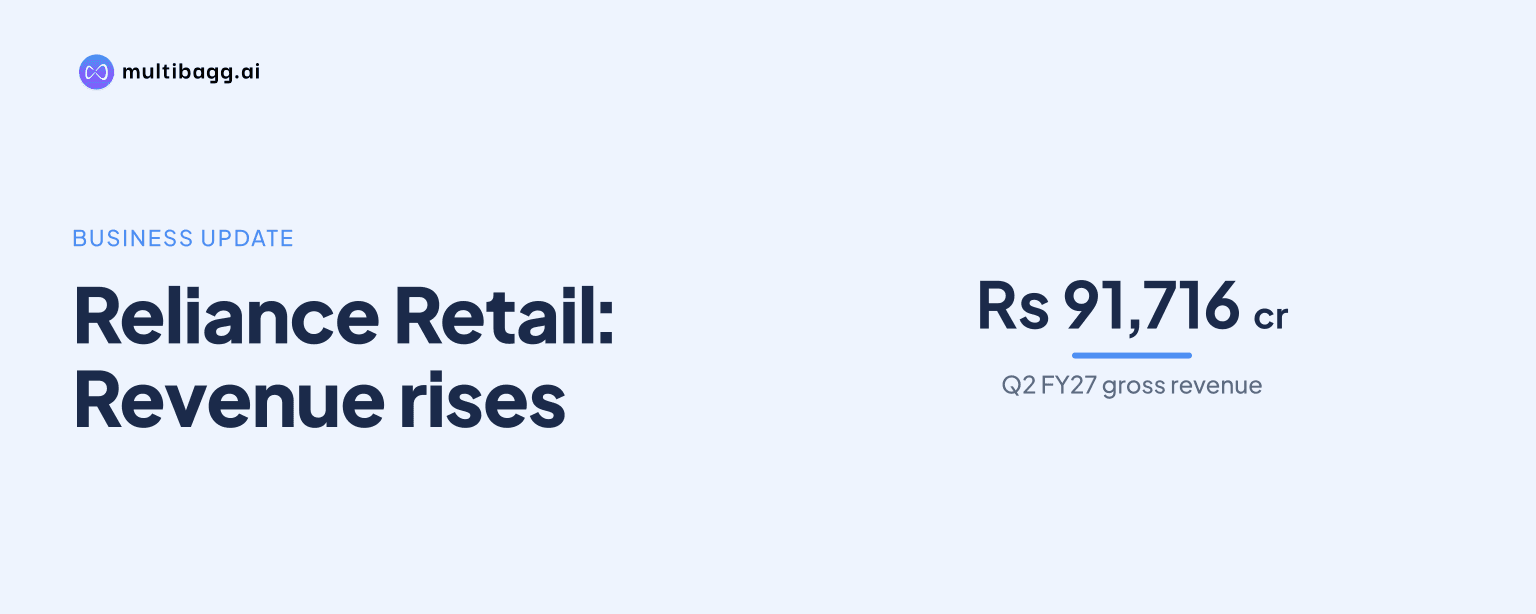
Reliance Retail is funding its FY27 digital-commerce build from store profits: grocery business-to-consumer (B2C) online revenue rose 42% year on year in Q2 FY27, while earnings before interest, tax, depreciation and amortisation (EBITDA) margin before a ₹108 crore charge fell 120 basis points to 7.8%.
Know Reliance Industries inside out
Results, valuation, peers and who's buying, in one view.
Why did Reliance Retail’s Q2 FY27 margin decline?
Reliance Retail’s margin declined because of planned digital-commerce investment, input-cost inflation absorbed for customers and the shift of major festivals into Q3. EBITDA before the one-time charge was ₹6,228 crore in Q2 FY27, down 8.6% year on year, while the margin fell from 9.0% in Q2 FY26 to 7.8%.
Revenue nevertheless increased in the second quarter (Q2) of financial year 2027 (FY27). Gross revenue rose 6.4% year on year to ₹91,716 crore and net revenue rose 5.8% to ₹80,220 crore, with the Q2 FY26 comparison adjusted for the Consumer Brands demerger. EBITDA from operations declined 11.1% to ₹5,886 crore, and its margin declined from 8.7% to 7.3%.
The ₹108 crore one-time impairment charge related to 7-Eleven reduced EBITDA after the charge to ₹6,120 crore, down 10.2% year on year. Profit after tax declined 24.3% to ₹2,611 crore, while depreciation increased 18.1% to ₹1,820 crore and finance cost increased 53.9% to ₹905 crore, which Reliance Retail attributed to a larger asset base, higher borrowings and interest rates.
How fast is Reliance Retail growing JioMart?
Reliance Retail is growing JioMart through grocery expansion, a wider store-linked network and larger customer baskets. Grocery B2C online revenue rose 42% year on year in Q2 FY27, and online share of Grocery B2C revenue increased 270 basis points. More than 5,000 stores across more than 1,000 cities were connected to the JioMart network.
The company reported a 24% year-on-year increase in units per order as customers built baskets to qualify for free delivery. It also said average order value was increasing. Each dark store is measured by cohort on order density, repeat purchases and cost per order, with Reliance Retail stating that cost per order falls as density rises.
JioMart’s offer now extends beyond grocery, with the consumer-electronics big-box range available with two-hour delivery. Reliance Retail said marketplace and seller services are being monetised, while deeper penetration in smaller cities and towns is generating new customers and growth.
What is Reliance Retail’s plan for online profitability?
Reliance Retail’s stated FY27 plan is to build online scale with discipline, prove unit economics market by market and continue expanding dark stores. Management says supply-chain and dark-store investment is funded through profits from the store business, rather than presented as a separate funding programme.
The company’s monitoring framework covers active customers, repeat rate, order frequency, net revenue, basket size, delivered gross margin, availability, fulfilment, cost per order, contribution margin, working capital and cash-to-cash days. Reliance Retail says it scales where service quality and market-level economics can be demonstrated, rather than measuring progress by volume alone.
Management’s disclosed FY28-FY29 sequence is to convert scale into value through higher repeat purchases, basket size and customer lifetime value. Its stated levers include own brands, monetisation, marketplace income, improved inventory turns and higher fulfilment density, with the intended outcome of compounding revenue, margin and cash generation.
Got a follow-up? Ask IRIS
How are Reliance Retail’s stores supporting the digital strategy?
Reliance Retail’s store network is supporting online fulfilment while being reshaped for productivity. It opened 303 stores in Q2 FY27, reaching 19,947 stores across more than 7,000 towns, but the net store count was 222 lower than in Q1 FY27 after exits from underperforming locations. Its 24.5 million square feet of warehousing supports omni-channel fulfilment.
Grocery reported 3% like-for-like revenue growth, while its digital share of B2C revenue rose 270 basis points. Reliance Retail said it did not fully pass input-cost inflation to customers in order to retain price trust; it identified space productivity, assortment optimisation, a more focused vendor base and joint business planning as margin-recovery measures.
Other consumption baskets added growth and customer reach in a quarter without the main festive dates. Business-to-business revenue rose 10% year on year, consumer electronics recorded 8% like-for-like growth and 20% distribution gross-revenue growth, and Apparel & Footwear’s digital share rose 100 basis points as own-brand contribution increased 710 basis points.
What does the festive shift mean for Reliance Retail’s results?
Reliance Retail says Q2 and Q3 FY27 should be assessed together because the principal festive dates moved entirely into Q3. Navratri fell on 11 October and Diwali on 8 November in FY27, compared with 22 September and 20 October in the prior year, leaving Q2 without comparable major festival trading.
The shifted calendar coincided with consumer price inflation of 5.5% and food inflation of 7.7% in September. Reliance Retail also cited higher input, freight and packaging costs, a weaker rupee that increased landed costs for imported electronics and fashion, and a monsoon deficit that put upward pressure on food prices and made rural demand uneven.
Conclusion
Reliance Retail’s Q2 FY27 results show the trade-off in its stated strategy: gross revenue increased to ₹91,716 crore and grocery B2C online revenue rose 42%, while EBITDA margin before the 7-Eleven impairment fell to 7.8%. Store earnings are funding JioMart, dark stores and omni-channel fulfilment during a period of inflation absorption and a shifted festive calendar.
The next disclosed test is Q3 FY27, when Navratri and Diwali trading is included. Management’s FY27 priorities are to improve availability, speed, reliability and market-level unit economics; its FY28-FY29 plan is to turn greater repeat demand, basket size, fulfilment density and monetisation into revenue, margin and cash generation.