










RRVL EBITDA falls 8.6% as margin declines to 7.8% in Q2
Key highlights
- RRVL’s EBITDA before a one-time impairment charge fell 8.6% year on year to Rs 6,228 crore in 2Q FY27.
- Gross revenue rose 6.4% year on year to Rs 91,716 crore, while revenue from operations increased 5.8% to Rs 80,220 crore.
- Profit after tax declined 24.5% year on year to Rs 2,619 crore in 2Q FY27.
- RRVL’s store count fell by 222 sequentially to 19,947 after the company closed unproductive locations.
powered by IRIS
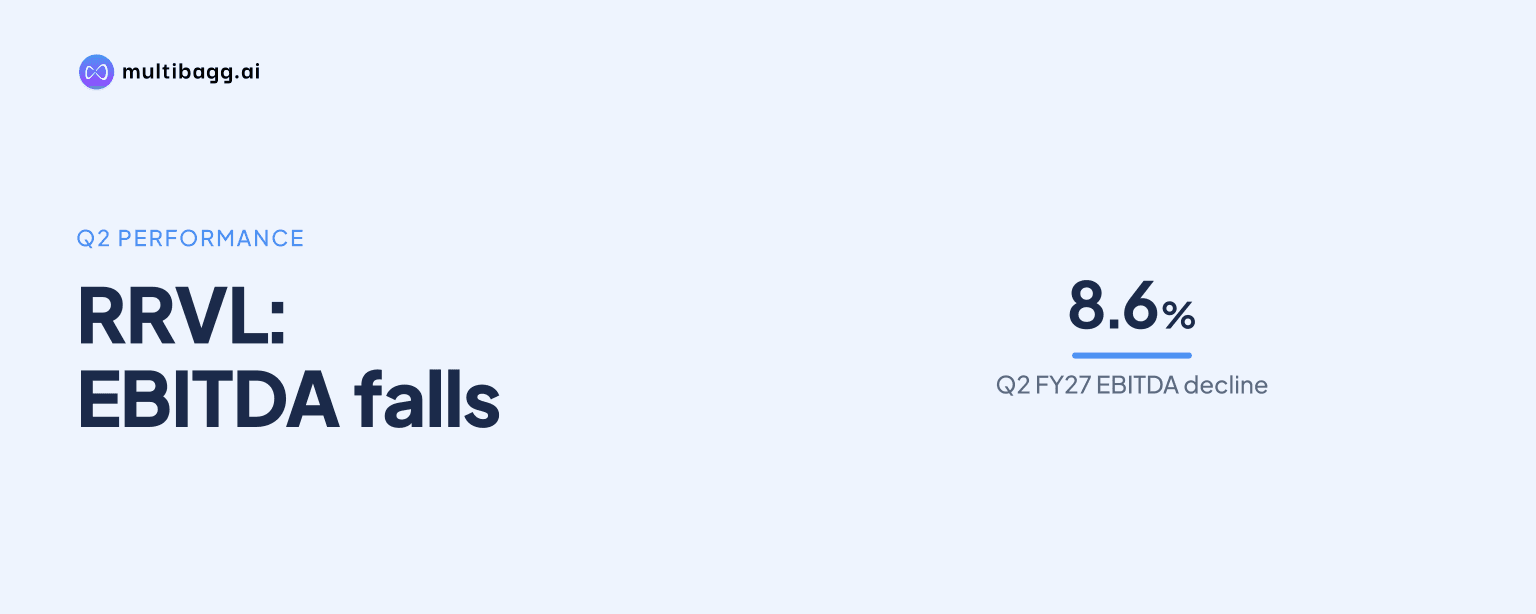
Reliance Retail Ventures Limited reported EBITDA before a one-time impairment charge of Rs 6,228 crore in 2Q FY27, down 8.6% year on year despite 6.4% gross-revenue growth to Rs 91,716 crore. RRVL said its EBITDA margin fell 120 basis points to 7.8% as it invested in Digital Commerce, absorbed input-cost inflation and faced a festive-calendar shift to Q3.
Know Reliance Industries inside out
Results, valuation, peers and who's buying, in one view.
Why did RRVL's EBITDA fall despite revenue growth?
RRVL's EBITDA fell because costs and investment reduced profitability even as revenue increased. Gross revenue rose from Rs 86,169 crore in 2Q FY26 to Rs 91,716 crore in 2Q FY27, while revenue from operations increased 5.8% to Rs 80,220 crore. EBITDA from operations declined 11.1% to Rs 5,886 crore over the same period.
RRVL attributed the margin moderation to its planned Digital Commerce investment phase, input-cost inflation absorbed for customers and the movement of major festivals into Q3. EBITDA margin, calculated on revenue from operations, was 7.8% in 2Q FY27, compared with 9.0% a year earlier and 7.9% in 1Q FY27. The year-on-year financial comparison is adjusted for the demerger of the Consumer Brands business.
RRVL recorded a one-time impairment charge of Rs 108 crore in 2Q FY27, taking EBITDA after the charge to Rs 6,120 crore, down 10.2% from Rs 6,816 crore in 2Q FY26. Depreciation rose 18.1% to Rs 1,820 crore as the asset base grew, while finance costs increased 53.9% to Rs 905 crore because of increased borrowing and higher interest rates.
How did RRVL's store network change in 2Q FY27?
RRVL recorded a net reduction of 222 stores in 2Q FY27 after closing unproductive locations. It opened 303 stores during the quarter but ended with 19,947 stores, compared with 20,169 at the end of 1Q FY27. The store count nevertheless remained 0.6% above the 19,821 stores reported in 2Q FY26.
Area operated declined to 77.5 million square feet from 78.4 million square feet in 1Q FY27 and 77.8 million square feet in 2Q FY26. Transactions still rose 7% year on year despite the major festivals shifting to Q3. RRVL linked this transaction growth to continued customer engagement during the quarter.
Grocery reported 3% like-for-like growth while absorbing part of input-cost inflation, with Staples, Dairy, and Frozen & Bakery contributing to category growth. RRVL said grocery-margin recovery is expected from space productivity, optimised assortment, a focused vendor base and joint business planning with brands. Business-to-business revenue grew 10%, supported by higher transaction volumes and average bill value.
How quickly is RRVL's Digital Commerce business expanding?
RRVL's JioMart revenue grew 42% year on year in 2Q FY27, driven by higher average order values and a 24% rise in units per order. JioMart used a network of more than 5,000 stores across more than 1,000 cities while extending its presence in smaller cities and towns. RRVL said free delivery encouraged customers to build larger baskets.
Digital Commerce increased its share of business-to-consumer grocery revenue by 270 basis points year on year. RRVL also continued to scale quick delivery in Consumer Electronics and worked to strengthen monetisation of marketplace and seller services. These activities were part of the planned Digital Commerce investment that RRVL cited in its explanation for the quarterly margin decline.
RRVL said dark-store productivity remains a focus and that it tracks performance by cohort to increase order density and reduce cost per order. The release did not disclose a JioMart profitability measure, dark-store count or target date for productivity gains. In Apparel & Footwear, Digital Commerce share increased by 100 basis points, while AJIO's catalogue grew 23% to 3.3 million options.
Got a follow-up? Ask IRIS
Which consumption baskets supported RRVL's sales activity?
RRVL reported different growth measures across its three disclosed consumption baskets in 2Q FY27. Grocery delivered 3% like-for-like growth, Consumer Electronics reported 8% like-for-like growth, and Fashion & Lifestyle recorded 3% like-for-like growth. The Fashion & Lifestyle result came despite the absence of the full-price festive weeks that moved into Q3.
Consumer Electronics growth reflected improved product availability, competitive pricing and targeted promotions, according to RRVL. Its distribution business revenue rose 20%, led by mobiles and laptops. RRVL said lower margins in premium Consumer Electronics represented a strategic investment in acquiring high-value customers.
In Fashion & Lifestyle, own brands increased their contribution by 710 basis points year on year, supported by new womenswear collections and a focus on customer preferences. The business launched more than 250 new options every week, while its premium and luxury portfolio surpassed 1,000 exclusive brand stores. AJIO Luxe added 22 brands, taking its portfolio to 1,040 brands.
What should readers watch in RRVL's next quarter?
Readers should watch whether the Q3 festive period changes the sales and margin pattern after major festivals shifted out of 2Q FY27. RRVL linked its 7.8% EBITDA margin to that timing effect, Digital Commerce investment and customer absorption of input-cost inflation. Its margin was 9.0% in 2Q FY26, a difference of 120 basis points.
The disclosed operating measures include higher grocery space productivity, assortment optimisation, a focused vendor base and joint business planning with brands. In Digital Commerce, RRVL plans to monitor dark stores by cohort to improve order density and reduce cost per order. The release does not provide a numerical EBITDA-margin target or guidance for 3Q FY27.
RRVL Executive Director Isha M. Ambani said the fast-growing Digital Commerce and business-to-business model is funded by offline-business profits. Her statement also said RRVL would continue investments in sustainable, profitable growth during the festive season. JioMart's 42% revenue growth and business-to-business revenue growth of 10% provide the disclosed indicators for those channels.
Conclusion
RRVL increased gross revenue by 6.4% and transactions by 7% in 2Q FY27, but EBITDA before the one-time impairment charge fell 8.6% as margin declined from 9.0% to 7.8%. JioMart's 42% revenue growth, 10% business-to-business revenue growth and positive like-for-like growth across Grocery, Consumer Electronics and Fashion & Lifestyle show where activity expanded while profit declined.
The next disclosed event is the Q3 festive period, which contains the major festivals shifted from 2Q FY27. RRVL's stated plan is to recover grocery margins through productivity, assortment and vendor measures, while using cohort tracking to improve dark-store order density and cost per order. The unresolved matter is whether those actions offset continued Digital Commerce investment and input-cost pressure.