










Reliance reports record Rs 29,550 crore PAT for 2Q FY27
Key highlights
- Reliance's recurring PAT including associates and joint ventures reached a record Rs 29,550 crore in 2Q FY27, up 33.8% year on year.
- Gross revenue increased 27.8% to Rs 3,62,268 crore, while EBITDA rose 23.9% to Rs 62,409 crore.
- Oil-to-chemicals EBITDA climbed 67.9% to Rs 25,203 crore, the largest disclosed segment increase.
- Net debt declined to Rs 1,17,140 crore at September 30, 2026, while first-half capital expenditure rose to Rs 76,835 crore.
powered by IRIS
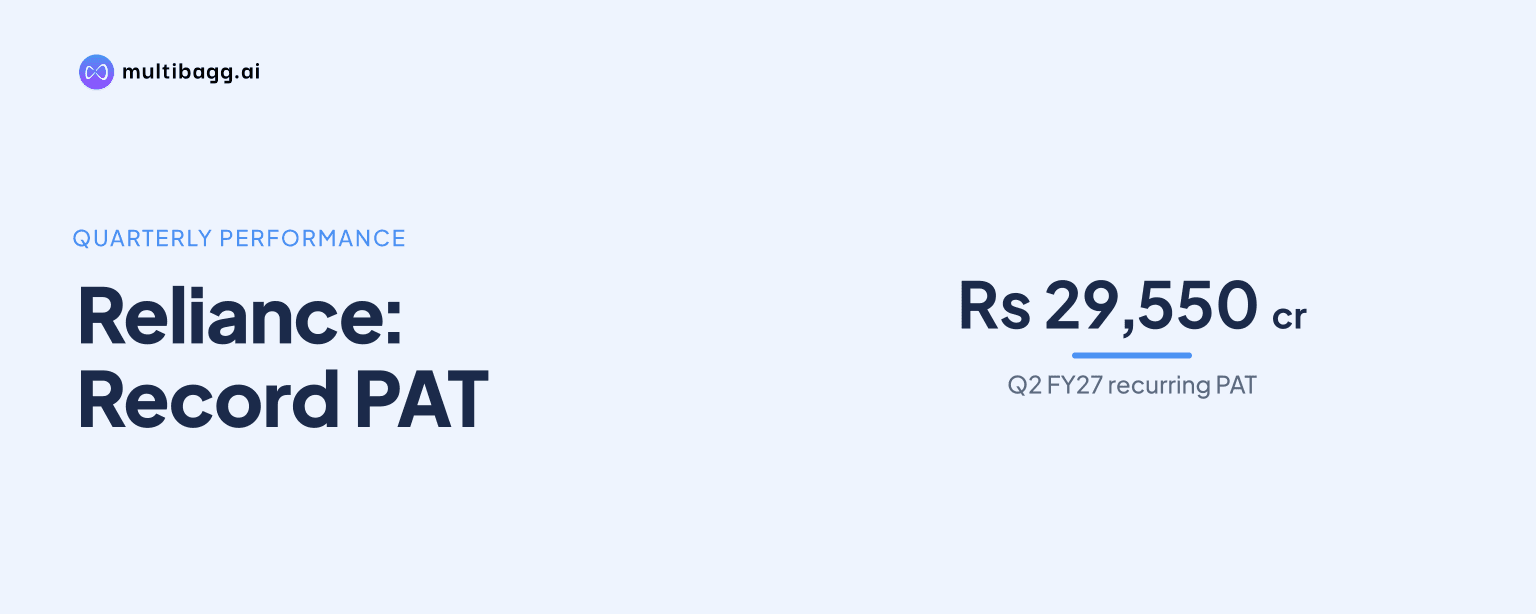
Reliance Industries Limited (Reliance) reported record recurring profit after tax (PAT), including its share of associates and joint ventures, of Rs 29,550 crore in 2Q FY27, up 33.8% year on year. Gross revenue rose 27.8% to Rs 3,62,268 crore and earnings before interest, tax, depreciation and amortisation (EBITDA) increased 23.9% to Rs 62,409 crore.
Know Reliance Industries inside out
Results, valuation, peers and who's buying, in one view.
What were Reliance's headline financial results in 2Q FY27?
Reliance recorded its highest reported quarterly gross revenue, EBITDA and recurring PAT in the quarter ended September 30, 2026. Profit before tax rose 32.6% year on year to Rs 38,613 crore, while tax expense increased 34.2% to Rs 9,363 crore. PAT before the Rs 300 crore share of profit from associates and joint ventures was Rs 29,250 crore, compared with Rs 22,146 crore in 2Q FY26.
The September quarter was also ahead of 1Q FY27 on key measures. Gross revenue increased from Rs 3,40,257 crore in 1Q FY27 to Rs 3,62,268 crore, while PAT including associates and joint ventures rose from Rs 23,196 crore to Rs 29,550 crore. For 1H FY27, this PAT measure reached Rs 52,746 crore, against Rs 43,951 crore in 1H FY26.
Reliance said its 2Q FY27 and 1H FY27 PAT figures were records on a recurring basis. First-half EBITDA was Rs 1,16,476 crore, compared with Rs 99,467 crore in 1H FY26. The company said the prior-period EBITDA comparison excludes Rs 8,924 crore of proceeds from profit on the sale of listed investments.
Which businesses drove Reliance's quarterly growth?
Reliance's oil-to-chemicals business was the largest disclosed EBITDA driver, with EBITDA rising 67.9% year on year to Rs 25,203 crore in 2Q FY27. Its revenue grew 44.2%, led by higher crude and product prices: crude prices rose 40.6%, transportation-fuel prices increased by 50% to 78%, and most downstream chemical-product prices rose by 25% to 35%.
The company attributed the oil-to-chemicals result to higher transportation-fuel cracks and downstream petrochemical margins. Fuel cracks increased by 3 to 3.7 times, while polyester-chain margins rose 33%, supported by a 15% higher paraxylene delta and a 52% increase in purified terephthalic acid delta. Reliance said higher crude premiums, freight rates, SAED-related costs and domestic fuel-retail under-recoveries constrained earnings.
Digital Services EBITDA was Rs 22,223 crore, up 17.7% year on year, in the consolidated highlights. Jio Platforms Limited (JPL) reported revenue of Rs 47,485 crore, up 11.3%, and EBITDA of Rs 21,879 crore, up 16.6%. JPL cited subscriber additions, higher average revenue per user and digital-services growth, alongside a 250-basis-point EBITDA-margin expansion.
Reliance's retail business increased revenue 6.4% to Rs 91,716 crore, but EBITDA declined 8.6% to Rs 6,228 crore and margin fell 120 basis points to 7.8%. The company cited investments in digital commerce, input-cost inflation absorbed for customers and a shift in the festive calendar to 3Q. Oil and gas EBITDA declined 2.0% as lower KG D6 gas revenue and higher Government of India levies outweighed other factors.
Got a follow-up? Ask IRIS
Why did Reliance's consolidated EBITDA margin decline?
Reliance's consolidated EBITDA margin was 17.2% in 2Q FY27, down 60 basis points from 17.8% in 2Q FY26, even as EBITDA increased 23.9% to Rs 62,409 crore. Gross revenue grew faster, rising 27.8% to Rs 3,62,268 crore. The margin was, however, above 1Q FY27's 15.9%.
The group outcome reflected differing segment trends in the same quarter. Oil-to-chemicals EBITDA rose 67.9%, JPL EBITDA increased 16.6% with a 250-basis-point margin expansion, and retail EBITDA fell 8.6%. These reported changes coincided with a 120-basis-point decline in the retail business's EBITDA margin to 7.8%.
Costs below EBITDA also increased. Depreciation rose 6.2% to Rs 15,315 crore, largely due to higher depreciation in Digital Services following 5G-asset capitalisation. Finance costs increased 24.2% to Rs 8,481 crore, which Reliance attributed largely to higher liability balances and 5G-asset capitalisation.
How did Reliance's capital expenditure and net debt change?
Reliance's capital expenditure, excluding spectrum expenditure, was Rs 38,153 crore in 2Q FY27, versus Rs 38,682 crore in 1Q FY27 and Rs 40,010 crore in 2Q FY26. First-half expenditure was Rs 76,835 crore, compared with Rs 69,885 crore a year earlier. The company said the quarter's spending was largely for oil-to-chemicals and new-energy projects, consumer-business infrastructure and distribution expansion.
Net debt fell sequentially to Rs 1,17,140 crore at September 30, 2026, from Rs 1,22,914 crore at June 30, 2026. Cash and cash equivalents increased to Rs 2,67,812 crore from Rs 2,46,791 crore, while outstanding debt rose to Rs 3,84,952 crore from Rs 3,69,705 crore. Net debt was also below Rs 1,18,545 crore reported in 2Q FY26.
The annualised net-debt-to-EBITDA ratio was 0.47 at the end of 2Q FY27, compared with 0.57 at the end of 1Q FY27 and 0.59 in 2Q FY26. Reliance reported a first-half ratio of 0.50, against 0.60 in 1H FY26. The lower ratio was reported alongside Rs 76,835 crore of capital expenditure in the first half.
Conclusion
Reliance's 2Q FY27 result combined record recurring PAT of Rs 29,550 crore with 27.8% gross-revenue growth and 23.9% EBITDA growth. Oil-to-chemicals supplied the largest disclosed earnings increase, while JPL expanded earnings and the retail business reported lower EBITDA amid investment and the festive-calendar shift. Consolidated margin fell 60 basis points as segment performance varied.
The next results will show progress on the Rs 38,153 crore quarterly capital-expenditure programme, particularly projects in oil-to-chemicals, new energy and consumer-business infrastructure. Reliance also disclosed that JPL used Rs 27,500 crore of its initial public offering proceeds to prepay certain external commercial borrowings, with the remaining proceeds intended for general corporate purposes.