










rentomojo H1 FY27 capex reaches ₹192.3 crore, up 140.6%
Key highlights
- rentomojo spent ₹192.3 crore on fleet and fit-outs in H1 FY27, up 140.6% year on year.
- Operating cash flow was ₹110 crore in H1 FY27, compared with ₹192.3 crore of capital expenditure.
- Gross fixed assets reached ₹702.8 crore at 30 September 2026, up 32.6% from FY26-end.
- Net debt declined to ₹130.6 crore and net debt to equity fell to 0.28 times at 30 September 2026.
powered by IRIS
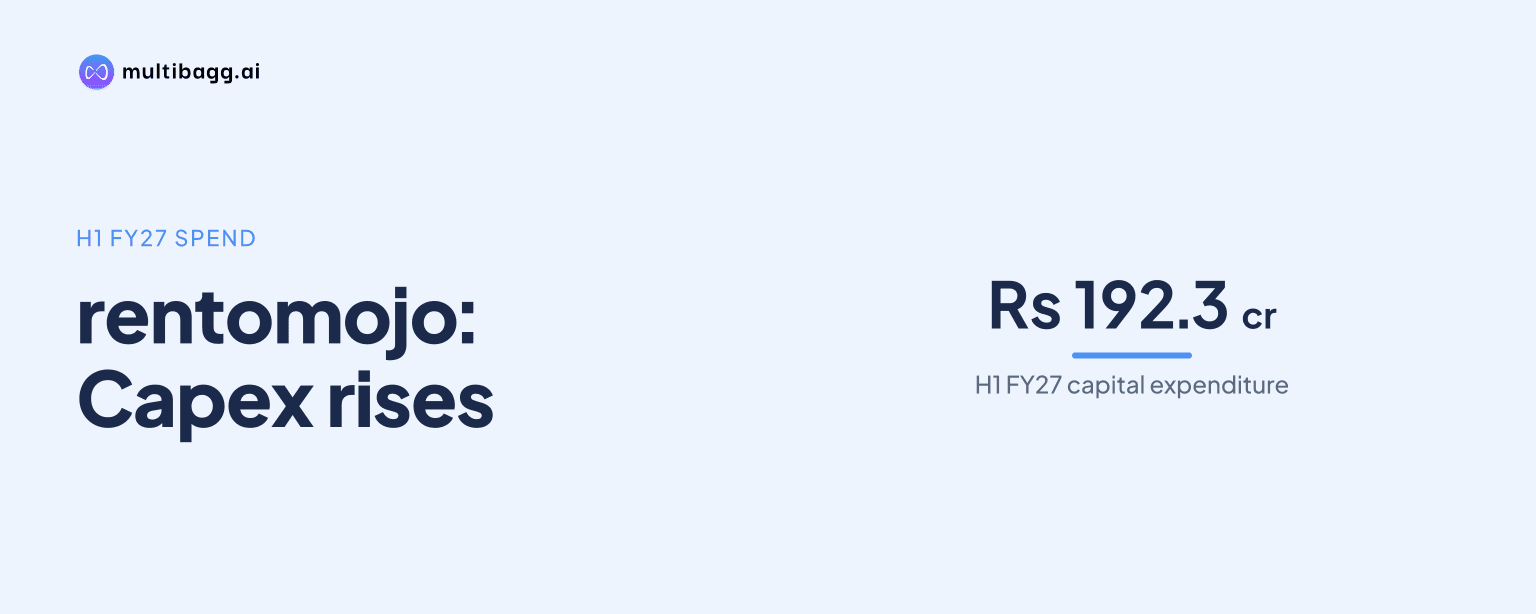
rentomojo spent ₹192.3 crore on fleet and fit-out capital expenditure in H1 FY27, 140.6% more than in H1 FY26, while operating cash flow was ₹110 crore. The spending exceeded six-month operating cash flow by ₹82.3 crore and coincided with gross fixed assets reaching ₹702.8 crore on 30 September 2026.
Know Rentomojo inside out
Results, valuation, peers and who's buying, in one view.
How much did rentomojo spend on fleet and fit-outs in H1 FY27?
rentomojo spent ₹192.3 crore on fleet and fit-outs in H1 FY27, compared with ₹79.9 crore in H1 FY26. The ₹112.4 crore increase matches the 140.6% year-on-year rise reported in the presentation. The H1 FY27 outlay was also ₹15.1 crore above the ₹177.2 crore spent in full-year FY26, although the H1 FY27 period covers six months rather than a full year.
The presentation identifies the expenditure as fleet and fit-out capital expenditure but does not separate the ₹192.3 crore between those two categories. Its live-item base rose 44.0% year on year to 10,49,419 in H1 FY27, while warehouse area increased 51.3% to 6,72,616 square feet. Experience stores also increased to 96 from 67, providing operating context for the higher deployment.
Did operating cash flow cover rentomojo's H1 FY27 capital expenditure?
No, rentomojo generated ₹110 crore of operating cash flow in H1 FY27, leaving an ₹82.3 crore gap against ₹192.3 crore of capital expenditure. Operating cash flow increased 36.7% from ₹80.5 crore in H1 FY26, but capital expenditure increased at a faster 140.6% rate. The presentation states that H1 FY27 fleet and fit-out spending was funded partly by operating cash flow and debt.
Operating cash flow equalled 109.8% of earnings before interest, tax, depreciation and amortisation, or EBITDA, in H1 FY27, compared with 109.7% in H1 FY26. The presentation calculates average operating-cash-flow conversion at 106% of EBITDA across FY25, FY26, H1 FY26 and H1 FY27. The near-unchanged H1 conversion ratio indicates that the disclosed funding gap followed the acceleration in capital expenditure rather than a lower cash-conversion percentage.
How did rentomojo's fixed-asset base change after the spending increase?
rentomojo's gross fixed assets rose 32.6% to ₹702.8 crore at 30 September 2026 from ₹529.9 crore at FY26-end. Net fixed assets, reported as the net block, increased 32.8% to ₹565.9 crore from ₹426.2 crore over the same period. The presentation gives balance-sheet positions for 31 March 2025, 31 March 2026 and 30 September 2026.
The gross fixed-asset base had already risen from ₹342.1 crore in FY25 to ₹529.9 crore in FY26. H1 FY27 capital expenditure of ₹192.3 crore was ₹19.4 crore higher than the ₹172.9 crore increase in gross fixed assets from FY26-end. The presentation does not reconcile the capital-expenditure figure with the gross-block movement, so the reason for that difference is not disclosed.
The expanded asset base was accompanied by higher customer and inventory measures. Live subscribers increased 42.5% to 3,24,208, gross items ordered rose 45.4% to 7,10,506, and average occupancy increased 91 basis points to 84.8%. Average revenue per item increased 5.9% to ₹3,271, while items per user remained unchanged at 2.8.
Got a follow-up? Ask IRIS
How did the fresh issue affect rentomojo's debt and equity measures?
rentomojo's net worth reached ₹466.2 crore at 30 September 2026, up 57.6% from ₹295.8 crore at FY26-end, after a ₹141.372 crore net fresh issue in Q2 FY27. Debt rose 23.9% to ₹232.4 crore from ₹187.6 crore, but debt to equity declined to 0.50 times from 0.63 times as equity rose faster than borrowings. Debt excludes leases under the presentation's definition.
Net debt fell ₹18.7 crore to ₹130.6 crore despite the ₹44.8 crore increase in reported debt. Net debt to equity declined to 0.28 times from 0.50 times, and net debt to annualised EBITDA declined to 0.65 times from 0.91 times. Debt to annualised EBITDA was 1.16 times, marginally above 1.15 times at FY26-end.
The larger equity base also affected reported return measures. Normalised return on equity fell to 23.8% in H1 FY27 from 26.6% in H1 FY26, a decline of 283 basis points that rentomojo attributes to the larger equity base after the fresh issue. Management said normalised return on equity would be about 29.1% without the net proceeds, while normalised return on capital employed would be about 27.3% after excluding those proceeds and adding back ₹70 crore of debt prepaid from initial public offering proceeds.
What business growth accompanied rentomojo's H1 FY27 investment?
rentomojo reported revenue from operations of ₹268.4 crore in H1 FY27, up 52.0% from ₹176.6 crore in H1 FY26. Reported EBITDA increased 36.5% to ₹100.1 crore, but its margin declined to 37.0% from 41.0%. Earnings before interest and tax, or EBIT, rose 24.2% to ₹51.3 crore, while the EBIT margin declined to 18.9% from 23.1%.
Reported profit after tax declined 57.6% to ₹26 crore from ₹61.4 crore. On a normalised basis, adjusted for exceptional items and deferred-tax income or expense as applicable, profit after tax rose 61.0% to ₹45.9 crore from ₹28.5 crore. Normalised EBITDA increased 51.5% to ₹111.1 crore, and its printed percentage label remained 41.0% in both H1 periods.
Customer-facing infrastructure also expanded. Warehouse space increased by 2,28,130 square feet to 6,72,616 square feet, and experience stores increased by 29 to 96. The presentation reported purchase displaced of ₹860.5 crore, up 56.1% from ₹551.3 crore, alongside the increases in subscribers, gross items ordered and live items.
Conclusion
rentomojo deployed substantially more capital in H1 FY27 than it generated from operations, with ₹192.3 crore of fleet and fit-out expenditure against ₹110 crore of operating cash flow. The deployment coincided with a ₹172.9 crore increase in gross fixed assets, 44.0% growth in live items and 52.0% growth in revenue from operations, while net debt declined to ₹130.6 crore.
The unresolved item to watch is the gap between H1 FY27 capital expenditure of ₹192.3 crore and the ₹172.9 crore increase in gross fixed assets, because the presentation provides no reconciliation. Further attention will also be on whether spending continues to require debt alongside operating cash flow, after debt reached ₹232.4 crore at 30 September 2026 and ₹70 crore of debt was prepaid from initial public offering proceeds.