










Rentomojo normalised Q2 PAT grew 52% despite reported fall
Key highlights
- Rentomojo's normalised PAT rose 52.2% year on year to Rs 23.99 crore in Q2FY27.
- Revenue from operations increased 52.8% year on year to Rs 142.1 crore in Q2FY27.
- Reported PAT fell 62.6% to Rs 18.19 crore after Rs 32.84 crore of Q2FY26 deferred-tax income.
- Live subscribers increased 42.5% year on year to 324,208 in Q2FY27.
powered by IRIS
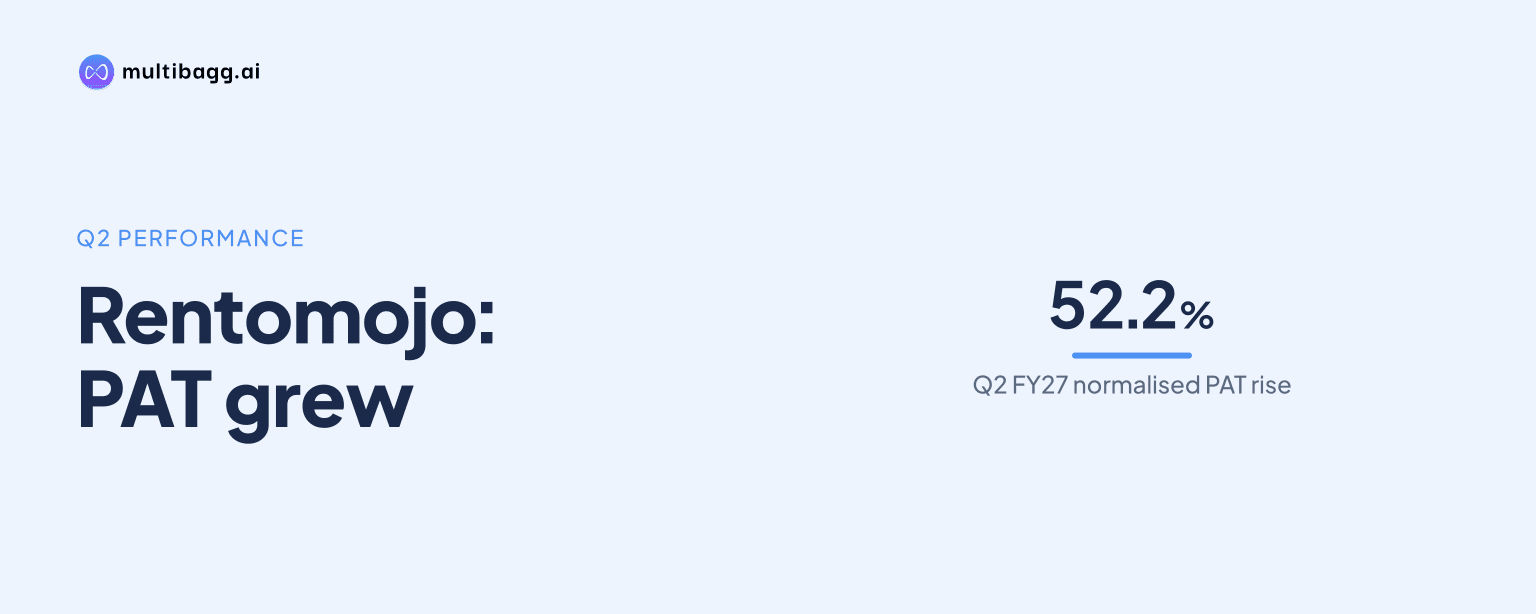
Rentomojo Ltd’s normalised profit after tax (PAT) rose 52.2% year on year to Rs 23.99 crore in Q2FY27, although reported PAT fell 62.6% to Rs 18.19 crore because the prior-year result included Rs 32.84 crore of deferred-tax income and the current quarter had specified adjustments.
Know Rentomojo inside out
Results, valuation, peers and who's buying, in one view.
Why did Rentomojo's reported Q2 PAT fall 63%?
Rentomojo’s reported PAT fell because Q2FY26 included a substantial deferred-tax item that does not form part of its normalised comparison. Reported PAT was Rs 48.61 crore in Q2FY26, Rs 7.84 crore in Q1FY27 and Rs 18.19 crore in Q2FY27, resulting in a 62.6% year-on-year decline but a 132.1% quarter-on-quarter increase.
The Q2FY26 normalisation bridge removes Rs 32.84 crore of deferred tax from reported PAT of Rs 48.61 crore, producing normalised PAT of Rs 15.76 crore. For Q2FY27, the bridge applies a Rs 6.21 crore deferred-tax adjustment, deducts Rs 1.21 crore related to the reversal of an exceptional expense under the New Labour Codes, and adds Rs 80 lakh of initial public offering, or IPO, expenses.
Rentomojo defines PAT as profit after exceptional items, while its normalised PAT also adjusts for deferred-tax income or expense. The company reported no cash tax paid in Q2FY27, distinguishing the tax adjustments in the profit bridge from cash-tax outgo.
How did Rentomojo's revenue and operating profit change?
Rentomojo grew revenue from operations 52.8% year on year to Rs 142.1 crore in Q2FY27 and 12.5% quarter on quarter from Rs 126.3 crore in Q1FY27. Reported total income increased 53.1% year on year, while other income was Rs 1.68 crore in Q2FY27 against Rs 92 lakh in Q2FY26.
Normalised earnings before interest, tax, depreciation and amortisation, or EBITDA, increased 52.7% year on year to Rs 58.83 crore, while normalised earnings before interest and tax, or EBIT, rose 50.7% to Rs 32.95 crore. The normalised EBITDA margin was 40.9%, compared with 41.0% in Q2FY26, and the normalised EBIT margin was 22.9%, compared with 23.3% a year earlier.
Reported EBITDA was Rs 59.24 crore in Q2FY27, versus Rs 38.54 crore in Q2FY26, while reported EBIT was Rs 33.36 crore, versus Rs 21.87 crore. The difference between reported and normalised Q2FY27 EBITDA and EBIT was a net Rs 41 lakh, reflecting the Rs 1.21 crore New Labour Codes reversal and Rs 80 lakh of IPO expenses.
What drove Rentomojo's Q2FY27 revenue growth?
Rentomojo attributed revenue growth to higher live items and gross items ordered. Gross items ordered rose 45.0% year on year to 381,347 in Q2FY27, while live items increased 44.0% to 1,049,419 from 728,773 in Q2FY26.
Live subscribers rose 42.5% year on year and 14.5% quarter on quarter to 324,208, while items per user stayed at 2.8 across Q2FY26, Q1FY27 and Q2FY27. This comparison shows that the disclosed expansion in the deployed base coincided with subscriber growth rather than a change in the average items held per user.
Average occupancy improved to 85.9% in Q2FY27 from 85.3% in Q2FY26 and 85.7% in Q1FY27. Purchase displaced increased 60.5% year on year to Rs 446.9 crore, while average revenue per item was Rs 1,650, up 4.6% year on year but down 0.8% sequentially because of reverse pick-up of air conditioners, according to Rentomojo.
Got a follow-up? Ask IRIS
How did exceptional items affect Rentomojo's quarterly comparisons?
Rentomojo’s Q1FY27 operating comparison included a Rs 11.37 crore fire loss, which it added back for normalised measures. Reported EBITDA of Rs 40.90 crore became Rs 52.27 crore, reported EBIT of Rs 17.91 crore became Rs 29.27 crore, and reported PAT of Rs 7.84 crore became Rs 21.93 crore after the fire-loss and Rs 2.73 crore deferred-tax adjustments.
Q2FY27 had smaller identified adjustments than Q1FY27, with the New Labour Codes item and IPO expenses producing normalised EBITDA of Rs 58.83 crore from reported EBITDA of Rs 59.24 crore. Normalised PAT margin was 16.7% in Q2FY27, compared with 16.8% in Q2FY26 and 17.3% in Q1FY27, making the normalised profit series less variable than reported PAT.
What happened to Rentomojo's returns and debt cost?
Rentomojo reported annualised normalised return on equity, or ROE, of 24.6% in Q2FY27, down 396 basis points year on year and 427 basis points quarter on quarter. Management attributed the change to the larger equity base after the Rs 141.372 crore net fresh issue in Q2FY27 and said normalised ROE would have been 30.0% without those proceeds.
Annualised normalised return on capital employed, or ROCE, was 25.3% in Q2FY27, compared with 27.4% in Q2FY26 and 26.6% in Q1FY27. Rentomojo said ROCE would be about 27.1% after excluding the Rs 141.372 crore net proceeds and adding back the Rs 70 crore debt repayment; its weighted average cost of debt was 9.27%, while its latest debt raised carried an 8.65% cost.
For H1FY27, revenue from operations increased 52.0% to Rs 268.4 crore and operating cash flow rose 36.7% to Rs 110 crore. H1FY27 EBITDA grew 36.5% to Rs 100.1 crore, while reported PAT declined 57.6% to Rs 26 crore and operating cash flow as a share of EBITDA was 109.8%, compared with 109.7% in H1FY26.
Conclusion
Rentomojo’s Q2FY27 figures show a divergence between reported and normalised profit caused principally by non-operating tax and exceptional-item effects. Revenue increased 52.8% to Rs 142.1 crore, normalised EBITDA rose 52.7% to Rs 58.83 crore, and normalised PAT increased 52.2% to Rs 23.99 crore, even as reported PAT was affected by the Q2FY26 deferred-tax income comparison.
The next disclosed item to watch is deployment of IPO proceeds. As of 30 September 2026, Rentomojo had utilised Rs 90 crore of Rs 141.372 crore in net proceeds, including the full Rs 70 crore earmarked for borrowings, leaving Rs 51.372 crore for warehouse and experience-store lease rentals, licence fees and general corporate purposes.