










Repco Home Finance Limited Q2 disbursements rise 43% sequentially
Key highlights
- Repco Home Finance reported Q2 FY27 disbursements of Rs 1,205 crore, up 43.0% from Rs 843 crore in Q1 FY27.
- Q2 FY27 sanctions reached Rs 1,359 crore, a 44.8% sequential increase from Rs 938 crore.
- Repco Home Finance's loan book stood at Rs 16,425 crore at September 2026, compared with Rs 15,990 crore at June 2026.
- Non-salaried borrowers represented 53.6% of the September 2026 portfolio, while home loans represented 71.0%.
powered by IRIS
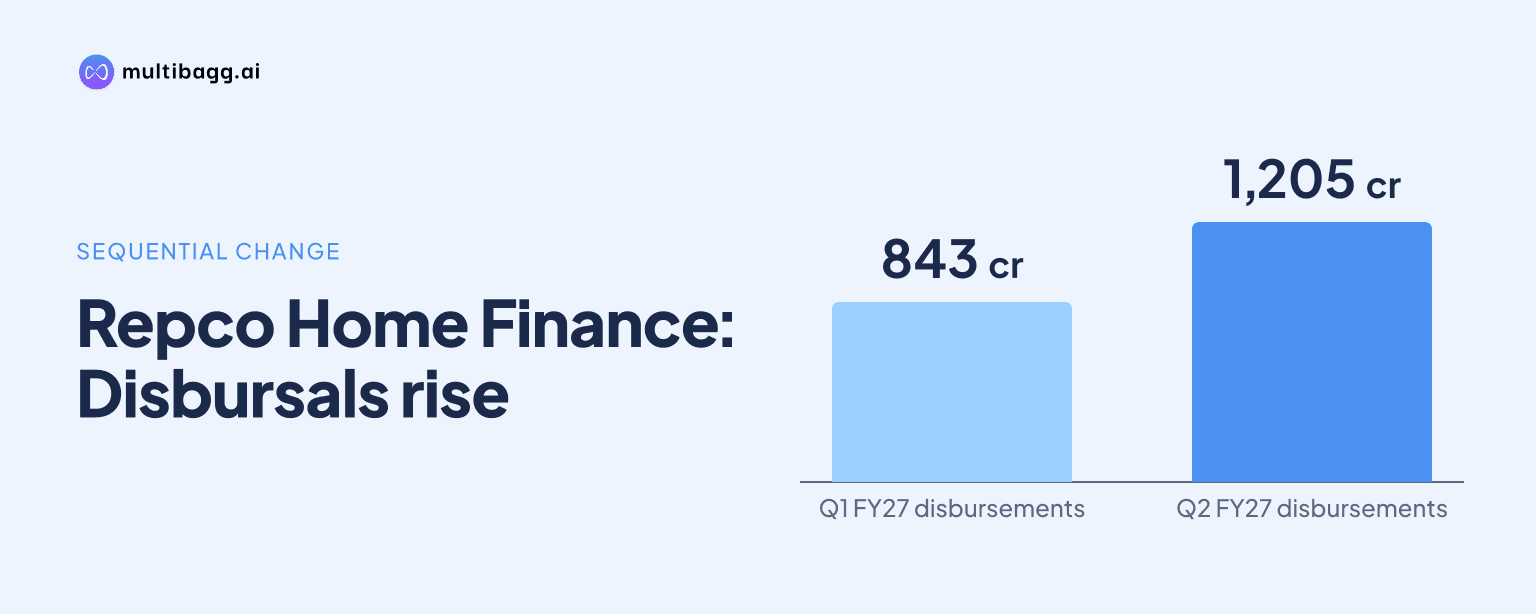
Repco Home Finance Limited reported Q2 FY27 disbursements of Rs 1,205 crore, up 43.0% from Q1 FY27, while its loan book reached Rs 16,425 crore at September 2026. The quarter also recorded Rs 1,359 crore of sanctions, supporting a sequential increase after Q1 FY27 disbursements of Rs 843 crore.
Know Repco Home Finance inside out
Results, valuation, peers and who's buying, in one view.
How quickly did Repco Home Finance's Q2 FY27 lending activity increase?
Repco Home Finance's disbursements increased to Rs 1,205 crore in Q2 FY27 from Rs 843 crore in Q1 FY27, a 43.0% sequential rise reported by management. Sanctions, which are loan approvals, increased by 44.8% sequentially to Rs 1,359 crore from Rs 938 crore. The two measures both rose after Q1 FY27, when sanctions and disbursements were lower than the subsequent quarter.
The Q2 FY27 result also exceeded the comparable prior-year quarter. Disbursements of Rs 1,205 crore were 12.7% above Rs 1,069 crore in Q2 FY26, while sanctions of Rs 1,359 crore were 12.7% above Rs 1,205 crore. In the prior sequence, disbursements were Rs 1,064 crore in Q3 FY26 and Rs 1,186 crore in Q4 FY26, placing Q2 FY27 above both those quarterly amounts.
What does Repco Home Finance's September 2026 loan book show?
Repco Home Finance reported a loan book of Rs 16,425 crore at September 2026, compared with Rs 15,990 crore at June 2026 and Rs 15,033 crore at September 2025. The September 2026 figure followed Q2 FY27 disbursements of Rs 1,205 crore. The presentation does not provide a separate quarterly repayment or run-off figure that explains the difference between disbursements and the closing loan-book change.
Net owned fund, the lender's reported owned capital base, was Rs 3,875 crore at September 2026, versus Rs 3,768 crore in June 2026 and Rs 3,464 crore in September 2025. The business summary reported a total capital adequacy ratio of 37%, 1,16,229 live accounts and an average loan per unit of Rs 14 lakh. Its network comprised 242 locations in the November 2026 earnings presentation.
The business summary also reported gross non-performing assets, or GNPA, of 2.4%, and expected credit loss, or ECL, provision of 2.1%. These portfolio-quality measures accompany the Rs 16,425 crore outstanding loan book, but the presentation does not provide comparable GNPA or ECL figures for June 2026 or September 2025. The available comparison therefore establishes loan-book and capital-base growth rather than a period-on-period asset-quality change.
Got a follow-up? Ask IRIS
How did Repco Home Finance's earnings move with disbursements?
Repco Home Finance reported net interest income, or NII, of Rs 220 crore in Q2 FY27, 1.8% higher than Rs 216 crore in Q1 FY27 and 10.0% above Rs 200 crore in Q2 FY26. Operating revenue was Rs 481 crore, rising 2.7% sequentially from Rs 468 crore and 8.0% year on year from Rs 445 crore. The increase in lending activity was larger than the reported sequential changes in NII and operating revenue.
Profit before tax was Rs 149 crore in Q2 FY27, compared with Rs 148 crore in Q1 FY27 and Rs 142 crore in Q2 FY26. Profit after tax was Rs 116 crore, versus Rs 114 crore in the preceding quarter and Rs 107 crore a year earlier. Management's tables show disbursements rose 43.0% sequentially while profit after tax increased 1.7%, distinguishing new-lending growth from the quarter's profit movement.
For the half year ended September 2026, the presentation reported NII of Rs 436 crore, compared with Rs 397 crore for September 2025. Net profit for the same six-month periods was Rs 230 crore and Rs 215 crore, respectively. These half-year figures combine Q1 and Q2 results and provide a broader comparison than the Rs 220 crore Q2 FY27 NII and Rs 116 crore quarterly profit after tax.
What is Repco Home Finance's loan portfolio mix?
Repco Home Finance remained predominantly focused on non-salaried borrowers at September 2026, when they represented 53.6% of the loan book and salaried borrowers represented 46.4%. The non-salaried share was 53.5% at June 2026 and 53.0% at September 2025. This represents a 0.1-percentage-point quarterly change and a 0.6-percentage-point annual change in the reported mix.
Home loans accounted for 71.0% of the September 2026 portfolio, while home equity accounted for 29.0%. The mix was unchanged from September 2025, when home loans and home equity were also 71.0% and 29.0%, respectively. At June 2026, home loans were 70.8% and home equity was 29.2%, so the September portfolio returned to the earlier reported split.
The composition data indicates that the Rs 16,425 crore loan book did not reflect a disclosed shift away from either core segment during the periods shown. Non-salaried borrowers retained a majority share at all three reported dates, rising from 53.0% in September 2025 to 53.6% in September 2026. Likewise, the home-loan share stayed around 71%, while home equity remained around 29%.
Conclusion
Repco Home Finance's Q2 FY27 presentation shows a marked sequential increase in originations, with disbursements rising to Rs 1,205 crore from Rs 843 crore and sanctions reaching Rs 1,359 crore from Rs 938 crore. The September 2026 loan book of Rs 16,425 crore was accompanied by a portfolio still led by non-salaried borrowers at 53.6% and home loans at 71.0%.
The presentation does not disclose a future lending target, portfolio-mix target or a reconciliation between quarterly disbursements and loan-book movements. Subsequent Repco Home Finance disclosures can clarify whether higher disbursements continue and provide comparable updates on the 2.4% GNPA, 2.1% ECL provision and 37% total capital adequacy ratio reported in the November 2026 presentation.