










Rico Auto Q2 revenue rises 36% as EBITDA margin falls to 0.7%
Key highlights
- Rico Auto’s consolidated Q2 FY27 revenue increased 36% to Rs 852.4 crore from Rs 627.4 crore.
- Q2 FY27 EBITDA fell to Rs 5.9 crore from Rs 61 crore, and EBITDA margin declined to 0.7% from 9.7%.
- Rico Auto reported approximately Rs 30 crore of temporary air-freight cost in Q2 FY27.
- H1 FY27 PAT was a loss of Rs 29.7 crore, compared with a Rs 34.4 crore profit in H1 FY26.
powered by IRIS
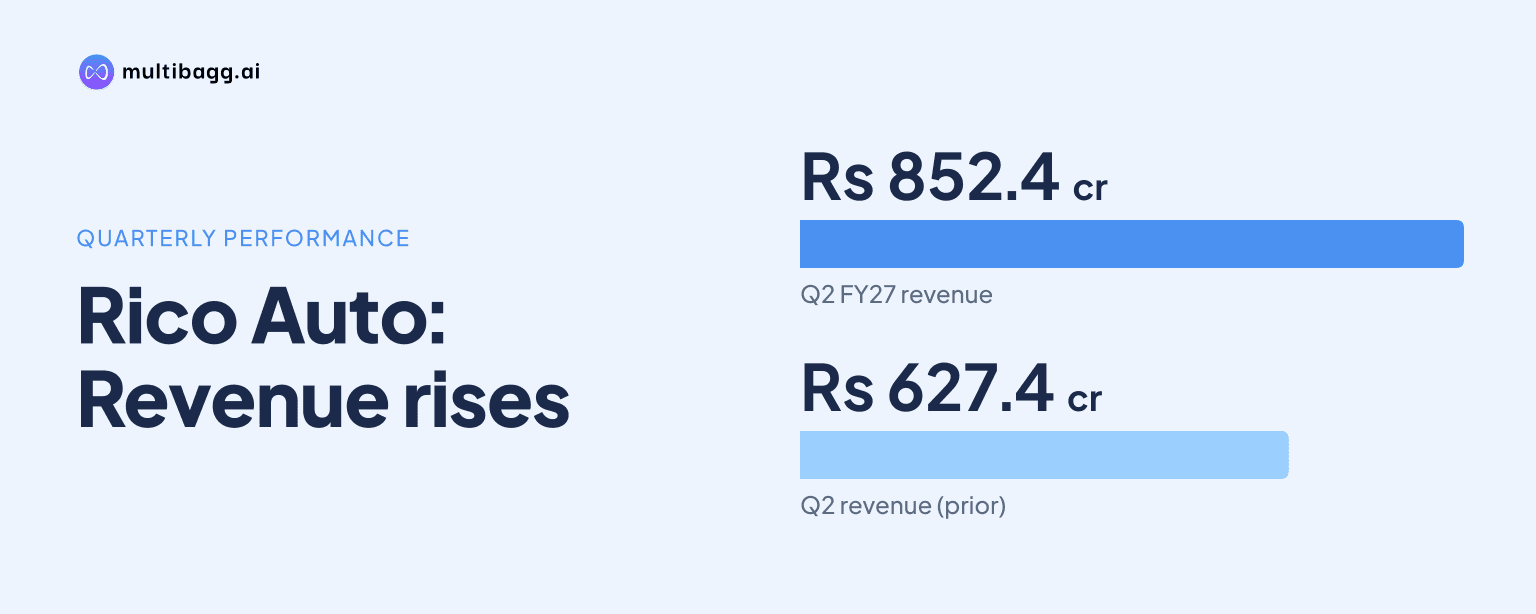
Rico Auto Industries Limited reported consolidated Q2 FY27 revenue of Rs 852.4 crore, up 36% from Rs 627.4 crore a year earlier, but EBITDA margin fell to 0.7% from 9.7% after approximately Rs 30 crore of temporary air freight and other operating-cost inflation reduced EBITDA to Rs 5.9 crore.
Know Rico Auto Industries inside out
Results, valuation, peers and who's buying, in one view.
What were Rico Auto’s Q2 FY27 revenue and profit results?
Rico Auto’s consolidated revenue from operations increased by Rs 225 crore year on year to Rs 852.4 crore in Q2 FY27, from Rs 627.4 crore in Q2 FY26. EBITDA, or earnings before interest, tax, depreciation and amortisation, instead declined to Rs 5.9 crore from Rs 61 crore, taking the EBITDA margin down by 9 percentage points to 0.7%.
The decline continued below the operating line in Q2 FY27. Depreciation increased to Rs 26.6 crore from Rs 25.7 crore and finance cost rose to Rs 15.9 crore from Rs 12 crore, while profit before tax moved to a loss of Rs 33.2 crore from a profit of Rs 24.5 crore. Profit after tax, or PAT, was a loss of Rs 26.3 crore, compared with a Rs 17.7 crore profit a year earlier.
Rico Auto’s standalone Q2 FY27 result showed a larger operating loss than the consolidated result. Standalone revenue increased to Rs 603.3 crore from Rs 461.6 crore, but EBITDA changed to a Rs 15 crore loss from positive EBITDA of Rs 43.7 crore, and the standalone EBITDA margin was negative 2.5%.
Why did Rico Auto’s Q2 FY27 margin fall to 0.7%?
Rico Auto said Q2 FY27 profitability was affected by Rs 46 crore of elevated operating costs, including approximately Rs 30 crore of temporary air freight. The company also cited inflation in manpower, power, fuel and gas, and tools as contributors to the fall in EBITDA from Rs 61 crore to Rs 5.9 crore.
Temporary air freight followed an increase in ocean-freight transit time to 10 weeks from five weeks, according to Rico Auto. The company said it needed to build inventory and kept using air shipments in Q2 because it was a single-source supplier for newly launched export programmes and sought uninterrupted customer supplies.
The cost lines reflect the pressure in Q2 FY27. Cost of goods sold rose by Rs 184.8 crore to Rs 572.8 crore, employee cost increased by Rs 5.9 crore to Rs 57.1 crore, and other expenses rose by Rs 89.4 crore to Rs 216.5 crore. The presentation does not provide a complete breakdown of other expenses beyond air freight and the inflationary categories identified by management.
Got a follow-up? Ask IRIS
How did Rico Auto’s first-half performance and revenue mix change?
Rico Auto’s consolidated H1 FY27 revenue rose to Rs 1,607.4 crore from Rs 1,170.8 crore in H1 FY26, while EBITDA fell to Rs 40.7 crore from Rs 114.9 crore. EBITDA margin declined to 2.5% from 9.8%, and the company reported Rs 71 crore of elevated first-half operating costs, including Rs 39 crore of temporary air freight.
PAT for H1 FY27 was a loss of Rs 29.7 crore, compared with a Rs 34.4 crore profit in H1 FY26. Finance cost increased to Rs 30.4 crore from Rs 25.27 crore and depreciation rose to Rs 53.7 crore from Rs 49.34 crore, alongside the operating-profit reduction.
Rico Auto’s revenue mix shifted only modestly between the periods. Domestic revenue accounted for 85% of H1 FY27 revenue versus 83% in H1 FY26, while exports were 15% versus 17%; in Q2 FY27, the respective shares were 84% and 16%. Aluminium casting represented 89% of H1 FY27 revenue and ferrous casting 11%, compared with 88% and 12% respectively a year earlier.
What is Rico Auto’s plan for air freight and profitability?
Rico Auto expects inventory to reach its desired level in Q3 FY27, after which the temporary air-freight requirement is expected to cease. Management said shipments are expected to return to normal sea-freight mode from the middle of Q3, supporting its stated expectation of progressive profitability improvement from Q3 onwards.
Rico Auto has raised the additional air-freight expense with the relevant original equipment manufacturers, or OEMs, seeking to share or recover part of the cost. The company said discussions had resulted in certain recoveries, but did not quantify recoveries or specify how much of the approximately Rs 30 crore Q2 FY27 air-freight expense might be recovered.
Management also said the group is pursuing customer price revisions, cost pass-throughs, productivity measures and cost optimisation to address inflation. At September 2026, inventory was Rs 354.1 crore against Rs 282.4 crore at March 2026, while trade receivables rose to Rs 478.9 crore from Rs 352.4 crore and cash and cash equivalents fell to Rs 5.7 crore from Rs 12.8 crore.
Conclusion
Rico Auto’s Q2 FY27 results show that a 36% increase in consolidated revenue to Rs 852.4 crore did not offset logistics and inflation-related cost pressure. EBITDA fell to Rs 5.9 crore, PAT moved to a Rs 26.3 crore loss and the first-half EBITDA margin declined to 2.5% from 9.8% a year earlier.
The next disclosed milestone is mid-Q3 FY27, when Rico Auto expects shipments to revert to sea freight after inventory reaches the desired level. The extent of OEM recoveries, customer price revisions and cost pass-throughs remains unquantified in the presentation and will be relevant to management’s expected profitability improvement from Q3 onwards.