










Rico says Rs 2,500 crore programmes support EV capacity
Key highlights
- Rico says new orders are worth Rs 2,500 crore over programme lives of five years.
- FY26 revenue was Rs 2,478 crore, up from Rs 2,212 crore in FY25.
- FY26 capital expenditure was Rs 212 crore, compared with Rs 151 crore in FY25.
- EV and hybrid products contribute about 7% to 9% of Rico's business mix.
powered by IRIS
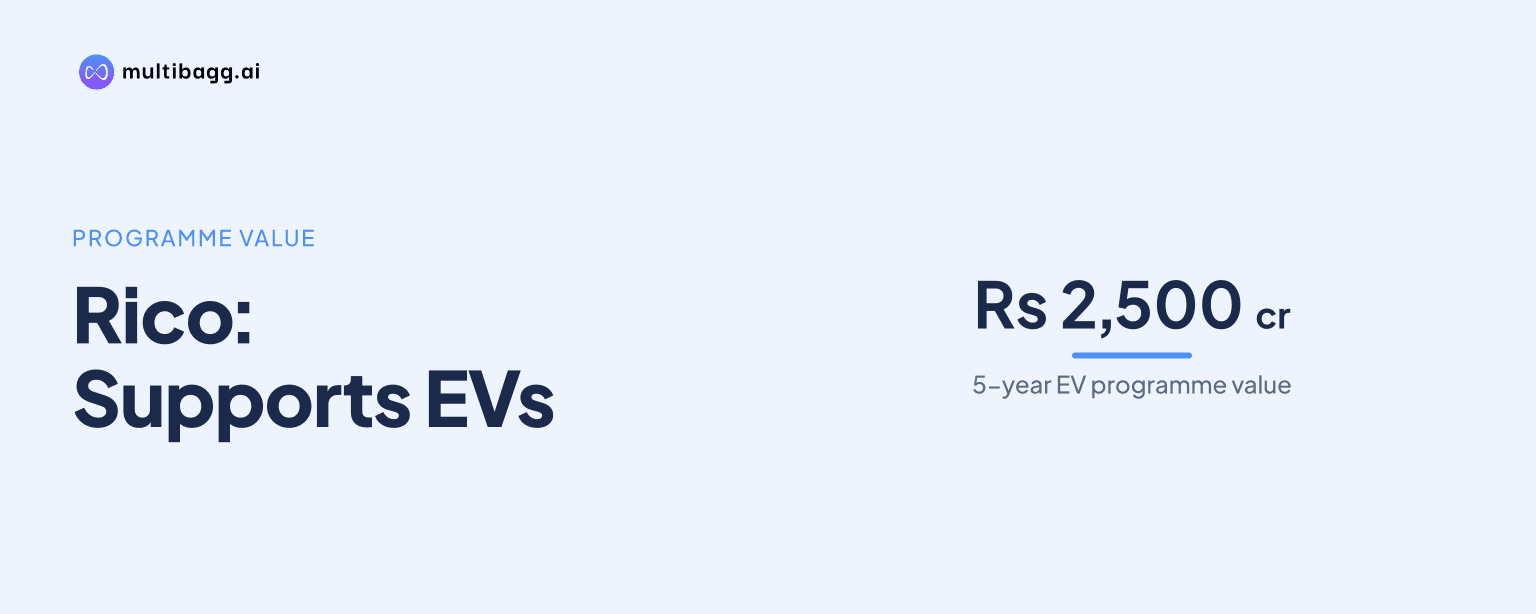
Rico Auto Industries Ltd. says new orders worth Rs 2,500 crore over five-year programme lives support capacity being directed towards hybrid and electric-vehicle (EV) components, including its Hosur greenfield facility. The disclosed programme value compares with FY26 revenue of Rs 2,478 crore and FY26 capital expenditure of Rs 212 crore.
Know Rico Auto Industries inside out
Results, valuation, peers and who's buying, in one view.
What is Rico's Rs 2,500 crore new-order pipeline?
Rico says new orders are worth Rs 2,500 crore across programme lives of five years, not as a one-year revenue target. The presentation places this order value beside management's stated objectives of moderate capital expenditure, higher utilisation, better operating leverage and better return ratios. It does not disclose an annual sales schedule, programme start dates or customer-by-customer values for the orders.
The Rs 2,500 crore programme value is broadly comparable with Rico's FY26 revenue of Rs 2,478 crore, but the measures cover different periods. FY26 revenue is a single-year result, while the new-order figure extends across five-year programme lives. The presentation therefore does not establish how much of the Rs 2,500 crore will be recognised in any individual financial year.
How is Rico allocating capacity to hybrid and EV products?
Rico says its Hosur greenfield manufacturing facility is focused on hybrid and EV component programmes, with capital expenditure executed in line with new programme requirements. It also says capacity allocation is increasingly directed towards hybrid and EV opportunities. The stated product focus includes precision aluminium components, machined EV components and lightweight structural systems.
EV and hybrid products contribute about 7% to 9% of Rico's business mix, according to the presentation. This is distinct from aluminium casting, which contributes 89% of total revenue and includes EV, engine and transmission applications. Rico identifies Hosur as aligned with next-generation mobility manufacturing and says incremental capital expenditure is focused on EV and hybrid platforms.
Rico lists more than 120 high-pressure die-casting machines in aluminium casting, with locking force from 135 tonnes to 2,700 tonnes and capacity above 1,10,000 metric tonnes of components a year. The business can produce components weighing up to 20 kilograms, including covers, housings and transaxle cases for EV and hybrid applications. More than 50% of Rico's products are assemblies, and it has more than 3,000 machining and special-purpose machines.
Got a follow-up? Ask IRIS
Which customer programmes are linked to Rico's expansion?
Rico links its future-growth programme list to hybrid, EV, engine, transmission and braking applications. Toyota is listed for a hybrid transmission component, while Maruti Suzuki is listed for engine, transmission and EV components used in engine-transmission systems and electric drive units or motors. The Hosur plant is separately described as strategically aligned with the Toyota-Aisin ecosystem.
Other named EV-related programmes include BMW components for electric drive units or motors, Bosch EV transmission components for e-axle systems, and Musashi EV transmission components. These disclosures identify products and applications but do not give values by customer, programme or vehicle platform. Rico also says it has product presence across Toyota, Maruti, Tata and Mahindra platforms.
The listed programmes also include Cummins new-engine-series components, Knorr-Bremse braking-system components, and Hero engine components and alloy wheels. This mix shows that the disclosed programme activity extends beyond electrification. Rico's customer list includes global vehicle manufacturers and system suppliers, but the presentation does not state that every customer listed is part of the Rs 2,500 crore new-order total.
What do Rico's capex and revenue figures show?
Rico reported FY26 capital expenditure of Rs 212 crore, up Rs 61 crore from Rs 151 crore in FY25 but below Rs 236 crore in FY23. Its timeline identifies a Chennai hybrid and EV plant in FY22 and a Hosur hybrid and EV plant in three phases in FY24. The presentation does not state how much of FY26 capital expenditure was allocated specifically to Hosur or EV programmes.
Revenue rose by Rs 266 crore to Rs 2,478 crore in FY26 from Rs 2,212 crore in FY25. This followed a fall from Rs 2,302 crore in FY23 to Rs 2,160 crore in FY24, before revenue rose in FY25 and FY26. Capital expenditure ranged from Rs 151 crore to Rs 236 crore during FY22 to FY26, rather than following the same pattern as revenue.
Rico reported an asset turnover ratio of 2.10 in FY26, compared with 1.11 in FY25 and 1.02 in FY22. Management places the FY26 figure alongside its plan for moderate capital expenditure and higher utilisation, but the presentation does not define the ratio or provide a target. The disclosed data shows a higher reported ratio in FY26 without specifying the operational drivers.
Conclusion
Rico's presentation connects Rs 2,500 crore of five-year new programmes to identifiable capacity actions rather than presenting EV activity as a standalone ambition. The Hosur facility, a 7% to 9% EV and hybrid business mix, and named programmes for Toyota, Maruti Suzuki, BMW, Bosch and Musashi indicate that capacity is being positioned for hybrid transmission, electric-drive, e-axle and lightweight-component applications.
The next item to watch is conversion of the five-year programme value into annual revenue, since FY26 revenue was Rs 2,478 crore and Rico gives no programme-wise sales timetable. Management says Hosur capacity will increasingly be directed to hybrid and EV opportunities, with expenditure aligned to programme requirements, while the presentation leaves the Hosur-specific capex and customer-level order values undisclosed.