










RICO cash drops to Rs 5.7 crore as investment outflows rise
Key highlights
- RICO ended Sep-26 with Rs 5.7 crore of cash and cash equivalents, versus Rs 12.8 crore at Mar-26.
- RICO reported Rs 140.6 crore of net investing cash outflow in Sep-26, compared with Rs 113.0 crore in Sep-25.
- Inventories rose Rs 71.7 crore and trade receivables rose Rs 126.5 crore between Mar-26 and Sep-26.
- Combined borrowings increased Rs 107.1 crore to Rs 809.5 crore at Sep-26.
powered by IRIS
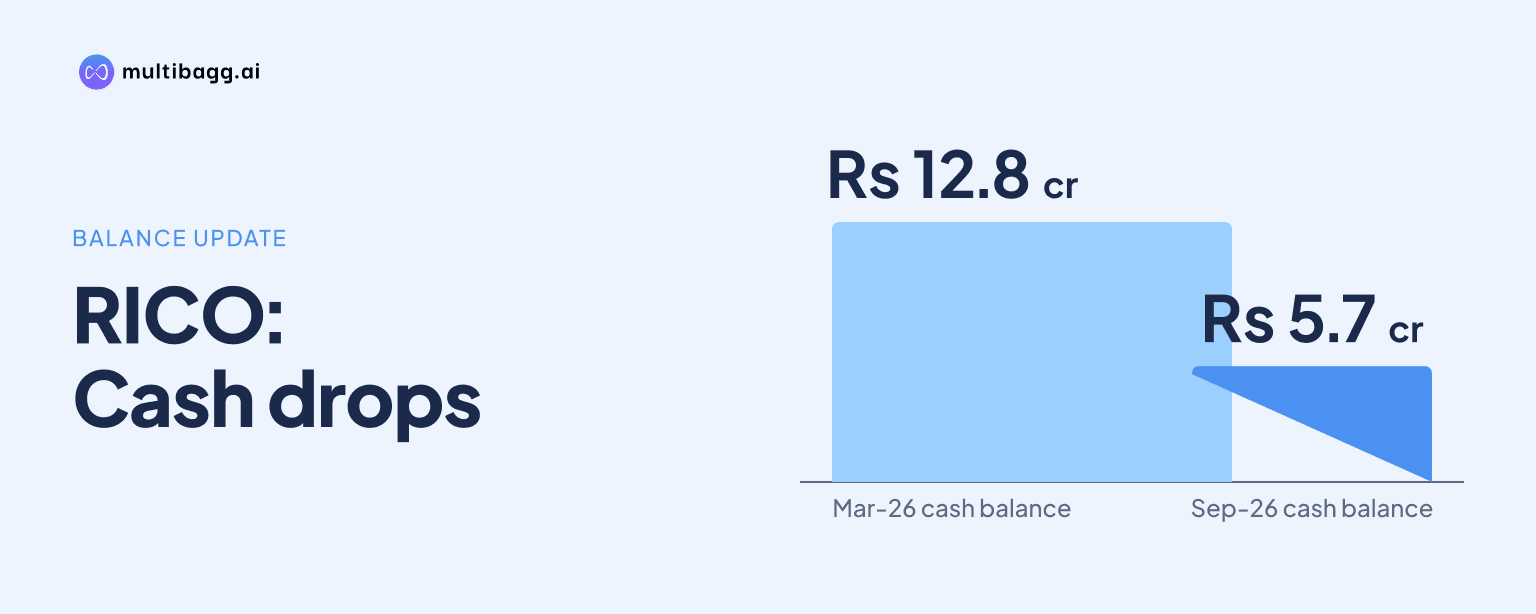
Rico Auto Industries Ltd. ended Sep-26 with Rs 5.7 crore of cash and cash equivalents, down from Rs 12.8 crore at Mar-26, as Rs 140.6 crore of net investing outflows exceeded Rs 67.2 crore of operating cash generation despite Rs 65.8 crore of financing inflows.
Know Rico Auto Industries inside out
Results, valuation, peers and who's buying, in one view.
Why did RICO’s cash balance fall in Sep-26?
RICO’s cash balance fell because its investing outflows exceeded cash generated from operations and were only partly covered by financing inflows. Cash and cash equivalents declined by Rs 7.7 crore during the Sep-26 period, compared with a Rs 4.8 crore decrease in Sep-25. A Rs 0.6 crore foreign-currency fluctuation arising from consolidation was included before the ending cash balance of Rs 5.7 crore.
RICO generated Rs 67.2 crore of net cash from operating activities in Sep-26, but used Rs 140.6 crore in investing activities. Financing activities supplied Rs 65.8 crore, compared with a Rs 41.0 crore financing outflow in Sep-25. The presentation reports investing cash flow as an aggregate and does not separately identify capital expenditure within that cash-flow line.
RICO’s operating cash inflow was Rs 82.0 crore below the prior-year period, while its investing outflow was Rs 27.6 crore higher. The move from a financing outflow in Sep-25 to a Rs 65.8 crore financing inflow in Sep-26 helped offset part of the investment-related cash requirement, but did not prevent the lower closing cash balance.
How much did RICO’s inventory and receivables increase?
RICO’s inventories and trade receivables increased by a combined Rs 198.2 crore between Mar-26 and Sep-26. Inventories rose Rs 71.7 crore to Rs 354.1 crore, while trade receivables rose Rs 126.5 crore to Rs 478.9 crore. These two items accounted for most of the Rs 205.9 crore increase in current assets to Rs 922.9 crore.
Trade receivables were Rs 124.8 crore higher than inventories at Sep-26. Other current assets rose Rs 14.8 crore to Rs 52.1 crore and current tax assets increased Rs 2.0 crore to Rs 13.5 crore, while cash and cash equivalents on the balance sheet declined Rs 7.1 crore from Mar-26.
RICO said it built inventory after ocean-freight transit time increased from five weeks to 10 weeks for newly launched export programmes. Management said it continued air shipments to avoid supply interruptions because it was a single-source supplier for those programmes. The presentation does not provide a customer-level or programme-level breakdown of the receivables increase.
Got a follow-up? Ask IRIS
How did RICO’s investment-related assets and borrowings change?
RICO’s capital work-in-progress, or CWIP, increased Rs 92.1 crore to Rs 253.9 crore at Sep-26, while combined borrowings increased Rs 107.1 crore to Rs 809.5 crore. Property, plant and equipment rose Rs 4.6 crore to Rs 1,182.2 crore, and non-current assets increased Rs 99.4 crore to Rs 1,524.6 crore.
Borrowings rose in both reported maturity categories. Non-current borrowings increased Rs 83.0 crore to Rs 489.0 crore and current borrowings increased Rs 24.1 crore to Rs 320.5 crore. The higher balance-sheet borrowings coincided with the Rs 65.8 crore financing cash inflow reported for the Sep-26 period.
RICO’s trade payables rose Rs 229.0 crore to Rs 699.9 crore, exceeding the Rs 198.2 crore combined rise in inventories and receivables. Total equity declined Rs 35.4 crore to Rs 748.8 crore, including a Rs 35.8 crore decline in other equity to Rs 730.1 crore. Total assets increased Rs 305.4 crore to Rs 2,447.5 crore.
What does RICO’s operating cash flow indicate?
RICO remained cash-generative from operations in Sep-26, although net operating cash fell to Rs 67.2 crore from Rs 149.2 crore in Sep-25. Operating profit before working-capital changes was Rs 46.0 crore, compared with Rs 121.6 crore a year earlier. Changes in working capital were reported at Rs 27.5 crore, resulting in Rs 73.6 crore of cash generated from operations before direct taxes.
The lower operating cash inflow coincided with a decline in consolidated earnings despite higher revenue. Revenue from operations increased to Rs 1,607.4 crore in H1FY27 from Rs 1,170.8 crore in H1FY26, while earnings before interest, tax, depreciation and amortisation, or EBITDA, declined to Rs 40.7 crore from Rs 114.9 crore. RICO reported a Rs 37.2 crore loss before tax, compared with a Rs 42.9 crore profit before tax in the comparable period.
Management attributed Rs 71 crore of elevated operating costs in H1FY27 partly to Rs 39 crore of temporary air freight, alongside inflationary pressures in manpower, power, fuel, gas and tools. Finance cost increased to Rs 30.4 crore from Rs 25.3 crore in H1FY26. Management said customer discussions had resulted in certain recoveries and that price revisions, cost pass-throughs, productivity measures and cost optimisation were expected to support progressive profitability improvement from Q3.
Conclusion
RICO’s Sep-26 position combined Rs 5.7 crore of closing cash with higher inventories, receivables, CWIP and borrowings. Operating activities generated Rs 67.2 crore of cash, but this was below the prior-year Rs 149.2 crore and did not cover the Rs 140.6 crore net investing outflow, leaving financing inflows to cover part of the period’s cash requirement.
The next disclosed checkpoint is Q3, when management expects inventory to reach the desired level and temporary air-freight requirements to cease, with sea shipments resuming from mid-Q3. The stated matters to watch are the moderation of inventory and receivables, the effect of customer recoveries and price revisions, and whether the planned freight change supports the management expectation of improved profitability.