










Rikhav current borrowings rose to ₹56.49 crore in H1 FY27
Key highlights
- Rikhav’s current borrowings increased to ₹56.49 crore in H1 FY27 from ₹5.59 crore in FY26.
- Cash and bank balances rose to ₹281.98 crore at 30 September 2026 from ₹237.37 crore at FY26-end.
- Rikhav reported ₹48.02 crore of financing cash inflow and negative net cash flow of ₹39.54 crore in H1 FY27.
- Trade receivables rose to ₹40.40 crore in H1 FY27, while inventories declined to ₹75.60 crore.
powered by IRIS
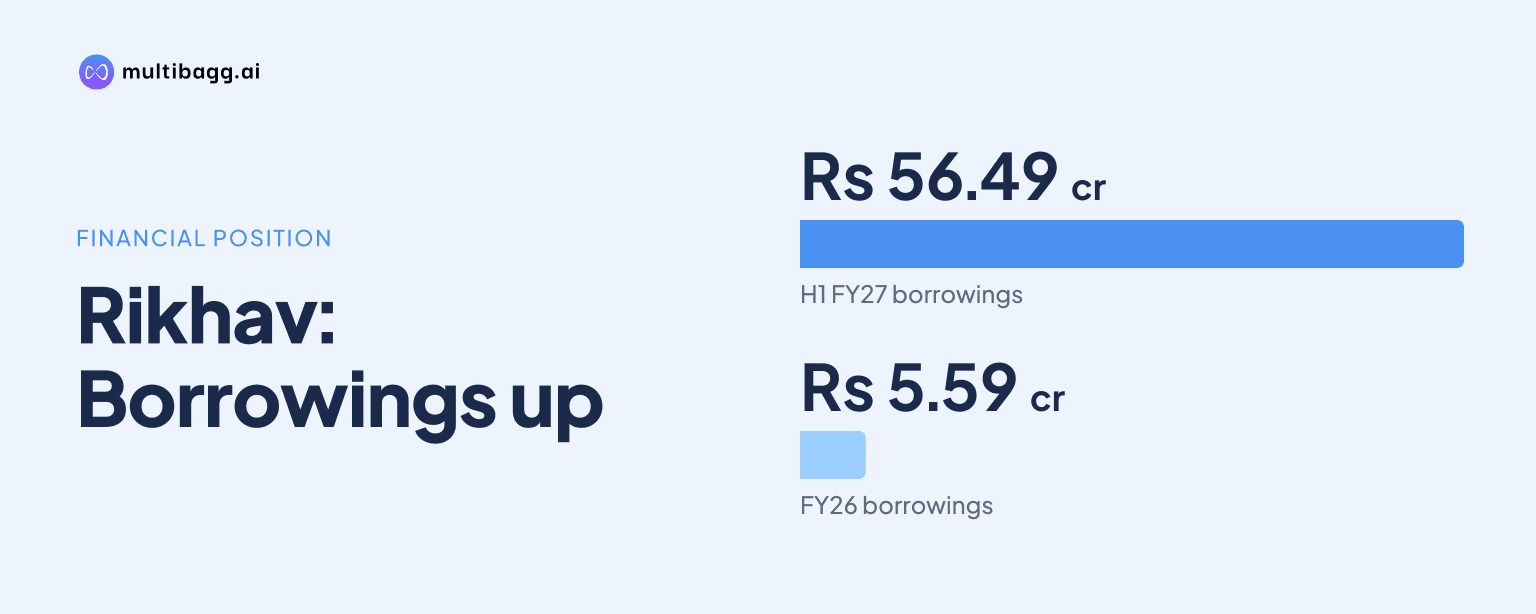
Rikhav Securities Ltd reported current borrowings of ₹56.49 crore in H1 FY27, up from ₹5.59 crore in FY26, while cash and bank balances rose to ₹281.98 crore at 30 September 2026 from ₹237.37 crore at FY26-end. The presentation does not disclose the purpose, terms or maturity of the additional current borrowing.
Know Rikhav Securities inside out
Results, valuation, peers and who's buying, in one view.
Why did Rikhav’s current borrowings increase?
Rikhav’s presentation records the increase in current borrowings but does not state why the balance reached ₹56.49 crore in H1 FY27. Current borrowings were ₹5.59 crore in FY26 and ₹39.91 crore in FY24, making the H1 FY27 balance ₹50.90 crore higher than the FY26 figure. The presentation does not identify a lender, interest rate, repayment date or end-use for the borrowing.
Non-current borrowings increased to ₹2.76 crore in H1 FY27 from ₹2.30 crore in FY26. The two reported borrowing categories therefore totalled ₹59.25 crore at 30 September 2026, compared with ₹7.89 crore at FY26-end. This total is calculated from the balance sheet’s current- and non-current-borrowing lines.
Total current liabilities rose by ₹19.49 crore to ₹169.76 crore in H1 FY27. Trade payables increased by ₹12.20 crore to ₹100.51 crore, while other current liabilities fell by ₹43.39 crore to ₹6.28 crore. Rikhav reported total income of ₹869.07 crore and purchases of stock in trade of ₹788.07 crore for the half year, but did not directly connect either item with borrowings.
How much cash did Rikhav hold against borrowings?
Rikhav held ₹281.98 crore in cash and bank balances at 30 September 2026, exceeding its combined reported borrowings of ₹59.25 crore by ₹222.73 crore. Cash and bank balances increased by ₹44.61 crore from ₹237.37 crore in FY26. That calculation compares reported balance-sheet amounts and does not establish that cash was set aside for debt repayment.
Cash and bank balances were Rikhav’s largest current-asset line in H1 FY27, followed by inventories of ₹75.60 crore and trade receivables of ₹40.40 crore. Total current assets rose to ₹418.30 crore from ₹388.06 crore in FY26. The period-end balance sheet does not state how much of the cash balance was restricted or available for a particular use.
The composition of current assets changed between FY26 and H1 FY27. Inventories declined by ₹28.55 crore from ₹104.15 crore, while trade receivables increased by ₹24.37 crore from ₹16.03 crore. Other current assets decreased by ₹10.28 crore to ₹19.89 crore, alongside the ₹44.61 crore increase in cash and bank balances.
Rikhav’s net worth increased to ₹259.06 crore at 30 September 2026 from ₹245.47 crore in FY26, with reserves rising to ₹239.92 crore from ₹226.32 crore. Total assets were ₹432.21 crore, matching total liabilities and equity of ₹432.21 crore in the consolidated balance sheet. Fixed assets also increased to ₹7.95 crore from ₹6.84 crore.
Got a follow-up? Ask IRIS
What does Rikhav’s cash flow show about the funding change?
Rikhav reported cash from financing activities of ₹48.02 crore in H1 FY27, compared with ₹2.57 crore in FY26, while cash from operations was negative ₹10.41 crore. The presentation does not break down financing cash flow, so it does not specify what portion, if any, came from borrowing, equity transactions or other financing activity. The financing inflow occurred in the same half year as current borrowings rose to ₹56.49 crore.
Cash used in investing activities was ₹77.14 crore in H1 FY27, compared with ₹6.75 crore in FY26. Rikhav consequently reported net cash flow of negative ₹39.54 crore for H1 FY27, versus positive ₹61.14 crore for FY26. The presentation provides no reconciliation between that summary cash-flow result and the increase in the reported cash-and-bank balance from ₹237.37 crore to ₹281.98 crore.
Operating cash flow changed from a ₹65.32 crore inflow in FY26 to a ₹10.41 crore outflow in H1 FY27. Rikhav had also reported negative operating cash flow of ₹184.91 crore in FY25 and positive operating cash flow of ₹109.05 crore in FY24. In H1 FY27, investing was the largest cash-flow outflow and financing was the only positive cash-flow category.
How did Rikhav’s leverage and earnings change?
Rikhav reported a debt-to-equity ratio of 0.13 times in H1 FY27, compared with 0.03 times in FY26. The H1 FY27 ratio was below the FY24 figure of 0.29 times and above the FY25 figure of 0.00 times. The presentation separately reports ₹56.49 crore of current borrowings and ₹2.76 crore of non-current borrowings.
Finance costs were ₹3.32 crore in H1 FY27, compared with ₹5.31 crore for the full FY26, while interest coverage was 6.97 times against 5.90 times. The H1 FY27 and FY26 finance-cost figures cover different lengths of time. Rikhav reported profit after tax of ₹13.60 crore in H1 FY27, compared with ₹18.96 crore for FY26.
Return on equity (ROE) was 5.25% in H1 FY27, compared with 7.72% in FY26, and return on capital employed (ROCE) was 7.89%, compared with 12.36%. Earnings per share (EPS) was ₹3.55 in H1 FY27 against ₹4.95 in FY26. Rikhav notes that its H1 FY27 ROE, ROCE and EPS figures are not annualised.
Rikhav generated total income of ₹869.07 crore in H1 FY27, including ₹849.88 crore from business and investment activities, ₹6.85 crore from brokerage and commission, and ₹12.35 crore from demat operations and other income. Management also reported trading volumes of ₹73,363 crore across equity, futures and options, and commodity segments during the half year. The presentation does not allocate the higher borrowing balance among these activities.
Conclusion
Rikhav’s H1 FY27 balance sheet shows a marked increase in current borrowings to ₹56.49 crore alongside a ₹281.98 crore cash and bank balance, higher receivables of ₹40.40 crore and lower inventories of ₹75.60 crore. The funding pattern also coincided with negative operating and investing cash flows, while financing activities generated ₹48.02 crore.
The next disclosures to watch are any detail on the source, terms and use of the ₹56.49 crore current borrowing, plus a reconciliation of cash-flow movements with the cash-and-bank balance. Management said it remains focused on strengthening its platform and improving operational efficiencies, but the presentation sets out no borrowing target, repayment schedule or financing plan.