










Rikhav Securities Says Higher Costs Squeezed H1 Margins
Key highlights
- Rikhav Securities said H1 FY27 income remained similar while expenses increased, pressuring operating margins.
- An investor cited H1 FY27 total income of around Rs 870 crore and EBITDA of around Rs 24 crore.
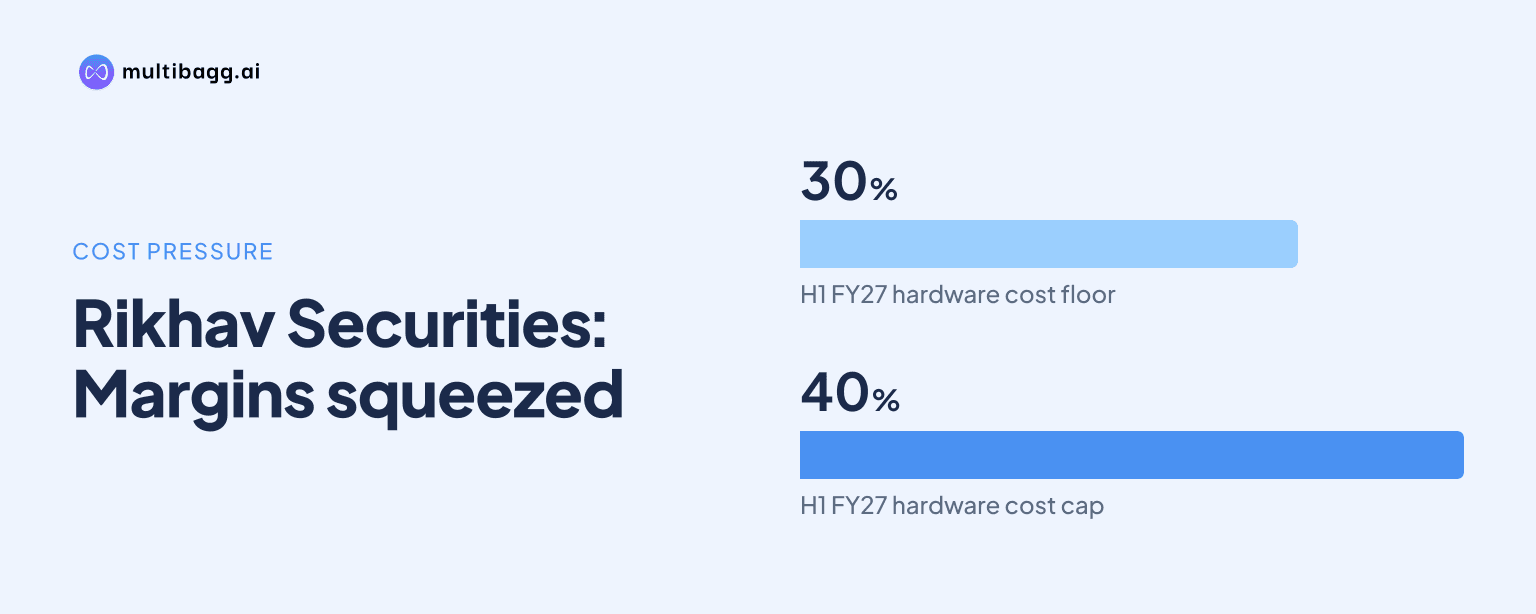
- Management said hardware costs had increased by around 30% to 40% and software-related remuneration could rise by around 10% to 15%.
- Rikhav Securities reported around Rs 50 lakh of institutional brokerage in H1 and expects around Rs 1.5 crore in the next six months.
powered by IRIS
Rikhav Securities Limited said H1 FY27 operating margins declined as income remained similar while regulatory financial costs, securities transaction tax, technology investment and employee expenses increased; an investor cited Rs 870 crore of total income and Rs 24 crore of EBITDA on the November 6, 2026 call.
Know Rikhav Securities inside out
Results, valuation, peers and who's buying, in one view.
Why did Rikhav Securities' H1 operating margin decline?
Rikhav Securities said its H1 FY27 operating margin declined because expenses rose while income remained at a similar level. Management gave that explanation after an investor referred to total income of around Rs 870 crore and EBITDA, or earnings before interest, tax, depreciation and amortisation, of around Rs 24 crore.
Management attributed the gap to higher costs rather than a specified fall in income. It said the market was weak and proportionate revenue had not increased sufficiently to absorb the expense base. The call did not provide a line-by-line income statement or a quantified split between proprietary trading, brokerage and other client-led income; management said it could provide the requested breakup within one or two days.
The comparison outlined on the call was between broadly similar income and increased expenses, not between two disclosed operating-margin periods. Rikhav Securities did not state a prior-year H1 margin, an operating-margin target, or the exact expense increase in each cost category.
Which costs did Rikhav Securities identify as the main pressures?
Rikhav Securities identified higher financial costs following changes in Securities and Exchange Board of India, or SEBI, rules, increased securities transaction tax, or STT, trading expenses, new information-technology systems and employee costs as the main pressures. Management also cited standard salary increases and the effect of new labour laws on its employee-cost base.
Technology expenditure covered more than one area. Management said it had invested in new computers and IT software, and later described server spending for institutional broking and exchange-traded fund, or ETF, market making. Those businesses require colocation support at the National Stock Exchange, or NSE, and BSE to support low-latency trading.
Rikhav Securities also cited point-to-point, or P2P, networking connections from its offices to NSE and BSE trading locations. Management said hardware costs had risen by around 30% to 40%, which it linked to increased hardware demand associated with artificial intelligence. It added that software-related remuneration could increase by around 10% to 15% as labour-related costs and market pay rise.
Is Rikhav Securities growing income fast enough to offset costs?
Rikhav Securities said income had not risen proportionately enough in a weak market to offset its H1 FY27 cost increase. Management did not quantify total-income growth against an earlier period, but said income remained similar while expenses increased, making cost absorption the key margin issue discussed on the call.
Management expects institutional brokerage to become an additional revenue stream. Rikhav Securities said institutional business produced around Rs 50 lakh of brokerage in the first half, and it expects around Rs 1.5 crore in the next six months and Rs 3 crore or more from the following year. It said it had empanelled around 15 banks and institutions, including Life Insurance Corporation of India and General Insurance Corporation of India.
Management separately expects around Rs 1.5 crore of annual brokerage from Life Insurance Corporation of India alone. Its broader target is Rs 5 crore of institutional-brokerage revenue annually within two years, alongside a projected 20% to 25% annual increase in existing business. These are management expectations rather than reported H1 FY27 revenue.
Rikhav Securities also named algorithmic trading and ETF market making as potential profitability drivers. Management said it had transferred most equity-market funds toward algorithmic trading, while ETF market making could receive additional capital if returns are favourable. The call did not disclose H1 FY27 profit or revenue from either activity.
Got a follow-up? Ask IRIS
How is Rikhav Securities using technology despite the cost pressure?
Rikhav Securities is using technology to automate processing, support institutional and ETF clients, and reduce manual intervention despite higher systems costs. Management said it is automating rectification, clarification and digital know-your-customer, or KYC, processes through artificial intelligence and standardised checks, with staff handling exceptional cases.
The company said digital onboarding had already improved client acquisition and that digital marketing could begin after March 2027. Its Rikhav Plus platform had around 10,000 daily active users and more than 18,000 created logins, according to management. Planned additions include charts, pay-in and pay-out functions, profit-and-loss reports, and application programming interface, or API, access within the next three months or next quarter.
For institutional broking and ETF market making, management said server capacity and exchange colocation are intended to accommodate new clients and support lower-latency trading. Rikhav Securities did not disclose an aggregate two- or three-year technology capital-expenditure budget, implementation cost, or quantified saving from automation.
What could change Rikhav Securities' margin trajectory next?
Rikhav Securities' margins could change if planned institutional revenue, digital client acquisition and trading businesses grow faster than regulatory, trading, technology and employee costs. Management said it aims to operate institutional business on a net-surplus basis from next year, while retail-focused digital marketing is planned after March 2027.
Market conditions remain relevant because management linked H1 FY27's limited income conversion to a weak market. Management said it expects the market to stabilise and improve, but this was its view rather than formal guidance. It also said it may consider capital augmentation in March or April if market conditions improve, particularly if demand for margin trading facility, or MTF, funding rises.
Conclusion
Rikhav Securities' H1 FY27 explanation is that income remained broadly similar while several expense lines increased at the same time. The investor-cited figures of around Rs 870 crore of income and Rs 24 crore of EBITDA show the scale discussed, but the call did not include an itemised expense bridge or a comparable prior-period margin.
The next disclosures to watch are management's expectation of around Rs 1.5 crore of institutional brokerage in the next six months, the planned start of digital marketing after March 2027, and a potential capital augmentation in March or April. A quantified update on technology spending, trading expenses and revenue from algorithmic trading and ETF market making would clarify whether these initiatives are improving cost absorption.