










Rikhav plans colocation as hardware costs rise 30%-40%
Key highlights
- Rikhav is acquiring servers, colocation and P2P links for institutional broking and ETF market making.
- Management said hardware costs have risen almost 30% to 40%.
- Rikhav reported about Rs 50 lakh of institutional brokerage in the first half of FY27.
- Management expects employee-related software costs to increase by 10% to 15%.
powered by IRIS
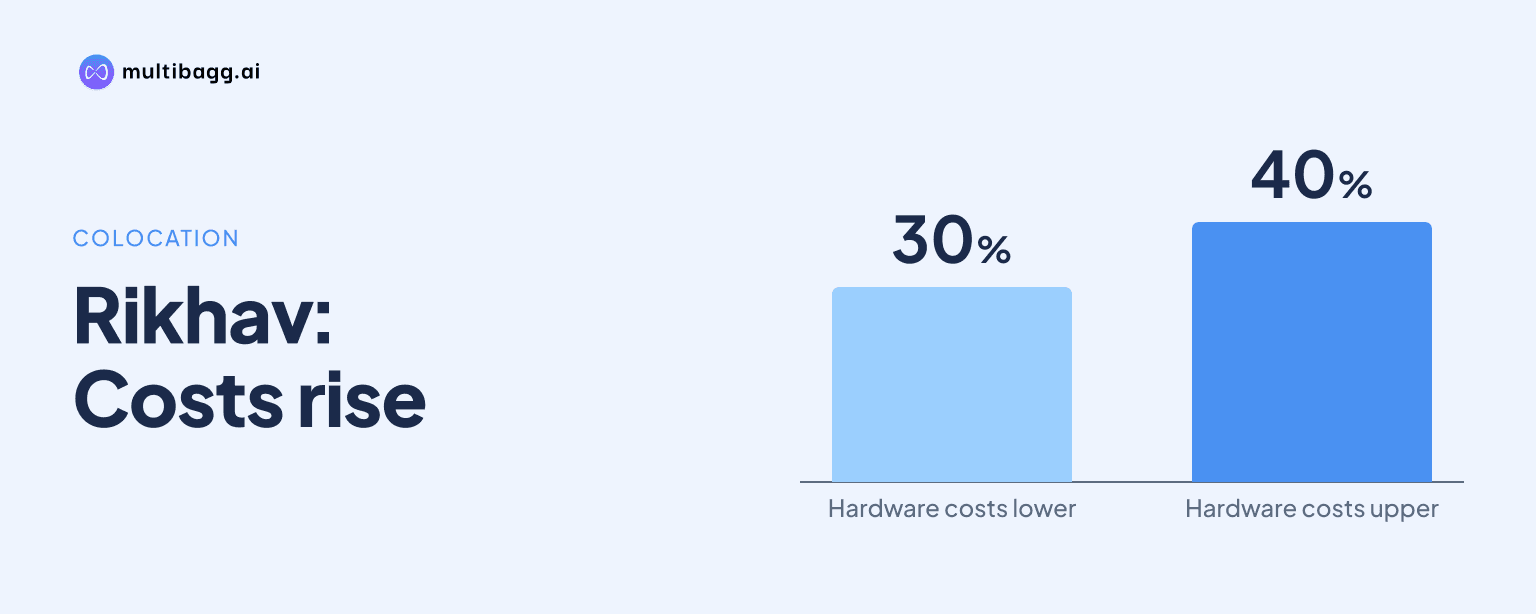
Rikhav Securities Limited is acquiring servers, exchange colocation and point-to-point network links for institutional broking and exchange-traded fund market making, while management said hardware costs have increased almost 30% to 40%. On the November 6, 2026 call, Rikhav linked the spending directly to the latency requirements of its two newer businesses.
Know Rikhav Securities inside out
Results, valuation, peers and who's buying, in one view.
What technology is Rikhav adding for institutional broking and ETF market making?
Rikhav is acquiring servers to accommodate clients in institutional broking and exchange-traded fund, or ETF, market making. Management said colocation support through NSE and BSE is required to support latency for these businesses, and described the server and colocation requirement as the major technology cost currently being incurred.
Rikhav is also spending on point-to-point, or P2P, connections between its offices and the locations where trades take place at NSE and BSE. Management identified these networking lines as the second infrastructure element after server and colocation expenditure. The transcript does not disclose a budget, server count, colocation capacity, implementation date or transaction-capacity target.
The company is separately building algorithmic-trading software through its in-house development team. Management said this software cost remains on par with the market, in contrast with the acquisition cost of hardware. It also said the base cost of employees would rise by 10% to 15%, citing new labour laws and higher basic remuneration.
Why does Rikhav need lower-latency exchange infrastructure?
Rikhav said the colocation and P2P links are intended to support the latency needs of institutional broking and ETF market making, rather than being a general upgrade for all brokerage operations. Management identified institutional business, algorithmic trading and ETF market making as the three expected contributors to incremental profitability.
ETF market making is being pursued as an arbitrage opportunity, according to management. It said more capital could be added to this activity if returns are good, but gave no revenue forecast, return target or dedicated capital allocation. Management also said it continues to look for new arbitrage strategies as market conditions and derivatives taxes evolve.
Institutional broking has only recently started, and management reported about Rs 50 lakh of brokerage in the first half of FY27. It expected about Rs 1.5 crore over the following six months and Rs 3 crore to Rs 4 crore from the business in the next year. Those figures are management expectations, not reported future results.
The comparison indicates a planned increase from Rs 50 lakh in the first half of FY27 to Rs 150 lakh in the subsequent six months, followed by Rs 300 lakh to Rs 400 lakh next year. Rikhav did not quantify how much of this expected increase depends on colocation, P2P connectivity, new clients or market conditions.
What is increasing Rikhav's technology and operating costs?
Rikhav said hardware costs have increased by almost 30% to 40%, which management attributed to rising demand associated with artificial intelligence. Management said it was still acquiring equipment at what it called reasonable rates through its channels, but did not provide a prior-period hardware-spending comparison, supplier information or total procurement expenditure.
Management said operating margins had declined because income remained similar while expenses increased. It cited higher financial costs after changes in Securities and Exchange Board of India rules, investment in computers and information-technology systems, higher trading expenses related to securities transaction tax and options, and employee-cost increases. It added that weak market conditions had limited proportional revenue growth.
The disclosed 10% to 15% expected increase in employee-related software costs adds to the 30% to 40% increase in hardware costs. However, Rikhav did not separate the financial effect of servers, colocation, P2P lines, in-house software development, employee remuneration or regulatory-related costs. The expense burden and the timing of its effect on margins therefore remain unquantified.
Got a follow-up? Ask IRIS
How does Rikhav expect technology spending to support growth?
Rikhav connects the infrastructure investment with onboarding clients in institutional broking and ETF market making. For existing business, management expects annual growth of 20% to 25%, and it projected the same 20% to 25% annual increase for institutional business after the next-year revenue expectation of Rs 3 crore to Rs 4 crore.
Management said it had reduced its exposure to the equity market and moved the majority of its funds toward algorithmic trading. It described algorithmic trading as providing safer and reasonable returns, but did not disclose the funds deployed, revenue earned or profitability from that activity. The call also did not provide a combined forecast for institutional broking, ETF market making and algorithmic trading.
Outside low-latency trading infrastructure, Rikhav is adding charts, pay-in and pay-out functions, and profit-and-loss reports to its Rikhav Plus platform. Management expected to provide application programming interfaces, or APIs, within the next three months or next quarter, allowing clients to use in-house software or third-party vendors.
Rikhav reported around 10,000 daily active app users and around 18,000 created logins. Management said digital onboarding had already improved customer acquisition and that it planned outreach through Meta, Google Ads and client interactions. These retail initiatives are separate from the colocation plan, which management specifically tied to institutional broking and ETF market making.
How is Rikhav managing trading and funding risks during expansion?
Rikhav said it uses an automated value-at-risk, or VAR, system to analyse risk on an order-to-order basis. Management said it assesses the risk exposure of each trade and mitigates it, while also maintaining risk profiles for each arbitrage and trading strategy. The company did not disclose risk limits, loss thresholds or strategy-level exposures.
Rikhav said it had adequate liquidity at present, but could increase capital if markets improve and demand rises for margin trading facility, or MTF, activity. Management said capital augmentation may be considered around March or April if market conditions improve. It did not state the amount of any potential capital raising.
The MTF book was about Rs 15 crore, and management said it could reach Rs 25 crore to Rs 30 crore in the next year if the market is good. Rikhav said it is expanding MTF selectively because of credit risk, using client and scrip exposure analysis. This is a separate funding and credit-risk consideration from the server and exchange-connectivity programme.
Conclusion
Rikhav’s technology programme is focused on servers, exchange colocation and P2P links needed for lower-latency institutional broking and ETF market making. The plan sits alongside in-house algorithmic-trading software and retail-platform upgrades, but its near-term cost backdrop includes hardware inflation of almost 30% to 40% and expected employee-related cost increases of 10% to 15%.
The next disclosed milestones are management’s expectation of about Rs 1.5 crore in institutional brokerage over the next six months and Rs 3 crore to Rs 4 crore in the following year. Investors can also watch for planned API availability within three months or the next quarter, potential capital augmentation around March or April, and broader retail digital marketing planned from April 2027.