










Rikhav shifts equity funds to algo trading, targets Rs 4 crore
Key highlights
- Rikhav said it moved the majority of equity-exposed funds towards algo trading.
- Rikhav expects Rs 3 crore to Rs 4 crore of institutional-business revenue from next year.
- Rikhav has empanelled about 15 institutions and expects about Rs 1.5 crore of annual brokerage from LIC.
- Rikhav reported H1 FY27 consolidated total income of Rs 869.07 crore and profit after tax of Rs 13.60 crore.
powered by IRIS
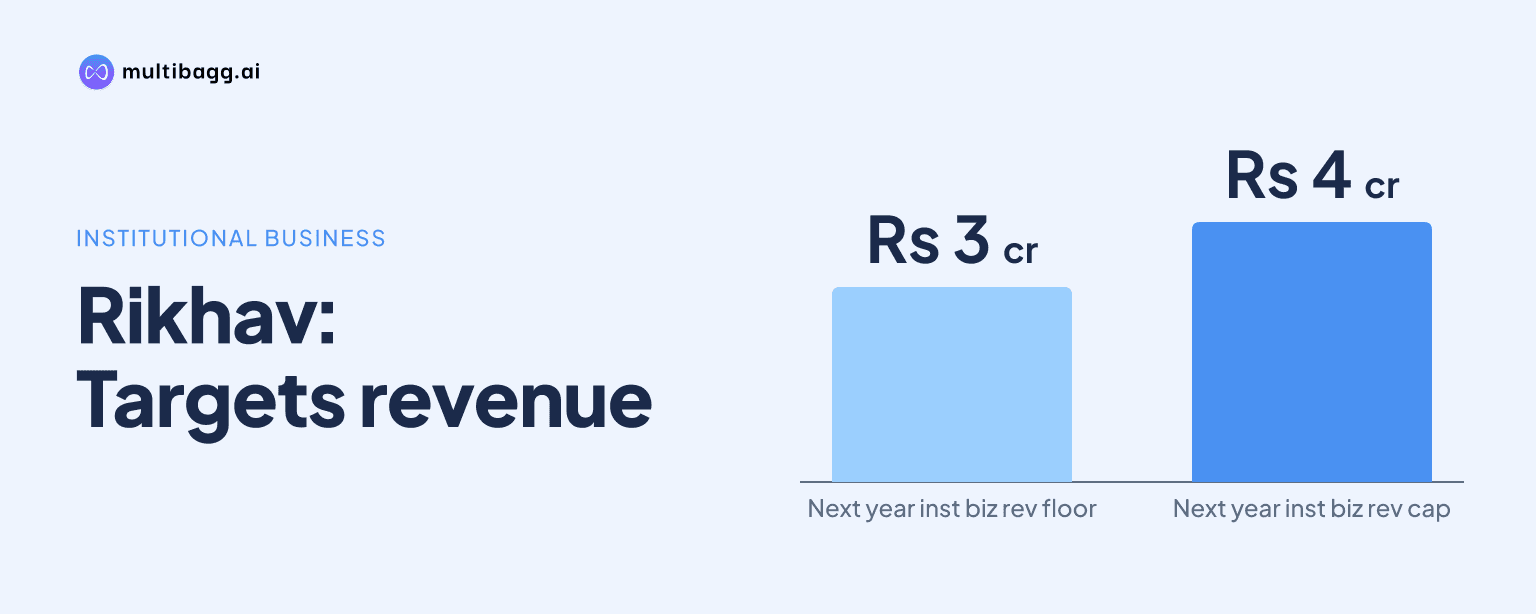
Rikhav Securities Limited said on November 6, 2026, that it had moved the majority of funds previously exposed to equities towards algo trading, while management expects Rs 3 crore to Rs 4 crore of institutional-business revenue from next year. The shift also includes exchange-traded fund, or ETF, market making and is intended to reduce sensitivity to market volatility.
Know Rikhav Securities inside out
Results, valuation, peers and who's buying, in one view.
How is Rikhav changing its capital allocation?
Rikhav is reducing direct equity-market exposure and redirecting the majority of those funds to algo trading, management said during the call. Management described algo trading as providing “rather safe and reasonable returns” and said the strategy is part of a move towards income sources that are remunerated more consistently amid volatile markets.
The company did not disclose the rupee value of equity exposure reduced, the capital assigned to algo trading, or the returns generated from the new allocation. It also did not provide a requested split between proprietary-trading income and client-driven income, including brokerage and services, saying it would provide that information within one or two days. The scale of the shift therefore cannot be measured against H1 FY27 consolidated total income of Rs 869.07 crore.
Which businesses is Rikhav prioritising for new income?
Rikhav identified institutional brokerage as its first expected driver of incremental profitability, followed by algo trading and ETF market making. It has commenced ETF market making and plans to add more asset management companies, while management said further capital deployment in that activity would depend on returns and the availability of new capital.
Institutional brokerage has the clearest disclosed targets. Rikhav said it had empanelled about 15 banks and institutions, including Life Insurance Corporation of India, or LIC, and General Insurance Corporation of India, or GIC. Management expects annual brokerage of about Rs 1.5 crore from LIC alone and plans to add 12 to 15 smaller institutions annually, while identifying State Bank Group as a prospective large relationship.
Management provided more than one target for institutional activity. It expects Rs 3 crore to Rs 4 crore of institutional-business revenue from next year and said this could increase by 20% to 25% annually. In another response, management said the institutional business could generate about Rs 5 crore of revenue within one year and set a target of Rs 5 crore in annual brokerage within two years.
How will Rikhav run algo trading and ETF market making?
Rikhav said ETF market making is based on arbitrage opportunities created by market discrepancies, while its algo-trading operation uses in-house software development. Management said it continues to adapt options-arbitrage strategies as derivatives-market conditions change, including after increases in futures and options, or F&O, taxes.
The operating model requires lower-latency trading infrastructure. Rikhav is acquiring servers and colocation support through the National Stock Exchange of India, or NSE, and BSE Limited, or BSE, for its institutional and ETF market-making activities. It is also building point-to-point network connections between offices and exchanges to support execution.
Management said hardware costs had risen by almost 30% to 40%, while employee-related software and remuneration costs could rise by 10% to 15%. Rikhav said it uses an automated value-at-risk, or VAR, system to assess exposure on each order, alongside defined risk profiles for each arbitrage and trading strategy. It did not disclose the capital assigned to ETF market making or individual algo strategies.
Got a follow-up? Ask IRIS
What do H1 FY27 results show about the transition?
Rikhav reported H1 FY27 consolidated total income of Rs 869.07 crore, earnings before interest, tax, depreciation and amortisation, or EBITDA, of Rs 24.47 crore, and profit after tax of Rs 13.60 crore. Earnings per share were Rs 3.55, while trading volume exceeded Rs 73,000 crore across equity, F&O and commodity segments during the half year.
The advisory vertical contributed Rs 3.15 crore in H1 FY27, adding an income stream alongside brokerage and trading. The expected Rs 3 crore to Rs 4 crore of institutional-business revenue from next year would therefore be smaller than the current total-income base, but management presents it as an additional source rather than a replacement for existing equity, derivative and commodity activity.
Management said operating margin had declined because income remained broadly unchanged while expenses increased. It cited Securities and Exchange Board of India, or SEBI, rule changes, higher finance costs, investment in computers and information-technology systems, higher trading expenses, labour-law changes and salary increases. These costs are relevant because the new algo and ETF activities also require servers, exchange connectivity and software development.
How does margin funding fit into Rikhav's plan?
Rikhav said its margin trading facility, or MTF, book was about Rs 15 crore and could reach Rs 25 crore to Rs 30 crore next year if market conditions are favourable. That implies an increase of Rs 10 crore to Rs 15 crore from the current book, although the outcome depends on market conditions rather than a fixed commitment.
Management said it is not expanding MTF rapidly because it is managing credit risk selectively. It monitors the security exposure of each client and moderates risk on that basis. The MTF book differs from the institutional-brokerage strategy because it requires funding capital, whereas institutional brokerage is expected to generate brokerage through newly empanelled clients.
Rikhav said it currently has adequate liquidity but may consider capital augmentation in March or April if market conditions improve. Management said extra capital could be needed if MTF demand rises or markets strengthen, and it separately linked further ETF market-making expansion to satisfactory returns. No fundraising amount, instrument or final timetable was disclosed.
What execution milestones has Rikhav set?
Rikhav said digital onboarding had already improved customer acquisition, and management plans to begin digital marketing after March 2027. It separately said retail expansion through digital marketing could start in April 2027. The company uses artificial intelligence, or AI, to automate standardised know-your-customer, or KYC, rectification and verification processes, with staff handling exceptions.
Rikhav reported a 99% retention rate among retail and high-net-worth individual clients, while stating that its institutional business had only just started. Beyond Maharashtra and Gujarat, it has begun operations in Uttar Pradesh, Punjab and Rajasthan. Management said branch and franchise expansion will remain selective because SEBI-related compliance makes franchise arrangements risk-sensitive.
Conclusion
Rikhav is repositioning part of its market-sensitive model by moving most equity-exposed funds towards algo trading and adding institutional brokerage and ETF market making. The strategy combines technology-led trading, institutional client acquisition and selective MTF growth, but the company has not disclosed the capital shifted, the proprietary-income contribution or returns from the new activities.
The next disclosed milestones are a potential capital-augmentation decision in March or April, the planned start of digital marketing after March 2027, and conversion of about 15 institutional empanelments into brokerage revenue. Management's Rs 3 crore to Rs 4 crore institutional-revenue expectation for next year and the possible increase in the Rs 15 crore MTF book will indicate how quickly the revised mix develops.