










Rikhav Securities targets Rs 5 crore institutional brokerage
Key highlights
- Rikhav Securities targets Rs 5 crore of annual institutional brokerage within two years.
- LIC is expected to generate nearly Rs 1.5 crore of brokerage per year for Rikhav Securities.
- Rikhav Securities had empanelled about 15 banks and institutions, including LIC and GIC.
- H1 FY27 profit after tax was Rs 13.60 crore on total income of Rs 869.07 crore.
powered by IRIS
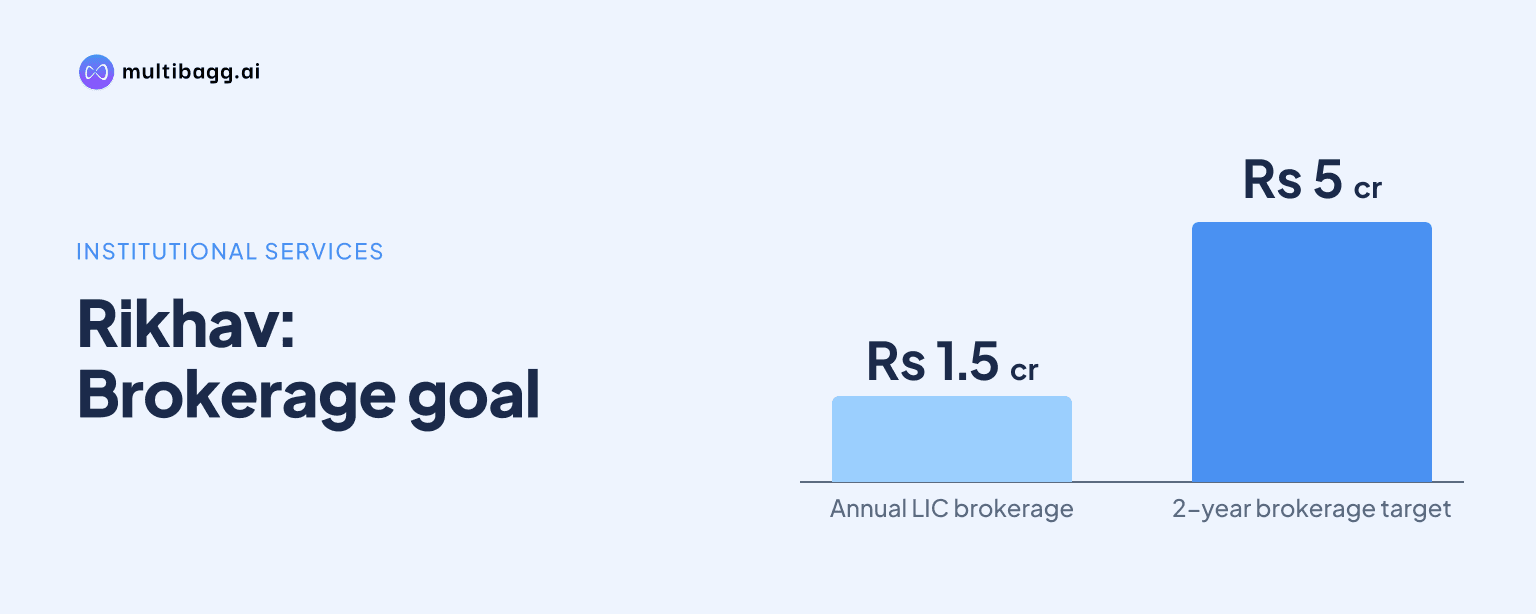
Rikhav Securities Limited said on November 6, 2026 that it is targeting Rs 5 crore of annual institutional brokerage within two years, supported by empanelment with LIC and GIC and management's expectation that LIC alone could generate nearly Rs 1.5 crore of brokerage a year.
Know Rikhav Securities inside out
Results, valuation, peers and who's buying, in one view.
What is Rikhav Securities' institutional brokerage target?
Rikhav Securities' stated target is Rs 5 crore in annual institutional brokerage within two years. Management gave the target during its H1 FY27 earnings call while explaining how its new research division would help it pursue banks, insurers and foreign portfolio investor-backed accounts.
The supplied transcript does not support the Rs 10 crore institutional-broking revenue target in the topic. Management made two separate comments: it said institutional business could earn about Rs 5 crore of revenue within one year, and later said brokerage business had a Rs 5 crore annual target within two years. The call did not explain whether the one-year figure includes income beyond brokerage.
The difference between the Rs 3 crore to Rs 4 crore expectation from next year and the Rs 5 crore annual brokerage target within two years indicates a staged build-up in management's plan. However, Rikhav Securities did not provide an institutional revenue base for H1 FY27, so the rate of progress toward either milestone cannot yet be measured from reported results.
Which institutional relationships has Rikhav Securities disclosed?
Rikhav Securities said it had empanelled about 15 banks and institutions by the November 6, 2026 call, including LIC and GIC. Management described LIC as one of its more remunerative clients and said it expected nearly Rs 1.5 crore in annual brokerage from that relationship.
Management also identified the SBI Group, or State Bank Group, as a prospective large institutional opportunity. The call did not say that SBI Group had been empanelled, begun trading or committed a revenue amount, distinguishing it from the disclosed LIC and GIC relationships.
Rikhav Securities plans to add about 12 to 15 small institutions every year. It did not disclose how many of the approximately 15 existing empanelled entities were active clients, when LIC or GIC would begin contributing, or a break-up of institutions among banks, insurers, mutual funds and foreign portfolio investors.
The company also did not report institutional trading volume, client assets or H1 FY27 brokerage from this segment. The disclosed figures are therefore management's pipeline and target indicators, rather than evidence of already reported recurring institutional revenue.
How will Rikhav Securities build institutional brokerage revenue?
Rikhav Securities said its research division will be a principal tool for targeting institutions. Management said the division had enabled the company to approach many institutions, while its institutional dealing team had hired Mr. Santosh, whom management described as having 20 years of institutional-dealing experience.
The stated model combines research coverage and dealing capability with the planned addition of 12 to 15 small institutions annually. Management did not disclose research coverage, commission schedules, execution volumes or the number of institutional dealers, so the financial contribution of these operating additions remains unquantified.
Rikhav Securities also placed institutional broking within a broader move toward what management described as more stable and recurring income sources. In H1 FY27, management said it was directing capital toward brokerage, institutional business, algorithmic trading and margin funding, while reducing equity-market exposure.
Management expects existing business to grow by 20% to 25% annually and said institutional business could also increase by 20% to 25% after it starts generating revenue. These are management expectations rather than formal guidance supported by a client-level revenue schedule, cost estimate or profitability forecast.
Got a follow-up? Ask IRIS
What financial and market conditions frame the plan?
Rikhav Securities reported H1 FY27 consolidated total income of Rs 869.07 crore, earnings before interest, tax, depreciation and amortisation, or EBITDA, of Rs 24.47 crore, and profit after tax of Rs 13.60 crore. Earnings per share were Rs 3.55, while the advisory vertical contributed Rs 3.15 crore during the half.
Rikhav Securities handled more than Rs 73,000 crore of trading volume across equity, futures and options, and commodities in H1 FY27. The company did not provide comparable prior-period figures or a client-segment split, leaving no disclosed measure of how institutional activity compares with retail, high-net-worth individual or proprietary trading activity.
Management said H1 FY27 was difficult for the broking industry because an April revision to securities transaction tax on derivatives moderated futures-and-options volumes and narrowed margins on some arbitrage and deleveraging strategies. It also said retail participation in the secondary market remained cautious, while frontline indices were broadly flat after a September correction.
Institutional business, algorithmic trading and exchange-traded fund, or ETF, market making were identified by management as expected contributors to incremental profitability. Rikhav Securities said it had commenced ETF market making and planned to add more asset management companies, but gave no revenue or capital target for that activity.
How does Rikhav Securities plan to support wider client growth?
Rikhav Securities said it had already implemented digital onboarding and expects to begin digital marketing after March 2027, with retail-business expansion planned from April 2027. Management said digital onboarding had improved customer acquisition, although it did not disclose additions, acquisition cost or active-client numbers.
The technology plan includes automating know-your-customer, or KYC, checks, rectification and clarification processes using artificial intelligence and standardised processes. Management said staff would handle the relatively rare cases that still require manual clarification, aiming to reduce manual intervention in onboarding.
For servicing, Rikhav Securities cited personalised dealer contact, product customisation and application programming interface, or API, access for clients with specific requirements. Management said it reported a 99% retention ratio among retail and high-net-worth individual clients, but did not disclose the measurement period, client count or revenue associated with that ratio.
Management also said it may consider capital augmentation around March or April if market conditions improve. It linked any additional capital need to demand for margin trading facilities and expansion of ETF market making, rather than announcing a fixed fundraising amount or instrument.
Conclusion
Rikhav Securities has disclosed a Rs 5 crore annual institutional-brokerage target within two years, not a Rs 10 crore target. LIC and GIC empanelment, an estimated Rs 1.5 crore annual LIC contribution, a base of about 15 empanelled institutions and planned research-led coverage form the disclosed basis for that strategy.
The next items to watch are management's expectation of Rs 3 crore to Rs 4 crore of institutional-business revenue from next year, annual additions of 12 to 15 small institutions and the distinction between its one-year Rs 5 crore institutional-revenue comment and two-year Rs 5 crore brokerage objective. Any capital decision around March or April, if markets improve, could also affect the pace of margin funding and ETF market-making expansion.