










RK SWAMY H1 profit rises 34% as EBITDA margin reaches 12%
Key highlights
- RK SWAMY’s H1 FY2027 profit after tax rose 34% to Rs 4.57 crore from Rs 3.41 crore.
- RK SWAMY’s H1 FY2027 EBITDA increased 22% to Rs 21.23 crore and reported EBITDA margin reached 12%.
- RK SWAMY’s H1 FY2027 total income increased 10% to Rs 172.43 crore.
- RK SWAMY disclosed FY27 capacity utilisation of 96% for CXC and 74% for CATI.
powered by IRIS
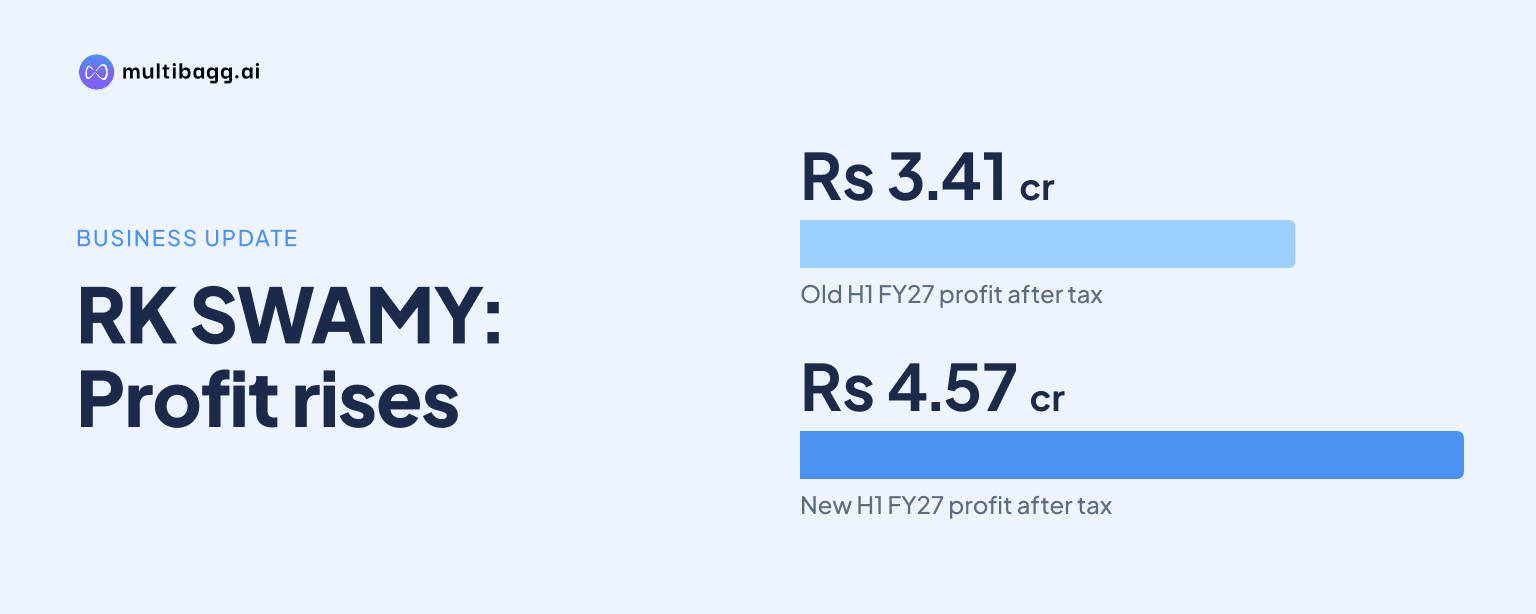
R K SWAMY reported H1 FY2027 profit after tax of Rs 4.57 crore, up 34% year on year, as EBITDA rose 22% to Rs 21.23 crore and the reported EBITDA margin increased to 12% from 11%. Total income grew 10% to Rs 172.43 crore, while profit before tax increased 26% to Rs 8.49 crore.
Know R K Swamy inside out
Results, valuation, peers and who's buying, in one view.
How did RK SWAMY’s H1 FY2027 earnings change?
RK SWAMY grew profit faster than income in H1 FY2027, with total income rising 10% to Rs 172.43 crore, EBITDA increasing 22% to Rs 21.23 crore, profit before tax rising 26% to Rs 8.49 crore and profit after tax increasing 34% to Rs 4.57 crore. In H1 FY2026, the comparable figures were Rs 156.63 crore, Rs 17.47 crore, Rs 6.73 crore and Rs 3.41 crore, respectively.
RK SWAMY’s gross margin, defined in the presentation as revenue from operations less operating expenses, increased by Rs 6.50 crore to Rs 111.05 crore in H1 FY2027 from Rs 104.55 crore a year earlier. The Rs 3.76 crore increase in EBITDA was recorded alongside a Rs 15.80 crore increase in total income, while the percentage growth rates were 22% and 10%, respectively.
The reported margin measures also increased during H1 FY2027. EBITDA margin rose to 12% from 11%, profit-before-tax margin rose to 5% from 4%, and profit-after-tax margin rose to 3% from 2%. RK SWAMY says all figures and percentages in the half-yearly statement are rounded to the nearest whole number, limiting the precision available from the displayed margin movements.
What explains RK SWAMY’s reported EBITDA margin of 12%?
RK SWAMY’s presentation reports a 12% EBITDA margin for H1 FY2027, versus 11% in H1 FY2026, but does not quantify the contribution of individual cost or revenue drivers. It defines the measure as EBITDA including other income divided by total income, which was Rs 172.43 crore in H1 FY2027. The reported ratio is therefore not presented as a margin calculated solely on revenue from operations.
The financial statement shows EBITDA rising to Rs 21.23 crore from Rs 17.47 crore as total income rose to Rs 172.43 crore from Rs 156.63 crore. That 22% EBITDA increase exceeded the 10% increase in total income, coinciding with the one-percentage-point reported margin change. The supplied pages do not provide an operating-expense breakdown, the amount of other income, or profitability by service line for H1 FY2027.
RK SWAMY’s margin-path slide identifies fixed-cost absorption from expansion and capacity addition, artificial intelligence and technology efficiencies across disciplines, and a revenue-mix shift toward high-margin services as mechanisms for improved cash flow and margins. The slide labels its FY26 base as approximately 15.5% EBITDA margin, but does not reconcile that figure with the separately reported 11% H1 FY2026 EBITDA margin or specify savings from each mechanism.
Got a follow-up? Ask IRIS
How did RK SWAMY’s Q2 FY2027 performance compare?
RK SWAMY reported 13% year-on-year total-income growth in Q2 FY2027, exceeding the 10% H1 growth rate, with quarterly income reaching Rs 86.62 crore from Rs 76.38 crore. Q2 EBITDA rose 19% to Rs 10.31 crore from Rs 8.67 crore, while the reported EBITDA margin was 12%, compared with 11% in Q2 FY2026.
Quarterly profit before tax increased 26% to Rs 3.95 crore in Q2 FY2027 from Rs 3.13 crore, the same percentage increase reported for H1. Q2 profit after tax rose 106% to Rs 1.11 crore from Rs 54 lakh, compared with H1 profit-after-tax growth of 34%. The presentation nevertheless shows profit-after-tax margin at 1% in both Q2 periods because its percentages are rounded to whole numbers.
RK SWAMY’s Q2 gross margin was Rs 54.55 crore, compared with Rs 51.92 crore in Q2 FY2026, an increase of Rs 2.63 crore. Total income increased by Rs 10.24 crore over the same comparison. The quarterly statement reports the income, gross-margin and profit measures, but does not identify the business segment or cost item behind their differing growth rates.
What margin-expansion plan has RK SWAMY disclosed?
RK SWAMY describes FY25 and FY26 as an investment phase in which it expanded capacity in CXC and CATI, two capacity measures whose full forms are not provided in the presentation. For FY27, the utilisation stage lists CXC capacity utilisation of 96% and CATI capacity utilisation of 74%, together with strengthening leadership and capabilities. The gap between the two utilisation figures is 22 percentage points.
For FY28 and beyond, RK SWAMY says it plans to create capacity in newer geographies within India and extend offerings to new clients. Management’s disclosed route from the FY26 base to improved cash flow and margins relies on fixed-cost absorption, technology efficiencies and scaling high-margin services. The presentation does not provide a date-specific margin target, earnings forecast or capital-spending amount for these actions.
RK SWAMY also identifies healthcare as an area for expansion, stating that it already serves more than 20 leading pharmaceutical companies and hospital chains. Its listed actions include increasing specialist medical-support capabilities, expanding live and online continuing medical education programmes, and taking healthcare communication to providers across India. The supplied pages do not disclose healthcare revenue, margins or a timetable for these initiatives.
Conclusion
RK SWAMY’s H1 FY2027 results show income growth of 10% to Rs 172.43 crore alongside faster increases in EBITDA, profit before tax and profit after tax of 22%, 26% and 34%, respectively. Reported EBITDA margin rose from 11% to 12%, while the reported pre-tax and post-tax margins each increased by one percentage point.
The next operational markers disclosed by RK SWAMY are FY27 utilisation of 96% for CXC and 74% for CATI after the FY25-FY26 investment phase. For FY28 and beyond, management plans additional capacity in newer Indian geographies and offerings for new clients, while the stated margin path depends on fixed-cost absorption, technology efficiencies and a shift toward high-margin services.