










RNFI loan collection revenue rises 268.33% through H1 FY27
Key highlights
- RNFI’s delinquent loan collection revenue rose 268.33% to Rs 43.61 crore in H1 FY27 from Rs 11.84 crore in H1 FY25.
- RNFI’s gross insurance premium mobilised increased 573.19% to Rs 57.76 crore in H1 FY27.
- RNFI’s CRA Business gross transactional volume grew 54.39% to Rs 12,344.96 crore in H1 FY27.
- RNFI reported 149,494 active Sahayaks in Q2 FY27, up 11.17% year on year.
powered by IRIS
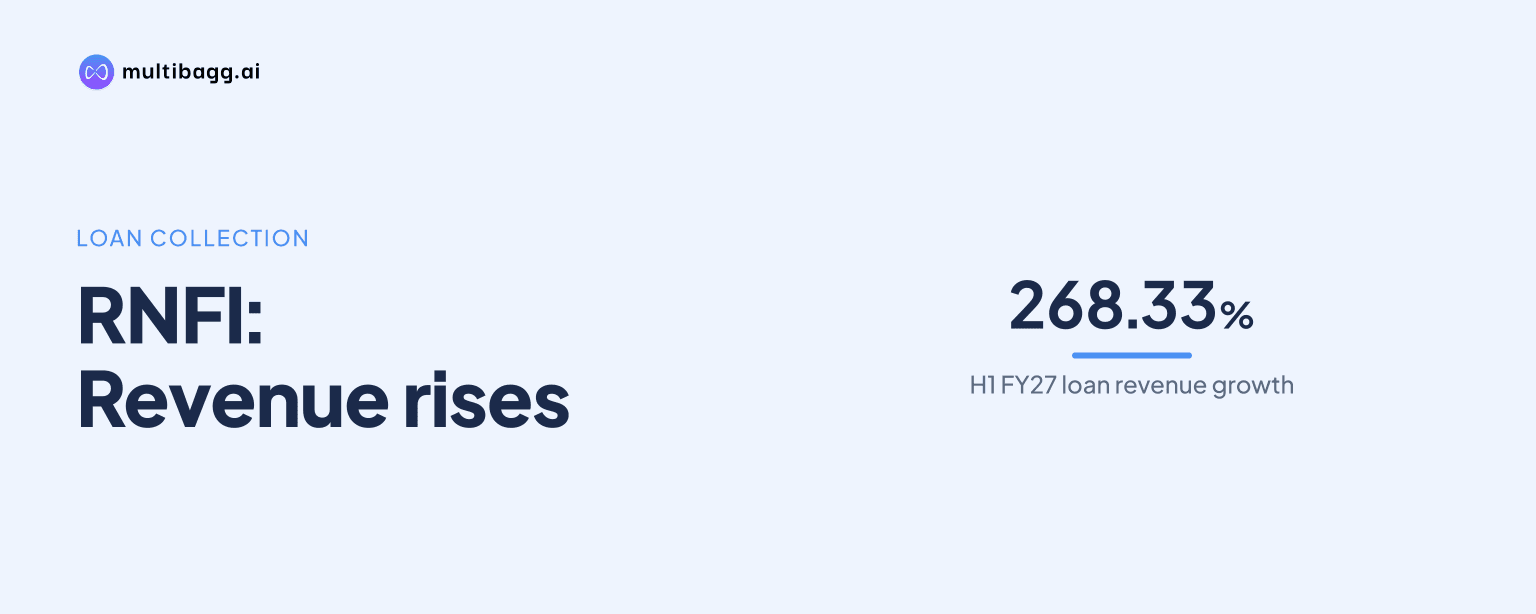
RNFI Services Limited reported Rs 43.61 crore of delinquent loan collection revenue in H1 FY27, 268.33% above Rs 11.84 crore in H1 FY25, while gross insurance premium mobilised rose 573.19% to Rs 57.76 crore. The figures show the reported scaling of two businesses introduced in RNFI’s diversification programme three years ago.
Know RNFI Services inside out
Results, valuation, peers and who's buying, in one view.
How much did RNFI’s loan collection revenue grow?
RNFI’s revenue from delinquent loan collection increased by Rs 31.77 crore between H1 FY25 and H1 FY27, reaching Rs 43.61 crore from Rs 11.84 crore. The company reported this as growth of 268.33% across the two half-year periods. The measure is specifically labelled revenue from operations in RNFI’s H1 FY27 presentation.
The loan-collection vertical is described as delinquent loan collection, and RNFI’s H1 FY27 achievements included an agreement with Indian Overseas Bank to act as a Fee-on-Street agency for collection and recovery. The presentation does not disclose the agreement’s value, duration or commercial terms, so its direct contribution to the Rs 43.61 crore of H1 FY27 revenue cannot be determined from the disclosed material.
Why did insurance show the highest percentage increase?
Insurance recorded RNFI’s highest reported percentage increase among the three disclosed diversification measures, with gross premium mobilised rising by Rs 49.18 crore to Rs 57.76 crore in H1 FY27 from Rs 8.58 crore in H1 FY25. RNFI states the increase as 573.19%. Gross premium mobilised is the measure disclosed for this vertical, rather than insurance revenue.
RNFI identifies insurance as one of three growth verticals introduced three years ago, alongside delinquent loan collection and the CRA Business. The presentation says RNFI invested in technology infrastructure, specialised talent and operational capabilities to build those businesses. It also lists ReliAssure Insurance Brokers Pvt. Ltd. as the group entity holding a composite insurance broker authorisation, in a category containing 69 entities according to the presentation.
What changed in RNFI’s CRA Business?
RNFI’s CRA Business gross transactional volume rose 54.39% to Rs 12,344.96 crore in H1 FY27 from Rs 7,995.89 crore in H1 FY25. That represents an increase of Rs 4,349.07 crore, measured as gross transactional volume rather than revenue or premium. Its percentage increase was below the reported rates for loan collection and insurance, while its disclosed rupee volume was larger.
The H1 FY27 presentation records a CRA tie-up with a leading private-sector bank under capability-building achievements. RNFI also reported empanelment as a business correspondent with a private-sector bank, appointment as a corporate business correspondent of a Gramin Bank, and empanelment as a corporate business correspondent with a public-sector bank. The company does not identify the banks in these three items or quantify the volumes generated by each arrangement.
Got a follow-up? Ask IRIS
What was RNFI’s diversification plan?
RNFI says it expanded beyond its core business three years ago by adding delinquent loan collection, insurance and the CRA Business. Its stated sequence was diversification first, followed by investment in technology infrastructure, specialised teams, banking partnerships and integration, and then business outcomes including recovery performance, premium mobilisation and increased gross transactional volume.
The H1 FY27 data provide RNFI’s reported outcome measures for that plan: Rs 43.61 crore of collection revenue, Rs 57.76 crore of insurance premium mobilisation and Rs 12,344.96 crore of CRA transactional volume. RNFI describes these as results of strategic investments, but the presentation does not provide expenditure on those investments, segment profit, margins or a time-bound target for any of the three verticals. The figures therefore show changes in operating measures rather than standalone profitability.
How does RNFI’s distribution activity support diversification?
RNFI reported 149,494 active Sahayaks in Q2 FY27, up 11.17% from 134,478 in Q2 FY26. Growth was fastest among Sahayaks selling four or more products, where the count rose 42.48% to 14,929 from 10,478. The two-product and three-product groups increased 13.32% and 18.17%, respectively, while the one-product group rose 4.38% to 77,811.
RNFI also reported 146 total clients in H1 FY27, compared with 130 in FY26 and 82 in FY25. Its product-countwise partner data show 110 partners with one product, 26 with two products and 10 with three or more products after additions in H1 FY27. These measures do not allocate Sahayaks, clients or partners to loan collection, insurance or the CRA Business, but they record a larger multi-product base during the period in which the newer verticals expanded.
Conclusion
RNFI’s disclosed diversification measures show different forms of growth between H1 FY25 and H1 FY27. Insurance had the highest percentage increase at 573.19%, loan-collection revenue rose 268.33% to Rs 43.61 crore, and CRA gross transactional volume increased 54.39% to Rs 12,344.96 crore. Revenue, premium mobilisation and transactional volume are distinct measures and are not directly interchangeable.
The next disclosures to watch are the execution of the H1 FY27 banking arrangements, including the Indian Overseas Bank collection-and-recovery agency agreement and the CRA tie-up with a private-sector bank. RNFI has not disclosed targets, contract values, segment earnings or the contribution of these arrangements, while its Q2 FY27 active-Sahayak count of 149,494 provides a further operating measure for future updates.