










RNFI monthly ARPU rose 33% to Rs 1,721 as cross-sell grew
Key highlights
- RNFI reported monthly ARPU of Rs 1,721 in H1 FY27, up 33% from Rs 1,294 in H1 FY26.
- Active RNFI Sahayaks using four or more products rose 42.48% to 14,929 in Q2 FY27.
- RNFI's total active Sahayak count increased 11.17% to 149,494 in Q2 FY27.
- RNFI reported 146 total clients in H1 FY27, compared with 130 in FY26.
powered by IRIS
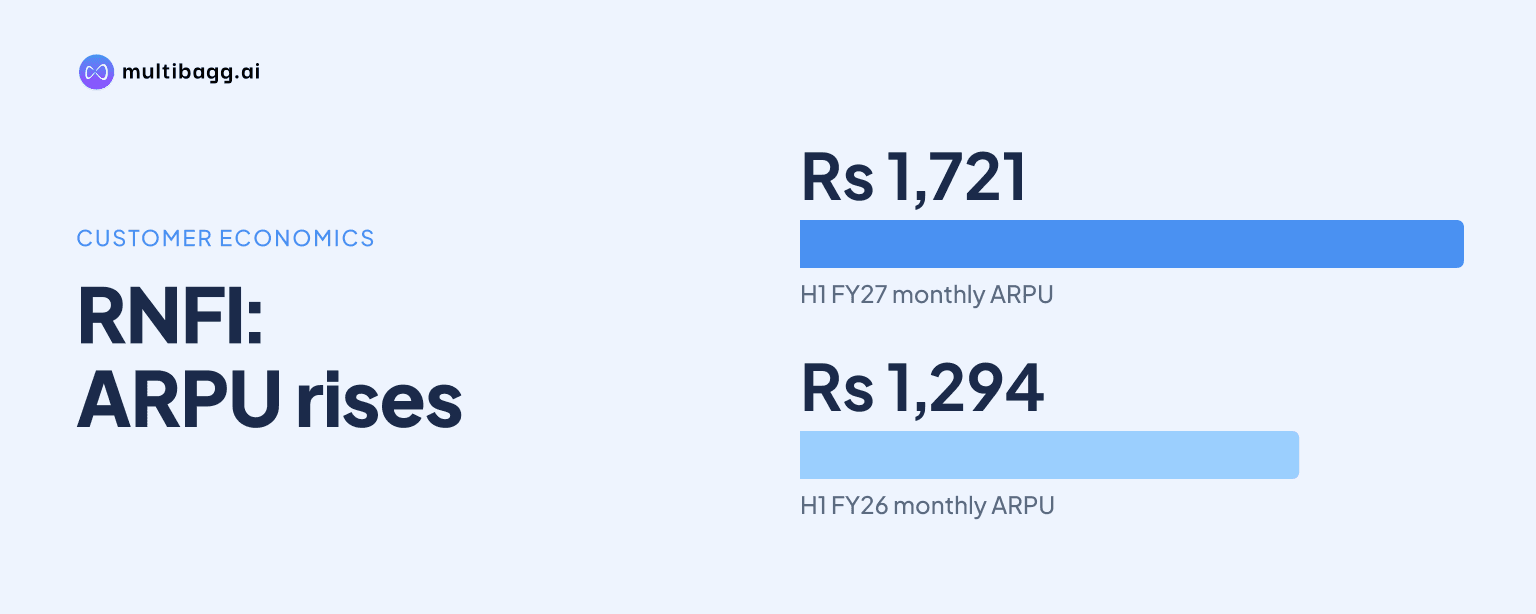
In H1 FY27, RNFI Services Limited reported average revenue per Sahayak of Rs 1,721 a month, 33% above Rs 1,294 in H1 FY26, while active Sahayaks using four or more products rose 42.48% year on year to 14,929 in Q2 FY27. The two measures cover different reporting periods.
Know RNFI Services inside out
Results, valuation, peers and who's buying, in one view.
How much did RNFI's multi-product Sahayak base grow?
RNFI's active Sahayak base using four or more products grew to 14,929 in Q2 FY27 from 10,478 in Q2 FY26, an increase of 42.48%. This was the fastest percentage increase among the four product-use groups shown in the presentation. Total active Sahayaks rose 11.17% to 149,494 from 134,478, so the four-plus-product group grew faster than the overall network.
Growth was concentrated in categories with more product use. The one-product group remained the largest, at 77,811 Sahayaks in Q2 FY27, but added 3,265 Sahayaks from Q2 FY26. The four-plus-product group added 4,451 Sahayaks from a smaller base of 10,478, while the two-product and three-product groups added 4,630 and 2,670 respectively.
What does RNFI's ARPU data show about monetisation?
RNFI reported average revenue per Sahayak, or ARPU, of Rs 1,721 a month in H1 FY27, compared with Rs 1,294 in H1 FY26, a reported increase of 33%. The difference between the two half-year periods was Rs 427 per Sahayak per month. ARPU is RNFI's disclosed measure of monthly revenue generated per Sahayak.
The ARPU and cross-sell disclosures both show higher network productivity measures, but they cannot establish product-level revenue contribution. ARPU compares H1 FY27 with H1 FY26, whereas the product-use data compares Q2 FY27 with Q2 FY26. RNFI does not disclose revenue generated by its 14,929 four-plus-product Sahayaks or state how much of the Rs 427 ARPU increase arose from that cohort.
The relative pace of the two measures is also different. ARPU increased 33% in the H1 comparison, while four-plus-product Sahayaks increased 42.48% in the Q2 comparison and the total active network increased 11.17%. The presentation supports an observed rise in both revenue per Sahayak and multi-product usage, rather than a stated causal connection between them.
How is RNFI expanding product cross-sell with clients and partners?
RNFI reported 146 total clients in H1 FY27, compared with 130 in FY26 and 82 in FY25. The H1 FY27 figure was 16 above FY26 and 64 above FY25. Its historical client-count series records 54 clients in FY24, 30 in FY23, 17 in FY22 and five in FY21.
RNFI's product-countwise partner table records 16 additions in H1 FY27, taking the total to 146 from 130 till FY26. Of those additions, 13 were one-product partners, two were two-product partners and one was a three-or-more-product partner. The resulting totals were 110 one-product partners, 26 two-product partners and 10 partners using three or more products.
The partner and Sahayak measures are separate disclosures. The table showing 10 three-or-more-product partners at H1 FY27 does not represent the same population as the table showing 14,929 active four-plus-product Sahayaks in Q2 FY27. RNFI labels one measure as partners and the other as active Sahayaks, and it uses different product-count thresholds of three-plus and four-plus.
Got a follow-up? Ask IRIS
What other H1 FY27 metrics did RNFI report?
RNFI reported growth in three businesses that it said it introduced three years earlier: delinquent loan collection, insurance and CRA business. Delinquent loan collection revenue from operations increased to Rs 43.61 crore in H1 FY27 from Rs 11.84 crore in H1 FY25, or 268.33%. Insurance gross premium mobilised rose to Rs 57.76 crore from Rs 8.58 crore, or 573.19%.
CRA gross transactional volume increased 54.39% to Rs 12,344.96 crore in H1 FY27 from Rs 7,995.89 crore in H1 FY25. RNFI said it had invested in technology infrastructure, specialised talent, operational capabilities, banking partnerships and integrations to build these verticals. The presentation identifies recovery performance, premium mobilisation and increased gross transactional volume as the current outcomes.
At the overall level, RNFI reported H1 FY27 revenue of Rs 547.9 crore, compared with Rs 471.4 crore in H1 FY26. Gross profit increased to Rs 111.8 crore from Rs 89.2 crore, and gross profit margin rose to 20.4% from 18.9%. Overall EBITDA, or earnings before interest, tax, depreciation and amortisation, rose to Rs 30.2 crore from Rs 28.6 crore, while EBITDA margin moved to 5.5% from 6.1%.
Profit after tax was Rs 15.1 crore in H1 FY27 versus Rs 14.6 crore in H1 FY26, while the reported margin was 2.8% versus 3.1%. Non-forex revenue increased to Rs 251.1 crore from Rs 220.7 crore, while forex revenue increased to Rs 296.8 crore from Rs 250.7 crore. The figures show revenue growth in both segments, alongside a decline in the reported overall EBITDA and profit-after-tax margins.
Conclusion
RNFI's H1 FY27 presentation shows a higher reported monthly revenue per Sahayak alongside faster growth in the four-plus-product Sahayak cohort than in the total active network. ARPU rose 33% to Rs 1,721 per month, and the four-plus-product cohort rose 42.48% to 14,929 in Q2 FY27, compared with 11.17% growth in all active Sahayaks. The disclosure indicates deeper product usage and higher reported revenue productivity, although it does not provide revenue by product-count group.
The presentation does not disclose a forward ARPU target, a target for multi-product Sahayaks, or a scheduled reporting milestone beyond H1 FY27. The next relevant evidence will therefore be whether subsequent disclosures retain the H1 FY27 ARPU measure of Rs 1,721 and the Q2 FY27 pattern in which four-plus-product Sahayaks grew faster than the 149,494-member active network.