










Robokidz cuts Maharashtra revenue share to 53.04% in FY26
Key highlights
- Maharashtra represented 53.04% of Robokidz revenue in FY26, down from 89.86% in FY24.
- Delhi generated Rs 18.64 crore for Robokidz in FY26, equal to 19.99% of revenue.
- Robokidz reported FY26 revenue generated of Rs 93.22 crore, versus Rs 58.75 crore in FY25.
- Kerala, Gujarat and Uttar Pradesh contributed a combined 15.89% of Robokidz FY26 revenue.
powered by IRIS
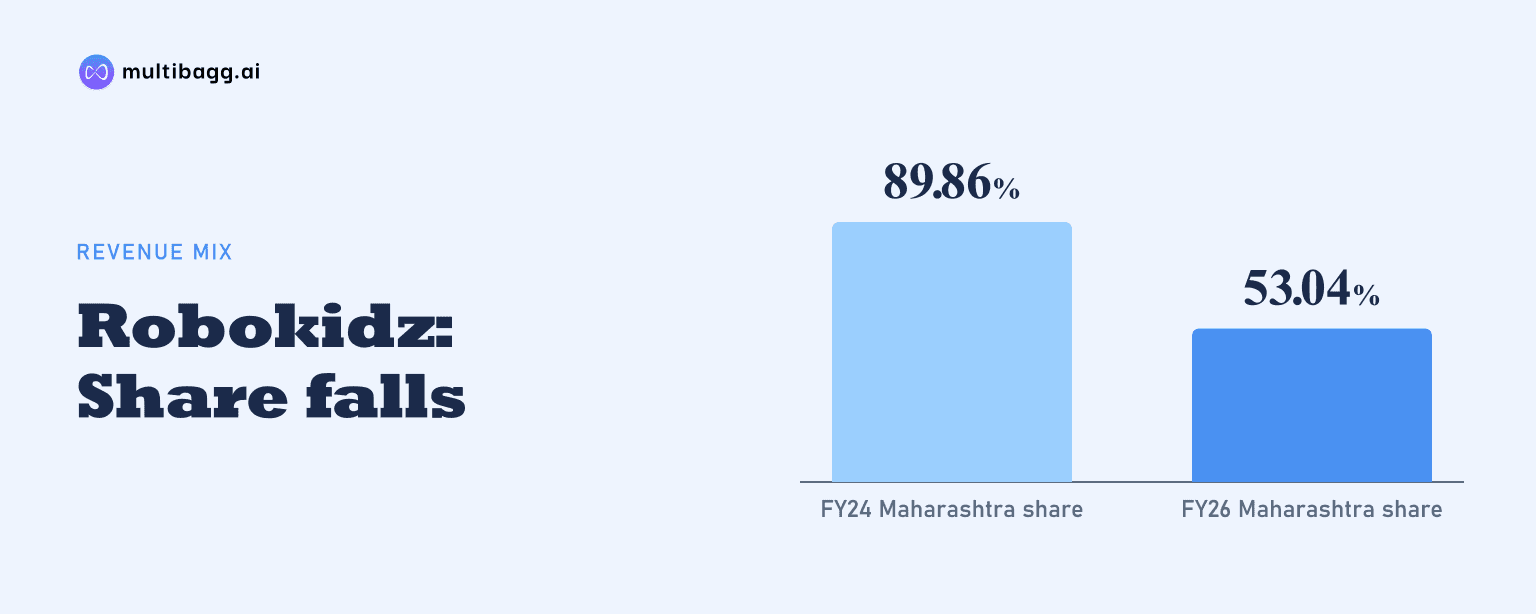
ROBOKIDZ cut Maharashtra’s share of revenue from operations to 53.04% in fiscal year 2026 (FY26), from 89.86% in FY24, as Delhi generated Rs 18.64 crore, or 19.99% of FY26 revenue. Total revenue generated was Rs 93.22 crore in FY26, although that period is consolidated while earlier data are standalone.
Know Robokidz Eduventures inside out
Results, valuation, peers and who's buying, in one view.
How did Robokidz’s Maharashtra dependence change?
Robokidz’s Maharashtra share fell by 36.82 percentage points between FY24 and FY26, based on its disclosed state-level revenue mix. Maharashtra generated Rs 49.45 crore in FY26, compared with Rs 34.30 crore in FY24. Revenue from the state increased over the two fiscal years, but its share of the total declined as revenue elsewhere expanded.
The change was also marked between FY25 and FY26. Maharashtra generated Rs 51.28 crore and represented 87.28% of revenue in FY25, before reported revenue declined to Rs 49.45 crore and its share fell to 53.04% in FY26. Robokidz says it operates in more than 25 states and presents the wider footprint as reducing single-region exposure.
The reporting basis changed in the geographic disclosure. FY26 state revenue is labelled consolidated, while FY25 and FY24 figures are labelled standalone. The reduction in Maharashtra’s revenue share is evident in the reported mix, but comparisons of revenue amounts across the three fiscal years should account for the differing reporting scope.
Which states became material revenue markets for Robokidz?
Delhi became Robokidz’s second-largest disclosed market in FY26, generating Rs 18.64 crore and accounting for 19.99% of revenue from operations. This compared with Rs 60.91 lakh, or 1.04%, in FY25 and Rs 52.90 lakh, or 1.39%, in FY24.
Kerala, Gujarat and Uttar Pradesh also represented material FY26 markets. Kerala generated Rs 6.31 crore, or 6.77% of revenue, Gujarat produced Rs 4.91 crore, or 5.27%, and Uttar Pradesh generated Rs 3.59 crore, or 3.85%. Together, these three states accounted for 15.89% of FY26 revenue, in addition to Delhi’s 19.99% share.
Rajasthan contributed Rs 2.04 crore in FY26, while Karnataka generated Rs 1.49 crore. Tripura and Madhya Pradesh each generated Rs 1.19 crore, and other states collectively contributed Rs 4.43 crore, or 4.75% of revenue. These markets added to the non-Maharashtra portion of the company’s FY26 revenue mix.
Did Robokidz grow revenue while broadening its geographic mix?
Robokidz reported total revenue generated of Rs 93.22 crore in FY26, compared with Rs 58.75 crore in FY25 and Rs 38.17 crore in FY24. Maharashtra’s reported revenue was Rs 49.45 crore in FY26, below Rs 51.28 crore in FY25, while the total reported revenue base was higher in FY26.
Delhi recorded the largest disclosed increase among the leading non-Maharashtra markets, rising from Rs 60.91 lakh in FY25 to Rs 18.64 crore in FY26. Kerala increased from Rs 34.76 lakh to Rs 6.31 crore, Gujarat rose from Rs 2.05 crore to Rs 4.91 crore, and Uttar Pradesh increased from Rs 1.54 crore to Rs 3.59 crore over the same periods.
Revenue outside Maharashtra represented 46.96% of FY26 revenue, compared with 12.72% in FY25 and 10.14% in FY24, based on the reported Maharashtra shares. The disclosed mix indicates that the expansion beyond Maharashtra was spread across several states: Kerala, Gujarat and Uttar Pradesh together generated Rs 14.80 crore in FY26.
Got a follow-up? Ask IRIS
What business model supports Robokidz’s multi-state delivery?
Robokidz says its integrated model combines laboratory setup, curriculum, training and support through one provider. The company describes the delivery cycle as covering assessment, infrastructure, content, training and support, with standardised protocols and tools intended to enable work across geographies.
Laboratory setup projects in artificial intelligence, robotics and science, technology, engineering and mathematics, or STEM, were Robokidz’s top revenue contributor for three straight fiscal years, according to the presentation. The company also identifies procurement, logistics and deployment capabilities as operating functions supporting projects for schools, colleges and government programmes across India.
The digital offering includes a learning management system, or LMS, that provides structured content, assignments, assessments and student-performance tracking. Drag-on.ai is Robokidz’s proprietary coding platform for classroom and laboratory-based learning, while its kit portfolio includes Paper Circuits, 3D Pen, Renewable Energy, Mechbotix, Woodtots and Autobotix products.
Which Robokidz plans could change the state mix next?
Robokidz plans to expand institutional laboratory deployments across Tier I and Tier II institutions through its track record and channel network. Management says its combination of laboratories, curriculum, training and support is designed to generate recurring subscription revenue after the initial deployment.
The company also plans to expand in the private-school segment through integrated robotics, artificial intelligence and STEM laboratories. Its disclosed subscription services include the LMS, Drag-on.ai, curriculum updates and annual maintenance contracts, or AMC, with direct engagement in Tier I and Tier II cities intended to build longer-term school partnerships.
In experiential learning, Robokidz plans to expand direct-to-consumer workshops and modular programmes delivered offline, online or in hybrid formats. Four Young Engineers’ Academy activity centres are already operating, comprising two company-owned and two franchise centres, while the company also plans technology upgrades and modular artificial intelligence, internet of things and robotics content.
Conclusion
Robokidz’s FY26 geographic data shows a substantially broader revenue profile. Maharashtra remained its largest disclosed market at 53.04% and Rs 49.45 crore, but Delhi reached 19.99% and Rs 18.64 crore, while Kerala, Gujarat and Uttar Pradesh collectively contributed 15.89% of FY26 revenue. Total revenue generated rose to Rs 93.22 crore from Rs 58.75 crore in FY25, subject to the consolidated-versus-standalone reporting difference.
The next point to watch is whether management’s planned Tier I and Tier II laboratory deployments, private-school expansion and subscription services add revenue across further states. Robokidz has four Young Engineers’ Academy centres in operation and plans franchise expansion, but the presentation does not disclose state-level revenue targets or a timetable for future geographic mix changes.