










Robokidz H1 FY27 PAT rose 395% as total income grew 182%
Key highlights
- Robokidz reported H1 FY27 standalone PAT of Rs 6.85 crore, up 394.82% year on year.
- Robokidz's H1 FY27 standalone total income rose 182.27% to Rs 52.37 crore.
- Robokidz's H1 FY27 standalone EBITDA increased 195.30% to Rs 11.53 crore.
- Robokidz listed on the BSE SME platform on September 28, 2026, raising Rs 31.09 crore.
powered by IRIS
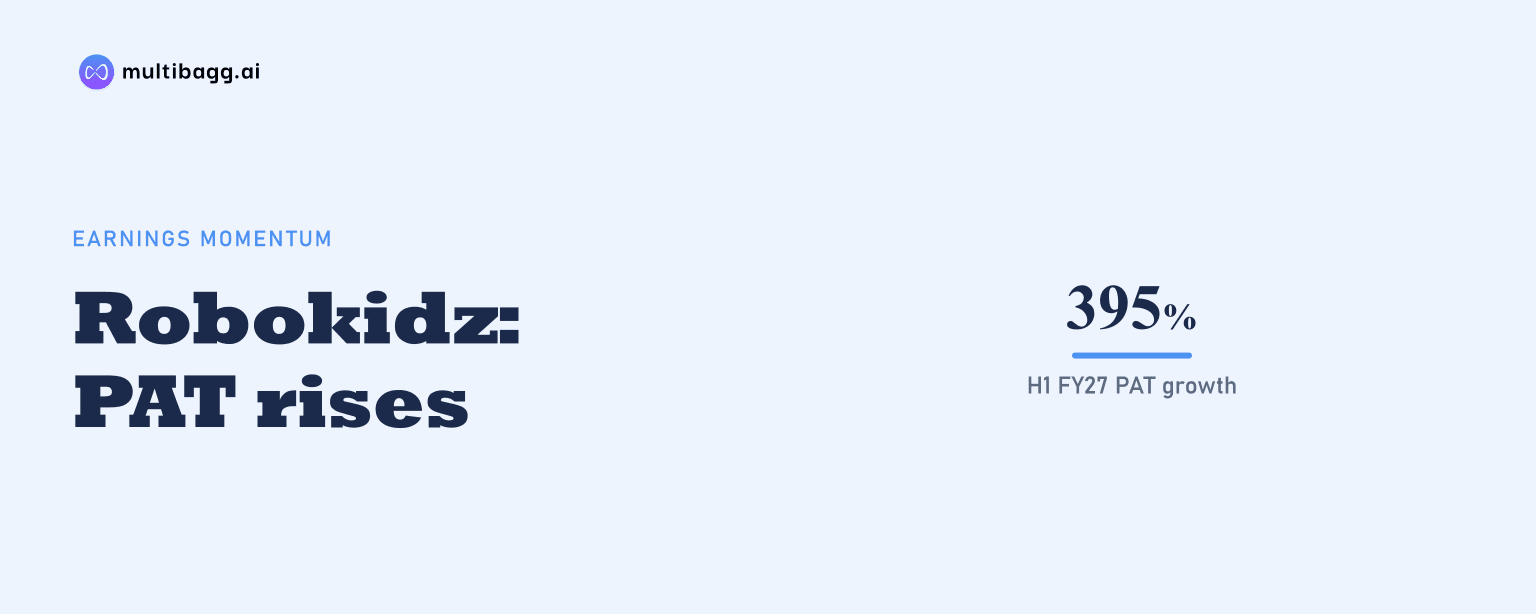
Robokidz Eduventures Limited reported H1 FY27 standalone profit after tax (PAT) of Rs 6.85 crore, up 394.82% year on year, while total income increased 182.27% to Rs 52.37 crore. Earnings before interest, tax, depreciation and amortisation (EBITDA) rose 195.30% to Rs 11.53 crore, and management reported a 22.0% EBITDA margin.
Know Robokidz Eduventures inside out
Results, valuation, peers and who's buying, in one view.
How did Robokidz's H1 FY27 income and profit change?
Robokidz's standalone PAT increased from Rs 1.39 crore in H1 FY26 to Rs 6.85 crore in H1 FY27, while total income rose from Rs 18.55 crore to Rs 52.37 crore. The 394.82% increase in PAT exceeded the 182.27% increase in total income, showing that profit grew faster than the top line during the reported period.
Revenue from operations was Rs 52.19 crore in H1 FY27, compared with Rs 18.26 crore in H1 FY26. Other income declined to Rs 18.30 lakh from Rs 29.64 lakh, meaning revenue from operations accounted for nearly all of the increase in the Rs 52.37 crore standalone total income figure.
EBITDA rose from Rs 3.91 crore in H1 FY26 to Rs 11.53 crore in H1 FY27, an increase of 195.30%. Profit before tax increased 281.91% to Rs 9.38 crore from Rs 2.45 crore, before tax expense rose to Rs 2.52 crore from Rs 88.68 lakh.
What caused Robokidz's H1 FY27 margin expansion?
Robokidz's management attributed the H1 FY27 result to an EBITDA margin of 22.0% and a net-profit margin of 13.1%, with the latter expanding by more than 560 basis points. One basis point equals one-hundredth of a percentage point, and the margin disclosures accompanied standalone total income of Rs 52.37 crore and PAT of Rs 6.85 crore.
Cost of goods sold remained Robokidz's largest expense, increasing to Rs 37.25 crore in H1 FY27 from Rs 13.36 crore in H1 FY26. Employee benefits expense rose to Rs 1.36 crore from Rs 78.84 lakh, while other expenses increased to Rs 2.24 crore from Rs 49.63 lakh.
Total expenses reached Rs 40.84 crore in H1 FY27, compared with Rs 14.65 crore in H1 FY26, leaving EBITDA of Rs 11.53 crore. Below EBITDA, depreciation and amortisation declined to Rs 19.46 lakh from Rs 20.88 lakh, whereas finance cost increased to Rs 1.96 crore from Rs 1.24 crore.
The stated margin movement can also be compared with the FY26 reference figures in the company overview. Robokidz reported a FY26 EBITDA margin of 17.77% and a PAT margin of 10.79%, compared with management's H1 FY27 figures of 22.0% and 13.1%, respectively.
Got a follow-up? Ask IRIS
How did Robokidz's consolidated H1 FY27 result compare?
Robokidz reported consolidated H1 FY27 PAT of Rs 7.93 crore, exceeding its standalone PAT of Rs 6.85 crore by Rs 1.08 crore. Consolidated total revenue was Rs 60.86 crore, compared with Rs 52.37 crore of standalone total income in the same H1 FY27 period.
Consolidated revenue from operations was Rs 60.67 crore and other income was Rs 19.35 lakh. Consolidated EBITDA was Rs 13.93 crore, while total expenses were Rs 46.94 crore, compared with standalone EBITDA of Rs 11.53 crore and expenses of Rs 40.84 crore.
The presentation supplies no H1 FY26 consolidated statement, so it does not disclose a year-on-year growth rate for consolidated H1 FY27 revenue, EBITDA or PAT. Its year-on-year comparisons, including 394.82% PAT growth and 182.27% total-income growth, apply to the standalone statement.
Robokidz identifies Robokidz Retails Private Limited as a wholly owned subsidiary that operates the Young Engineers Academy, or YEA, franchise model. The presentation does not provide a segment-wise split of revenue or profit across educational laboratory setup projects, subscription-based learning programmes, other educational services and YEA.
What is Robokidz planning after H1 FY27?
Robokidz said it is expanding the YEA network through three new centres in Pune at Amanora Park Town, Weikfield Chambers and City Vista. Management said the planned expansion is part of its focus on bringing learning programmes closer to more students through the YEA activity-centre network.
Management also said it aims to expand institutional partnerships and strengthen digital platforms, educational kits and programme delivery. Robokidz's institutional offer combines laboratory solutions, curriculum, teacher training and ongoing learning programmes, while its two-tier revenue architecture uses laboratory setup projects to establish engagements and subscription services plus other educational services to support continuing relationships.
Robokidz listed on the BSE SME platform on September 28, 2026, raising Rs 31.09 crore through its initial public offering. Management said the proceeds will strengthen working capital and reduce borrowings; the presentation lists an issue price of Rs 106 and a listing price of Rs 201.40, a 90% gain over the issue price.
The presentation also states that the initial public offering was subscribed more than 834 times. While management has identified institutional partnerships, digital platforms, kits and programme delivery as areas of focus, it has not disclosed a numerical target or timetable for revenue, margins, centre additions, working capital or borrowing reduction.
Conclusion
Robokidz's H1 FY27 standalone results show PAT rising more quickly than total income, with PAT reaching Rs 6.85 crore on total income of Rs 52.37 crore. EBITDA increased to Rs 11.53 crore, while management reported EBITDA and net-profit margins of 22.0% and 13.1%, respectively, alongside the increase in operating scale.
The next disclosed developments to watch are management's use of the Rs 31.09 crore initial public offering proceeds for working capital and borrowing reduction, and the rollout of three Pune YEA centres. Management has also outlined plans to build institutional partnerships and digital platforms, but the presentation gives no quantified targets or scheduled milestones for those initiatives.