










Rupa targets 20% H2 growth as hosiery price war persists
Key highlights
- Rupa reported H1 FY27 revenue of Rs 522.8 crore, up 3.7% year on year.
- Rupa agreed that its FY27 growth ambition implies roughly 20% revenue growth in H2 FY27.
- Q2 FY27 EBITDA rose 15.9% to Rs 26 crore while revenue was nearly flat at Rs 320.4 crore.
- Thermal wear grew more than 30% in Q2 FY27, while modern trade contributed 5% of business.
powered by IRIS
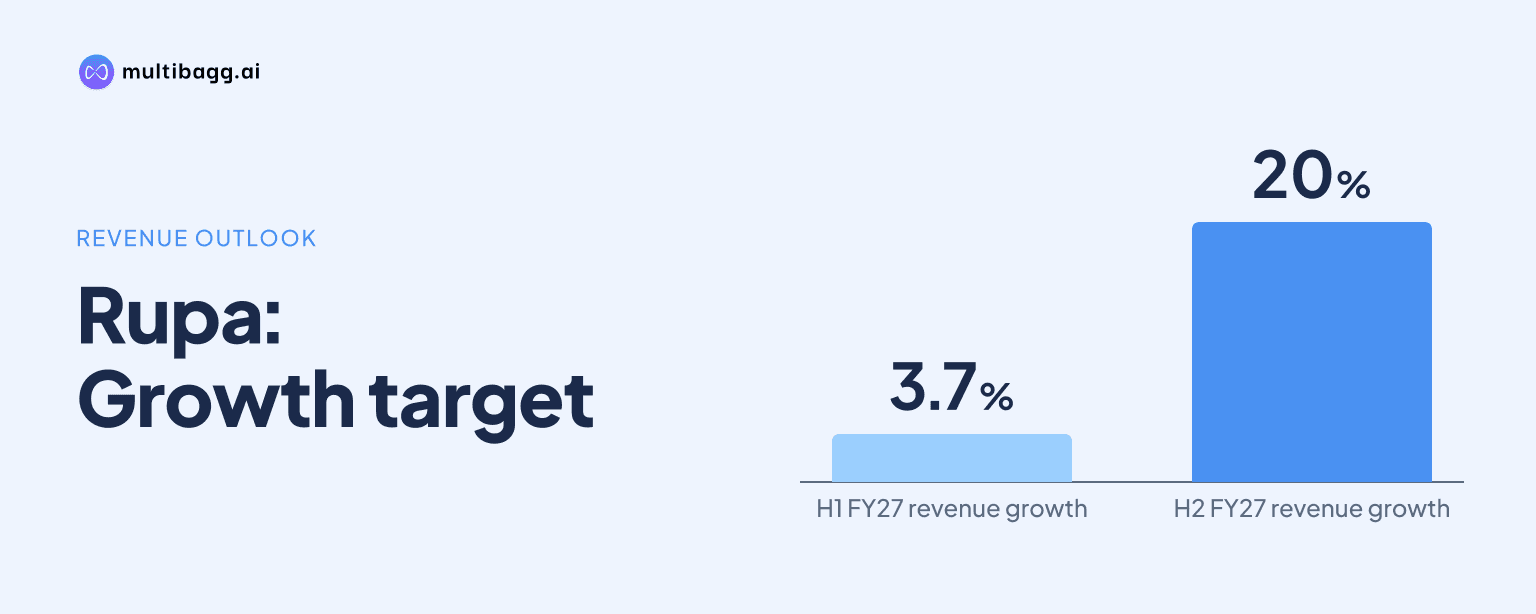
Rupa & Company Limited is targeting roughly 20% year-on-year revenue growth in H2 FY27 to support management’s around 10% full-year growth ambition, even as it says hosiery competition remains intense on schemes, discounts and credit days; H1 FY27 revenue rose 3.7% to Rs 522.8 crore.
Know Rupa & Company inside out
Results, valuation, peers and who's buying, in one view.
Can Rupa deliver 20% revenue growth in H2 FY27?
Rupa is targeting a marked H2 FY27 acceleration, because management agreed that roughly 20% growth over H2 FY26 would be required to achieve its around 10% FY27 revenue-growth ambition. During the November 3, 2026 earnings call, the Chief Financial Officer said the company was hopeful of delivering this growth for the year.
An investor calculated that FY26 revenue of around Rs 1,260 crore and H2 FY26 revenue of around Rs 750 crore would imply H2 FY27 revenue of about Rs 880 crore. When asked whether this meant a roughly 20% year-on-year H2 target, management answered yes, making the calculation consistent with its stated full-year ambition.
The required pace is materially above Rupa’s H1 FY27 performance. Revenue rose 3.7% to Rs 522.8 crore in H1 FY27 from Rs 504.1 crore a year earlier, while Q2 FY27 revenue was nearly unchanged at Rs 320.4 crore against Rs 320.2 crore in Q2 FY26.
Is hosiery competition still affecting Rupa?
Yes, Rupa said hosiery competition remained intense at the November 3, 2026 call, with a price war operating through schemes, discounts and extended customer credit. Management confirmed that the competitive intensity had not improved from the preceding quarter.
Rupa did not quantify the sales effect of discounting or the value of additional credit extended during Q2 FY27. However, management described receivables and credit days as a major challenge, meaning its H2 FY27 growth plan is being pursued amid continuing pressure on both realised prices and working-capital requirements.
Whole-Time Director Vikash Agarwal said the challenge was not specific to Rupa and affected major brands across the industry. He cited high raw-material prices and said management expected conditions to improve in coming quarters, although the call gave no date or specified pricing catalyst for that improvement.
How did Rupa increase profit despite flat Q2 revenue?
Rupa increased Q2 FY27 profit through higher gross margin and lower costs despite revenue remaining almost flat year on year. Earnings before interest, tax, depreciation and amortisation, or EBITDA, increased 15.9% to Rs 26 crore, while profit after tax, or PAT, rose 17.4% to Rs 17 crore.
The Chief Financial Officer attributed the 110-basis-point Q2 EBITDA-margin increase to a gross-margin improvement of about 30 basis points, lower advertising expense and savings in other expenses. Advertising cost fell to 4.7% of revenue in Q2 FY27 from 5.1% in Q2 FY26, while other expenses accounted for roughly 40 basis points of savings.
H1 FY27 EBITDA rose 20.4% to Rs 41.7 crore from Rs 34.6 crore, outpacing the 3.7% revenue increase. PAT increased 25.9% to Rs 25.3 crore from Rs 20 crore, lifting the H1 PAT margin to 4.8% from 4.0% in H1 FY26.
Got a follow-up? Ask IRIS
Which categories and channels could support Rupa’s H2 plan?
Thermal wear and athleisure are the categories Rupa identified as contributors to H2 FY27 execution. Management said thermal wear grew more than 30% in Q2 FY27, while athleisure recorded encouraging traction during the quarter.
Rupa said modern trade contributed 5% of overall business in Q2 FY27 and provided an opportunity to diversify distribution. Its stated actions include expanding the distribution network, strengthening secondary sales and building a sales leadership and execution team with experienced industry professionals.
Management presented these measures as medium- to long-term drivers of revenue growth and margin improvement through a better product mix. The call did not disclose thermal or athleisure revenue, category profitability, or a target share for modern trade beyond the 5% Q2 contribution.
What investment and working-capital demands accompany Rupa’s plan?
Rupa’s board has approved Rs 83 crore of capital expenditure to be spent over the next 2 to 2.5 years. The plan allocates Rs 58 crore to a factory-cum-warehouse at West Bengal Hosiery Park and Rs 25 crore to a warehouse and accessories-storage facility dedicated to modern trade.
Working capital increased by almost Rs 75 crore between March 2026 and September 2026, according to management. The Chief Financial Officer said borrowings increased to meet that working-capital requirement, linking the funding change to the higher capital tied up in operations.
The transcript did not disclose the September 2026 borrowing balance, interest cost, receivable days or a commissioning date for the Rs 83 crore projects. The 2 to 2.5-year expenditure period indicates that the facilities are a longer-term operational plan rather than a stated driver of H2 FY27 revenue.
Conclusion
Rupa’s FY27 objective requires a substantial shift in revenue momentum: H1 sales rose 3.7% and Q2 sales were flat, while management agreed that H2 growth of roughly 20% is needed. At the same time, Q2 EBITDA margin improved to 8.1% from 7.0%, despite ongoing discount, scheme and credit competition in hosiery.
The next disclosed milestones are management’s around 10% FY27 revenue-growth ambition and around 9% EBITDA-margin ambition, alongside thermal wear’s performance after more than 30% Q2 growth. Investors can also monitor the Rs 83 crore capital-expenditure programme and whether the almost Rs 75 crore working-capital increase leads to further borrowing during its 2 to 2.5-year spending period.