










RUPA Plans to Double Regional, Value Stores and Launch D2C Site
Key highlights
- RUPA reports a modern-retail network of more than 1,500 stores.
- RUPA plans to double regional and value large-format store count with a major focus on southern Indian states.
- rupabrands.com is in the final stage of launch as one online home for all RUPA brands.
- RUPA is modernising logistics through an integrated SAP, order-management and warehouse-management platform.
powered by IRIS
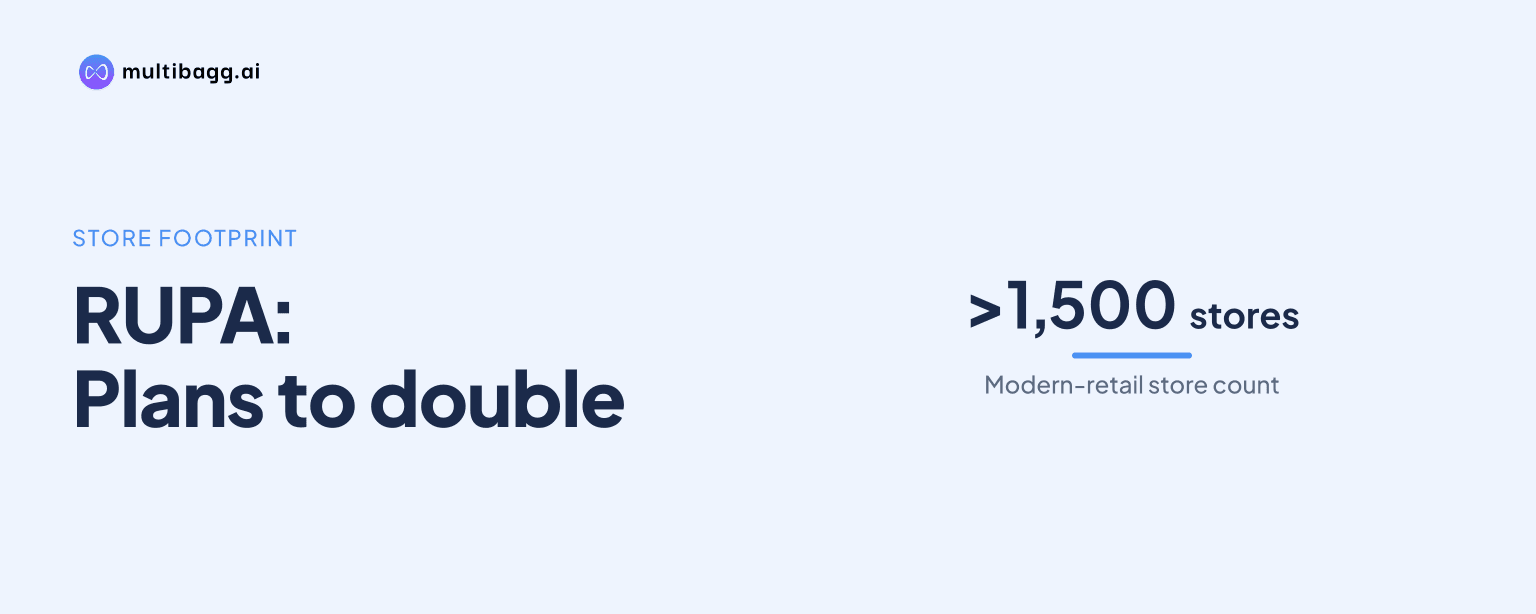
RUPA plans to double its regional and value large-format store count from an existing modern-retail network of more than 1,500 stores, while rupabrands.com is in the final stage of launch as one online home for its brands. The strategy combines southern-state physical expansion with integrated SAP, order-management and warehouse-management systems.
Know Rupa & Company inside out
Results, valuation, peers and who's buying, in one view.
What is RUPA's modern retail base?
RUPA's disclosed modern-retail base is more than 1,500 stores, served through retailers including D-Mart, Reliance, METRO Cash & Carry, Walmart and STYLE BAAZAAR. This is the only current physical-store figure in the presentation, and it covers the modern-retail network rather than separately identifying regional stores, value large-format stores or each retailer's contribution.
RUPA says the network strategy is to increase brand footprints across all brands and create product lines that are more relevant for modern trade. The presentation does not quantify the number of brands, stock-keeping units or store-level product lines involved. It does identify Macroman M-Series, Macrowoman W-Series, Softline, Bumchums, Torrido and Thermocot within its recent strategic initiatives.
The physical-distribution plan also calls for technology-driven warehouse infrastructure and additional brand visibility through Space on Hire. RUPA does not provide a warehouse count, capital-spending amount or implementation deadline for these measures. The stated mechanisms indicate that the store strategy extends beyond outlets to product assortment, operational handling and in-store visibility.
How will RUPA expand regional and value stores?
RUPA's future plan is to double the store count in regional and value large-format stores, with major focus on southern Indian states. The presentation does not state the starting store count specifically for these two formats, so it does not establish that the total modern-retail network will rise from more than 1,500 to more than 3,000 stores. It also gives no target date for the doubling plan.
The format focus distinguishes the next physical expansion from RUPA's broader existing modern-retail footprint. The current network is described through national and large retail names such as Reliance, Walmart and D-Mart, while the future plan specifically highlights regional and value large-format stores. This is a comparison across distribution segments: the base is the full 1,500-plus modern-retail network, whereas the doubling target applies only to the named regional and value-format subset.
Southern India is the only geography singled out for the domestic store programme. RUPA does not list the southern states, name regional retail partners or disclose the number of outlets expected in the area. Management's plan therefore establishes direction and format priority, but leaves the pace, state allocation and revenue contribution of the expansion unresolved.
How is RUPA rebuilding online fulfilment?
RUPA is modernising logistics and warehousing through an integrated SAP platform plus an order management system and warehouse management system, referred to as OMS/WMS. According to the presentation, the intended operating result is real-time inventory visibility and automated order flow. These are process objectives, not disclosed performance outcomes, and RUPA gives no current fulfilment-time, cancellation-rate or inventory-accuracy metric.
The technology plan is tied to the same distribution agenda as the 1,500-plus store network because both address order execution. In physical modern trade, RUPA says it seeks to avoid revenue loss through improved OTO; online, the specified mechanism is automated order flow through SAP and OMS/WMS integration. The presentation does not provide a financial estimate for revenue at risk or savings from either process change.
RUPA also says it is building a reporting system to track its brands, competitors and market trends. That reporting capability sits alongside warehouse and logistics modernisation rather than being presented as a separate sales channel. The source does not identify the reports' frequency, data providers, users or competitive measures to be monitored, but it makes brand intelligence one of the stated digital-transformation actions.
Got a follow-up? Ask IRIS
What is RUPA's marketplace and D2C plan?
RUPA says it is present on leading marketplaces and is expanding into fashion and beauty, with Myntra, Nykaa and AJIO identified for onboarding. Its online channel display also includes Amazon, Flipkart and Tata CLiQ. The change described is from broad marketplace availability to a stated effort to reach fashion and lifestyle shoppers through the three specifically named platforms.
Quick commerce is another part of the plan, with Blinkit, JioMart, SWIGGY, D-Mart Ready and zepto shown in the presentation. RUPA's future plan is to scale up on quick-commerce platforms, but it provides neither a current number of active quick-commerce listings nor a sales target. This separates quick commerce from conventional marketplaces, even though both can use the proposed inventory and order-management infrastructure.
RUPA's direct-to-consumer, or D2C, site is rupabrands.com, which the presentation says is in the final stage of launch. Management describes it as one online home for all RUPA brands and intends to grow it into the single online home for RUPA. The future plan also includes launching RUPA brands globally on Amazon.com, scaling e-commerce-exclusive ranges across brands, and using return-on-investment-driven advertising and content marketing across e-commerce portals.
The online plan therefore has three routes: third-party marketplaces, quick-commerce services and RUPA's own D2C site. Unlike the physical-store plan, which contains the quantified objective of doubling a format-specific store count, the digital plan supplies no target for site visitors, online sales, marketplace orders or advertising returns. That difference limits direct measurement of execution until RUPA discloses operating results.
Conclusion
RUPA has set out a distribution overhaul built around a reported base of more than 1,500 modern-retail stores and a format-specific plan to double regional and value large-format stores. Its physical and digital programmes are linked by special modern-trade product lines, warehouse modernisation, real-time inventory objectives and automated order flow, while marketplaces, quick commerce and rupabrands.com provide separate routes to customers.
The next points to watch are evidence of the southern-state rollout, the initial launch of rupabrands.com and progress in onboarding Myntra, Nykaa and AJIO. Management has also outlined global Amazon.com launches, e-commerce-exclusive ranges and scaled quick-commerce activity, but the presentation gives no timetable, regional-store baseline, sales target or fulfilment metric against which to assess these plans.