










Rupa & Company Limited Reports Flat Q2 FY27 Revenue Growth
Key highlights
- Rupa reported Q2 FY27 revenue of INR 3.204 billion, compared with INR 3.202 billion in Q2 FY26.
- Rupa outlined approximately INR 0.830 billion of capex over about two to two-and-a-half years.
- Approximately INR 0.580 billion of the planned capex is for a warehouse in Western India.
- Approximately INR 0.250 billion is planned for warehouse and storage facilities supporting modern trade.
powered by IRIS
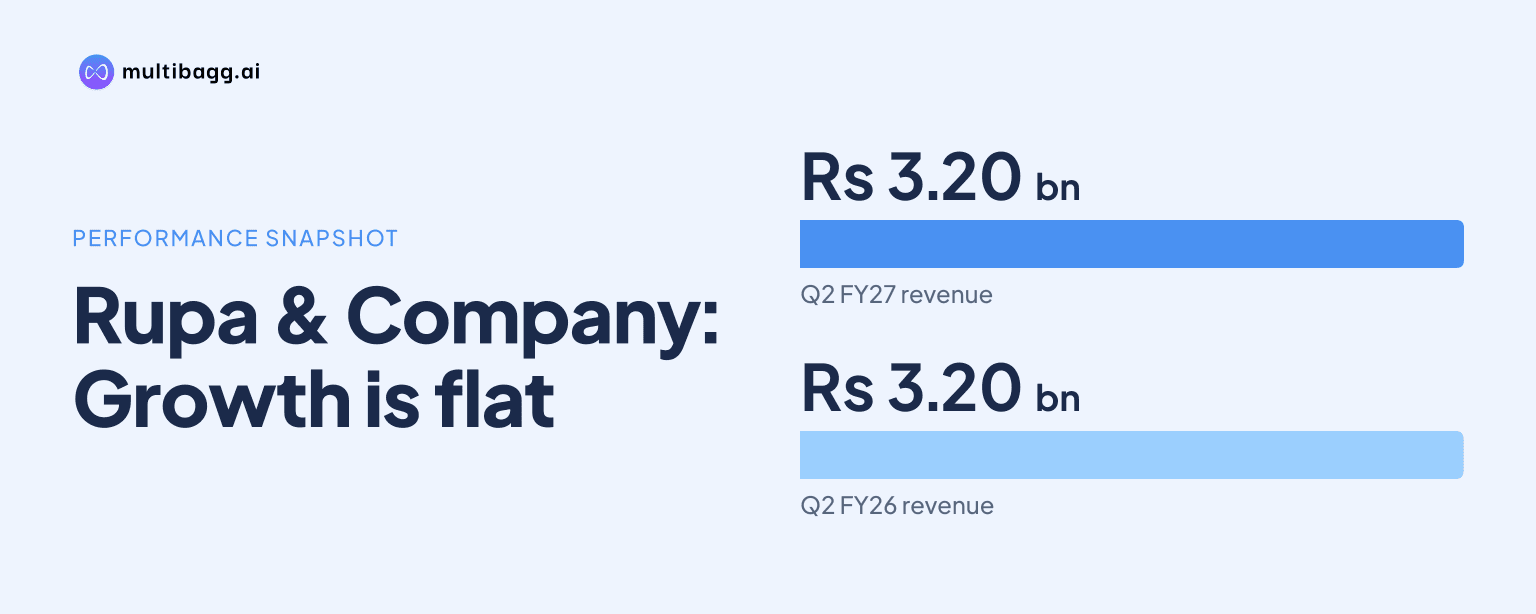
Rupa & Company Limited reported Q2 FY27 revenue of INR 3.204 billion, compared with INR 3.202 billion in Q2 FY26, showing that revenue was broadly unchanged year-on-year. The result matters because management also outlined INR 0.830 billion of warehouse and storage capital expenditure to support distribution and modern trade operations over the next two to two-and-a-half years.
Know Rupa & Company inside out
Results, valuation, peers and who's buying, in one view.
What did Rupa report for Q2 FY27?
Rupa reported Q2 FY27 revenue of INR 3.204 billion, against INR 3.202 billion in the corresponding quarter of FY26. The INR 0.002 billion difference indicates a broadly flat revenue performance on a year-on-year basis. The supplied earnings-call highlights do not provide a breakup by brand, category, geography, channel, or volume for the quarter.
The release date for the Q2 FY27 earnings-call highlights was November 3, 2026. The available extract identifies the result as a comparison with Q2 FY26, while the wider source material also refers to the company's earnings-call transcripts and audio records. Rupa's Q1 FY27 earnings call had been held on August 11, 2026 to discuss results for the quarter ended June 30, 2026.
The supplied Q2 FY27 extract does not state EBITDA, profit after tax, gross margin, operating margin, inventory, receivables, or cash-flow figures. It also does not provide a quantified comment on the margin trend referenced in the source heading. Investors should therefore distinguish the confirmed revenue number from financial metrics that are not contained in the provided material.
How will Rupa use the planned INR 0.830 billion capex?
Rupa plans to deploy approximately INR 0.830 billion on warehouse and storage infrastructure over about two to two-and-a-half years. Management outlined roughly INR 0.580 billion for a warehouse in Western India and another INR 0.250 billion for warehouse and storage facilities supporting the modern trade business.
The plan links a significant part of the proposed investment to Western India and to modern trade operations. Warehouses and storage facilities are part of the physical distribution network that supports product availability, inventory handling and delivery across sales channels. The extract does not specify the warehouse location within Western India, project milestones, commissioning dates, funding sources, or expected financial return from the investment.
Management's disclosure describes the capex as an intended spend over multiple years rather than an amount already incurred in Q2 FY27. That distinction is relevant when assessing near-term quarterly financial performance, since the provided information does not indicate how much, if any, of the planned amount was spent during the reported quarter.
Got a follow-up? Ask IRIS
What is the background to Rupa's current performance?
Rupa's Q2 FY27 revenue comparison follows a stronger reported Q4 FY26 revenue performance. In its Q4 FY26 earnings-call highlights, the company reported year-on-year revenue growth of 6.3% and volume growth of 9%. The Q4 FY26 material attributed an increase in EBITDA primarily to improved gross margins arising from a favourable product-mix change.
Management had also said during the Q4 FY26 discussion that it implemented a price increase of around 4% to 5% in April and could consider another increase of 2% to 3% in June or July, depending on market conditions. The Q2 FY27 extract provided here does not confirm whether any additional price increase was implemented or quantify its effect on quarterly revenue.
The earlier Q4 FY26 commentary also referred to a strengthened sales and distribution network. The newly outlined warehouse and storage projects fit within that operational context, although the available Q2 FY27 material does not quantify the effect of the projects on sales reach, delivery timelines, costs, or market share.
What does the update mean for investors and operations?
The update gives investors two confirmed data points: quarterly revenue was nearly unchanged from a year earlier, and management has a multi-year infrastructure capex plan of approximately INR 0.830 billion. Flat revenue means the quarter did not extend the 6.3% year-on-year revenue growth reported in Q4 FY26, based on the figures available in the supplied material.
The capex plan is operationally relevant because it is directed at warehousing in Western India and facilities for modern trade. Modern trade requires dependable inventory availability and storage support, but the provided disclosure does not state expected sales growth, cost savings, capacity addition, or the timing of benefits. No conclusion on earnings impact can therefore be drawn from the disclosed information alone.
For shareholders, the next useful disclosures would be the pace of capex spending, construction progress, the impact on working capital and any update on sales through modern trade. Quarterly revenue, margin and cash-flow data will also be important for evaluating whether the planned infrastructure is being supported by an improving operating trend.
Conclusion
Rupa's Q2 FY27 revenue of INR 3.204 billion was broadly flat against INR 3.202 billion in Q2 FY26. At the same time, management outlined INR 0.830 billion of warehouse and storage capex, with INR 0.580 billion earmarked for a Western India warehouse and INR 0.250 billion for modern trade-related facilities.
The key point to watch is execution over the stated two to two-and-a-half year spending period. Future disclosures on the timing of project completion, capex outgo, modern trade operations and quarterly financial metrics will provide a clearer view of the operational and financial effect of the plan.