










RUPA targets premium growth through six apparel brands
Key highlights
- RUPA says Softline offers more than 250 colours across sizes.
- RUPA reported more than 1,500 modern-retail stores and plans to double the count in regional and value large-format stores.
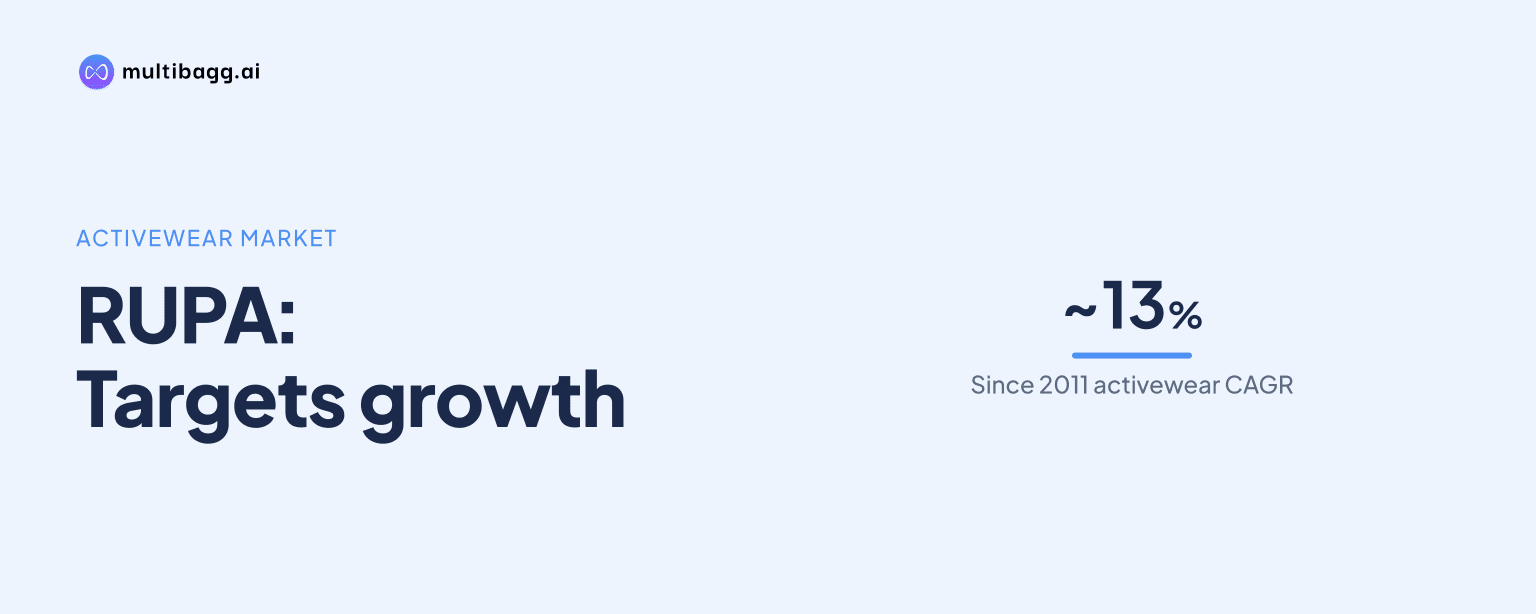
- RUPA cites activewear-industry growth of about 13% CAGR since 2011.
- RUPA says rupabrands.com, its all-brand D2C website, was in the final stage of launch.
powered by IRIS
RUPA is targeting higher-margin growth through Macroman, Macrowoman, Softline, Bumchums, Torrido and Thermocot, with Softline offering more than 250 colours across sizes. The presentation places these product lines within a strategy to scale women’s wear and athleisure while expanding modern retail, online channels and exports.
Know Rupa & Company inside out
Results, valuation, peers and who's buying, in one view.
How is RUPA targeting higher-margin categories?
RUPA’s stated approach is to focus on high-margin business while scaling its women’s and athleisure segments. Its recent strategic initiatives identify five priorities: higher-margin business, rapid expansion in high-potential areas, modern-trade investment, exports in emerging markets, and growth in women’s wear and athleisure. The presentation does not disclose brand-level revenue, gross margin or operating margin, so it does not quantify the current financial contribution of these categories.
The product plan spans innerwear, leisurewear, sportswear, activewear and athleisure rather than relying on a single category. Macroman M-Series is positioned in innerwear and athleisure, while Macrowoman W-Series extends the proposition to women’s products. RUPA says both ranges use top-notch fabrics, cutting-edge designer styling, and a variety of colours and patterns, which are the features it links to the premium proposition.
RUPA is also using a designer collaboration within the Macroman platform. The company says it launched a gold collection under the M-Signature brand with fashion designer Rohit Bal. That collection adds a designer-led range to a strategy otherwise built around fabric, fit, colour, category breadth and women’s apparel expansion.
What products are in RUPA’s premium-growth portfolio?
RUPA’s premium-growth portfolio includes Macroman and Macrowoman across men’s and women’s innerwear, leisurewear, sportswear, activewear and athleisure. The company describes this platform as one of the largest premium offerings in those categories, but provides no market-share figure, sales value or volume measure to support a comparison with competitors.
Macroman M-Series is RUPA’s men’s branded platform, with innerwear and athleisure displayed as its core categories. Macrowoman W-Series is the women’s line within the same broader proposition. The company’s emphasis on fabrics, designer styling, colours and patterns indicates that the product strategy is based on differentiation alongside distribution expansion.
The Macroman and Macrowoman platform also includes Socks Sutra, a socks range presented under both brands. That range extends the offer beyond core innerwear into an adjacent everyday category. RUPA’s presentation therefore shows premiumisation across innerwear, athleisure and socks rather than through a standalone luxury label.
How does Softline expand RUPA’s women’s wear range?
RUPA uses Softline to expand its women’s wear offer through premium leggings, lingerie and outerwear. The brand includes pants and leggings and is presented around comfort, innovation, variety and wardrobe essentials. This gives RUPA exposure to products that can function as both innerwear and visible apparel, alongside Macrowoman’s women’s innerwear and athleisure categories.
Softline offers more than 250 colours across sizes, according to RUPA. That is the clearest numerical measure of assortment depth disclosed for the premium-growth portfolio. The company says the “Effortless You” brand message is aimed at its primary consumer base, but does not identify that group by age, income, geography or channel.
Softline differs from the thermal ranges because it is framed around leggings, lingerie and outerwear rather than winter demand. It also differs from Macroman M-Series because RUPA presents it as a dedicated premium leggings and women’s wardrobe-essentials brand. The presentation supplies no separate sales, growth or profitability figures for Softline, Macrowoman or M-Signature.
Got a follow-up? Ask IRIS
Which activewear and thermal brands broaden RUPA’s mix?
RUPA adds casual activewear through Bumchums, whose range includes T-shirts, Bermudas, tracks and muscle products. The company places the brand in casualwear and athleisure and identifies the health- and lifestyle-focused activewear segment as having high growth potential. Its presentation says the industry has grown by about 13% compound annual growth rate, or CAGR, since 2011, without specifying the geography or source for that industry measure.
Bumchums expands RUPA’s range into activity-led apparel, while Macroman M-Series offers athleisure alongside innerwear. The two brands therefore create multiple category entry points in athleisure. The presentation does not state whether they target different price points, consumers or distribution formats, so the extent of differentiation between their commercial roles is not disclosed.
For winter demand, RUPA offers Torrido as a premium thermal brand and Thermocot as a thermal line for men, women and children. Torrido is described as stretchable, body-hugging, soft and non-itchy, with products knitted on hi-tech machines for warmth and fit. Thermocot uses a cotton-polyester blend suitable for low temperatures, creating a separate thermal proposition within the broader clothing portfolio.
How will RUPA distribute its premium-growth brands?
RUPA plans to support its brands through modern retail, online marketplaces and its own direct-to-consumer, or D2C, website. The company reported more than 1,500 modern-retail stores across outlets including D-Mart, Reliance, METRO Cash & Carry, Walmart and Style Baazar. Management’s stated plan is to double the store count in regional and value large-format stores, with a major focus on southern Indian states.
The modern-trade strategy includes extending brand footprints, creating product lines more relevant to the channel, improving OTO and building a tech-driven warehouse infrastructure. RUPA also plans to create additional visibility through space-on-hire arrangements. These are execution plans rather than reported evidence that premium-brand sales or margins have already increased.
Online, RUPA says it is present on leading marketplaces and is expanding into fashion and beauty through Myntra, Nykaa and AJIO. The company says logistics and warehousing are being modernised on an integrated SAP, order-management-system and warehouse-management-system platform for real-time inventory and automated order flow. Rupabrands.com, intended as one online home for all RUPA brands, was in the final stage of launch when the presentation was prepared.
Conclusion
RUPA’s strategy combines premium innerwear and athleisure through Macroman and Macrowoman, women’s wardrobe essentials through Softline, casual activewear through Bumchums, and thermal wear through Torrido and Thermocot. The disclosed evidence is product- and channel-led: Softline has more than 250 colours across sizes, the presentation cites about 13% activewear-industry CAGR since 2011, and modern retail exceeds 1,500 stores. It does not show financial results by brand or confirm margin expansion achieved to date.
What comes next depends on management’s execution plans: doubling modern-retail stores in regional and value large-format formats, focusing on southern India, scaling quick-commerce and e-commerce ranges, and launching RUPA brands globally on Amazon.com. The presentation also identifies rupabrands.com as being in its final launch stage, making subsequent disclosures on sales mix, channel growth and brand-level profitability relevant measures of progress.