










S Chand loss widens to Rs 85.63 crore as costs outpace income
Key highlights
- S Chand’s consolidated half-year loss after tax widened to Rs 85.63 crore from Rs 67.66 crore a year earlier.
- S Chand’s revenue from operations increased to Rs 162.37 crore from Rs 151.97 crore.
- Total expenses rose to Rs 276.25 crore from Rs 247.70 crore in the half year ended 30 September 2026.
- Operating activities used Rs 67.34 crore in cash and period-end cash stood at Rs 13.04 crore.
powered by IRIS
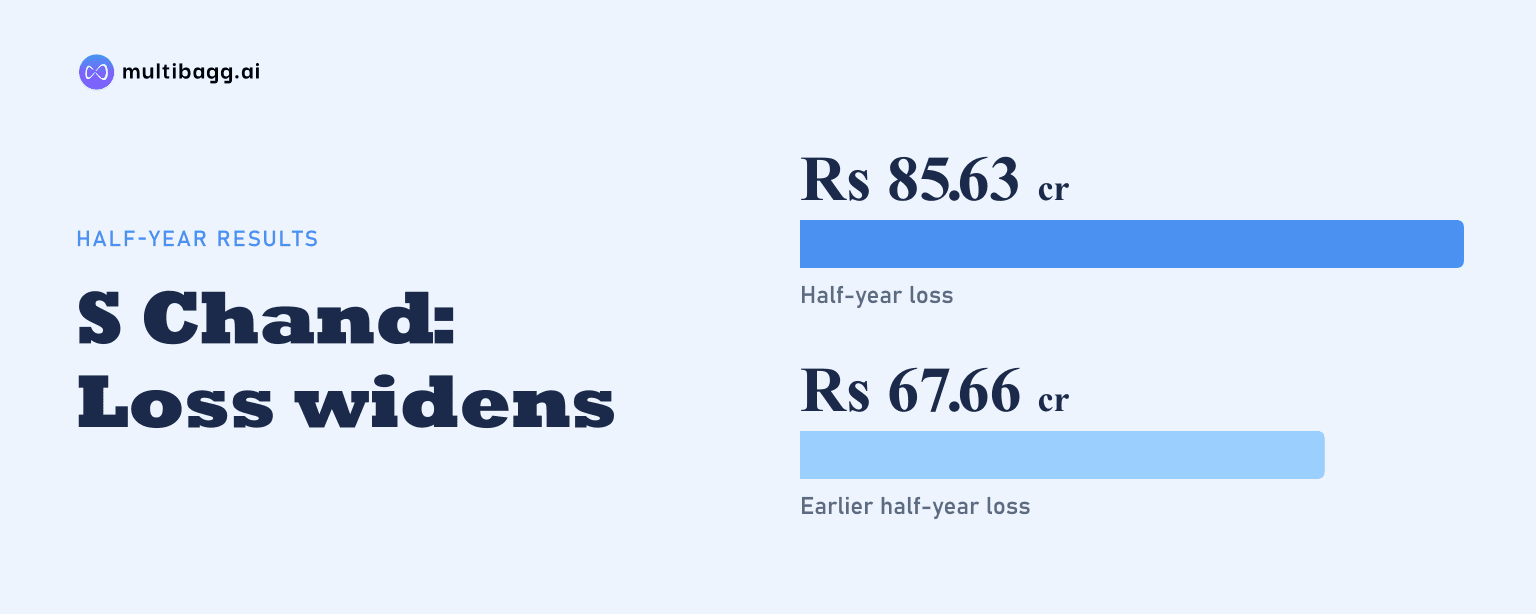
S Chand And Company Limited reported a consolidated loss after tax of Rs 85.63 crore for the half year ended 30 September 2026, compared with a Rs 67.66 crore loss a year earlier, as total expenses rose by Rs 28.56 crore while total income increased by Rs 12.66 crore.
Know S Chand & Company inside out
Results, valuation, peers and who's buying, in one view.
What did S Chand report for the half year ended 30 September 2026?
S Chand reported a consolidated loss after tax of Rs 85.63 crore for the half year ended 30 September 2026, widening from Rs 67.66 crore in the corresponding 2025 period. The loss attributable to equity holders of the parent was Rs 83.94 crore, compared with Rs 66.01 crore a year earlier, while non-controlling interests accounted for Rs 1.69 crore of the loss.
Revenue from operations increased to Rs 162.37 crore from Rs 151.97 crore, and other income rose to Rs 8.84 crore from Rs 6.58 crore. Total income therefore reached Rs 171.21 crore, compared with Rs 158.55 crore in the half year ended 30 September 2025, but the pre-tax loss widened to Rs 105.05 crore from Rs 89.15 crore.
The quarter ended 30 September 2026 generated revenue from operations of Rs 47.82 crore, below Rs 114.55 crore in the quarter ended 30 June 2026. The September-quarter loss after tax was Rs 66.90 crore, compared with Rs 18.73 crore in the preceding quarter and Rs 53.59 crore in the quarter ended 30 September 2025.
Why did S Chand’s loss widen despite higher revenue?
S Chand’s loss widened because total expenses increased to Rs 276.25 crore from Rs 247.70 crore, exceeding the increase in total income. Employee benefits, published-goods materials consumed and other expenses were the main expense lines during the half year ended 30 September 2026.
Employee benefits expense rose by Rs 8.99 crore to Rs 99.54 crore, while the cost of published goods and materials consumed increased by Rs 11.36 crore to Rs 60.51 crore. Other expenses increased by Rs 17.55 crore to Rs 88.45 crore, purchases of stock-in-trade rose to Rs 8.79 crore from Rs 7.33 crore, and finance costs increased to Rs 5.73 crore from Rs 5.31 crore.
Inventory changes provided a Rs 7.46 crore credit in the 2026 half year, compared with a Rs 3.29 crore expense in the prior-year period. Depreciation and amortisation declined to Rs 20.69 crore from Rs 21.16 crore, but these movements did not offset the higher employee, material and other costs.
S Chand recorded a deferred-tax credit of Rs 16.72 crore for the half year ended 30 September 2026, compared with a Rs 21.68 crore credit a year earlier. The company said it intends to opt for the lower tax regime under Section 115BAA of the Income-tax Act, 1961, from financial year 2026-27, and has recalculated deferred tax following Finance Act 2026 amendments.
Got a follow-up? Ask IRIS
How did S Chand’s cash flow and financial position change?
S Chand used Rs 67.34 crore in operating activities during the half year ended 30 September 2026, compared with an outflow of Rs 38.75 crore in the comparable 2025 period. Cash used in operations was Rs 64.55 crore after working-capital adjustments, against Rs 32.67 crore a year earlier, while operating loss before working-capital changes was Rs 78.00 crore.
Investing activities generated Rs 19.69 crore in the 2026 half year, compared with an outflow of Rs 20.48 crore in the previous year’s period. Financing activities used Rs 43.76 crore, versus Rs 3.47 crore a year earlier, resulting in a Rs 91.40 crore net decrease in cash and cash equivalents to Rs 13.04 crore at 30 September 2026.
Total assets stood at Rs 1,208.13 crore at 30 September 2026, down from Rs 1,395.38 crore at 31 March 2026. Current assets fell to Rs 534.45 crore from Rs 725.65 crore, while total equity declined to Rs 951.03 crore from Rs 1,050.75 crore; current liabilities decreased to Rs 193.21 crore from Rs 275.92 crore.
Why does S Chand’s revenue vary between quarters?
S Chand says its business is a single operating segment, publishing of books, under Indian Accounting Standard 108, and that it primarily operates in India. The company said book sales are generally higher in January, February and March because academic sessions begin in April, while revenue is usually lower in quarters that are not close to the start of the academic session.
The reported quarterly pattern reflected that stated seasonality, with Rs 114.55 crore of revenue from operations in the quarter ended 30 June 2026 and Rs 47.82 crore in the quarter ended 30 September 2026. S Chand said these seasonal trends are likely to continue, making the January-March period relevant to its annual sales pattern.
The board approved the unaudited consolidated results on 5 November 2026 after audit committee review. Walker Chandiok & Co LLP issued its limited-review conclusion on the same date, stating that nothing had come to its attention suggesting that the results contained a material misstatement under the applicable reporting requirements.
Nine subsidiaries reviewed by other auditors contributed total revenue of Rs 77.25 crore and a net loss after tax of Rs 26.63 crore for the half year ended 30 September 2026. Those subsidiaries held total assets of Rs 343.69 crore at 30 September 2026, and their results were included in S Chand’s consolidated statement.
Conclusion
S Chand’s half-year revenue increase of Rs 10.40 crore was outweighed by a Rs 28.56 crore rise in total expenses, resulting in a wider Rs 85.63 crore consolidated loss. Operating cash outflow also increased to Rs 67.34 crore, while total equity and period-end cash were lower than the respective comparison figures.
The next results will show the effect of the January-March academic-sales period, which S Chand identifies as its higher-volume book-sales season. Investors can also watch for the financial effect of S Chand’s stated plan to use the lower tax regime under Section 115BAA from financial year 2026-27.