










S. Chand Group H1FY27 Loss Widens 27% Despite Revenue Growth
Key highlights
- S Chand’s H1FY27 consolidated loss widened 27% to Rs 85.6 crore while revenue rose 7% to Rs 162.4 crore.
- H1FY27 other expenses increased 25% to Rs 88.4 crore after certain marketing activities were moved forward to Q2.
- S Chand’s Q2FY27 revenue declined 3% to Rs 47.8 crore and its quarterly loss widened 25% to Rs 66.9 crore.
- Operating cash outflow was Rs 67.3 crore in H1FY27, with inventory absorbing Rs 54.4 crore of cash.
powered by IRIS
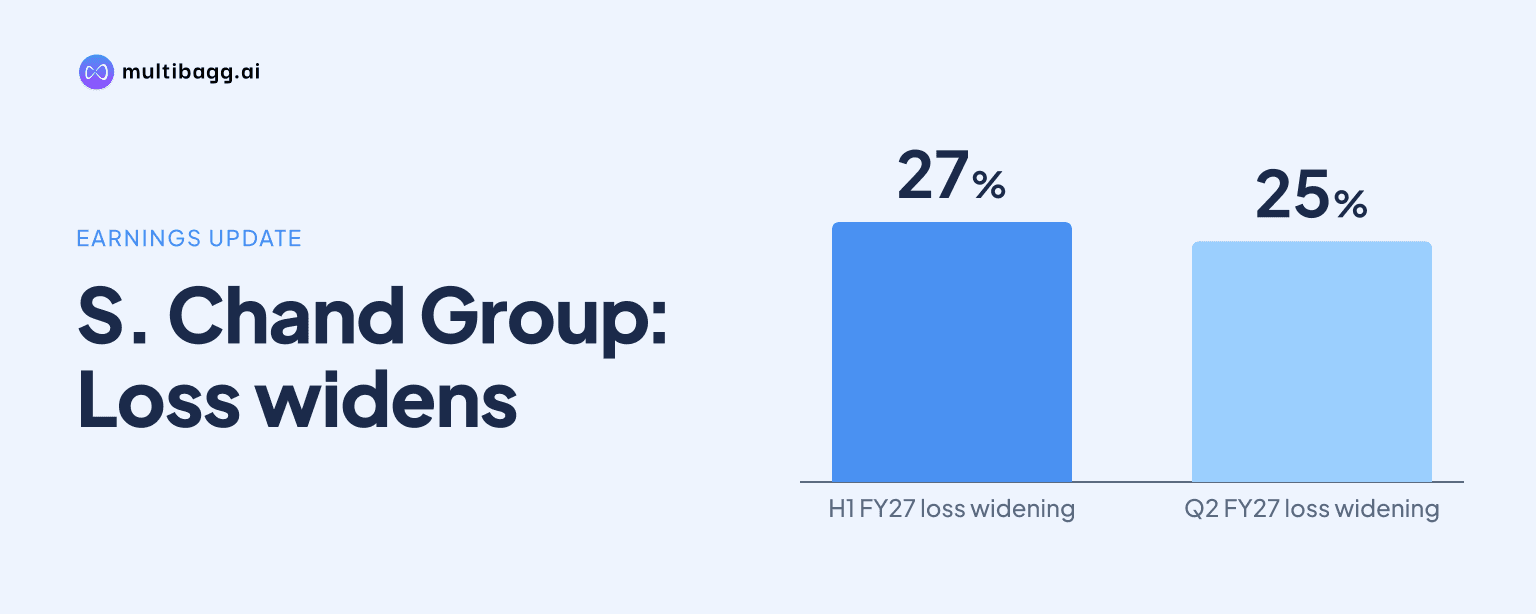
S. Chand Group’s H1FY27 consolidated loss widened 27% to Rs 85.6 crore, even as revenue from operations rose 7% to Rs 162.4 crore, because employee benefits and other expenses increased faster than gross margin. Management attributed the rise in losses partly to marketing activities moved forward from Q3 to Q2.
Know S Chand & Company inside out
Results, valuation, peers and who's buying, in one view.
Why did S Chand’s H1FY27 loss widen?
S Chand’s H1FY27 loss widened because a Rs 8.3 crore increase in gross margin did not absorb higher employee and other expenses. Revenue from operations increased by Rs 10.4 crore year on year to Rs 162.4 crore, while gross margin rose 9% to Rs 100.5 crore. Gross margin as a share of revenue increased to 62% from 61% in H1FY26.
Employee benefits expense rose 10% to Rs 99.5 crore from Rs 90.6 crore, while other expenses increased 25% to Rs 88.4 crore from Rs 70.9 crore. Earnings before interest, tax, depreciation and amortisation, or EBITDA, was a loss of Rs 87.5 crore, compared with a Rs 69.3 crore loss in H1FY26. The EBITDA margin declined by eight percentage points to negative 54% from negative 46%.
Other income increased 34% to Rs 8.8 crore in H1FY27, while finance cost rose 8% to Rs 5.7 crore and depreciation and amortisation expense declined 2% to Rs 20.7 crore. Loss before tax consequently widened 18% to Rs 105 crore. Basic and diluted loss per equity share was Rs 23.80, compared with Rs 18.73 in H1FY26.
What happened in S Chand’s Q2FY27?
S Chand’s Q2FY27 revenue declined 3% to Rs 47.8 crore and its loss widened 25% to Rs 66.9 crore. Management described Q2 as the company’s smallest revenue quarter. Gross margin fell 14% to Rs 20 crore, while gross margin percentage declined to 42% from 47% in Q2FY26.
Cost of published goods and materials consumed increased 37% to Rs 28 crore, and purchases of traded goods rose 35% to Rs 7.2 crore. Employee benefits expense increased 8% to Rs 51.2 crore, while other expenses rose 28% to Rs 46.6 crore. EBITDA loss widened 29% to Rs 77.8 crore, and the EBITDA margin moved to negative 163% from negative 122%.
Management said higher other expenses reflected the preponement of certain marketing activities from Q3 to Q2. The Q2 activity list included Hindi Diwas for Madhuban, Bhasha Mela for NSH, a Maths Summit for S Chand SE, a channel-partner product briefing in Thailand and a Teachers Conclave for Chaaya. The presentation separately listed Saraswati Shikshak Samman for NSH as scheduled for Q3.
Got a follow-up? Ask IRIS
How has S Chand’s business mix changed?
S Chand’s largest reported annual segment remained K-12 National Boards, where revenue increased 9% to Rs 578.3 crore in FY26 from Rs 528.9 crore in FY25. K-12 Regional Boards grew 14% to Rs 132.7 crore, and Higher Education rose 2% to Rs 53.4 crore. K-12 National Boards generated more than four times the FY26 revenue of K-12 Regional Boards.
Digital was the fastest-growing reported segment, increasing 53% to Rs 33.6 crore in FY26 from Rs 22 crore in FY25. Total revenue across the disclosed segments rose 11% to Rs 798.7 crore from Rs 719.7 crore. The presentation said its digital businesses had scaled rapidly, but it did not disclose H1FY27 revenue by segment.
K-12 International Boards recorded Rs 70 lakh of FY26 revenue after the acquisition of CPD Singapore. Management said FY26 revenue represented only two months after the acquisition and that the business addressed a gap in S Chand’s offering. Management expects the segment to scale as international-curriculum schools are added across South East Asia, the Middle East and India, but this remains an expectation rather than a reported outcome.
What do S Chand’s cash flow and balance-sheet figures show?
S Chand used Rs 67.3 crore in operating activities in the six months ended 30 September 2026, compared with Rs 38.7 crore used in the comparable 2025 period. Trade receivables generated Rs 133.3 crore of cash, compared with Rs 113.9 crore a year earlier. That improvement was offset by inventory, trade payables and other working-capital movements.
Inventory absorbed Rs 54.4 crore of cash in H1FY27, against Rs 16.4 crore in H1FY26. Management said it brought raw-material purchases forward into Q2 in response to expected increases in paper prices. It calculated that inventory alone created a Rs 38 crore difference between the two periods, exceeding the Rs 28.6 crore deterioration in operating cash flow.
Cash and cash equivalents were Rs 13 crore at 30 September 2026, down from Rs 104.5 crore at 31 March 2026. Total assets declined to Rs 1,208.1 crore from Rs 1,395.4 crore, while total equity fell to Rs 951 crore from Rs 1,050.7 crore. Current assets fell by Rs 191.2 crore to Rs 534.4 crore as trade receivables declined by Rs 139.8 crore, although inventories increased by Rs 54.4 crore to Rs 217.8 crore.
Management reported net cash of Rs 9.5 crore at the end of Q2FY27, compared with Rs 23.5 crore in Q2FY26, and described S Chand as net debt free. Gross debt stood at Rs 70 crore, compared with Rs 88 crore a year earlier. Trade receivable days increased to 95 from 81, inventory days rose to 307 from 237, and net working-capital days reached 147 from 123.
Conclusion
S Chand’s H1FY27 outcome shows that 7% revenue growth and a one-percentage-point gain in gross margin did not offset a 25% increase in other expenses and a 10% rise in employee benefits expense. The Q2 revenue decline of 3%, together with marketing spending brought forward from Q3 and inventory purchases, widened the half-year loss to Rs 85.6 crore and increased operating cash use to Rs 67.3 crore.
The next disclosed milestones are management’s expectation that working-capital effects and operating cash flow will normalise by Q4, and its FY27 target of operating cash flow above Rs 100 crore. Management also targets FY27 operating-revenue growth of 10% to 15% excluding acquisitions, an EBITDA margin band of 17% to 19%, and content-licensing revenue above Rs 40 crore while evaluating inorganic opportunities.