










S D Retail sets 8,000 daily-departure airport threshold after exits
Key highlights
- S D Retail ended H1 FY27 with 84 stores after opening 15 and closing six.
- S D Retail set an 8,000 average daily-departure benchmark for airport apparel stores after the Vizag and Chennai exits.
- S D Retail's EBO sales grew 65% in H1 FY27 and contributed more than one-third of revenue.
- S D Retail's mature stores reported annualised sales of Rs 21,266 per square foot versus Rs 14,559 for other stores.
powered by IRIS
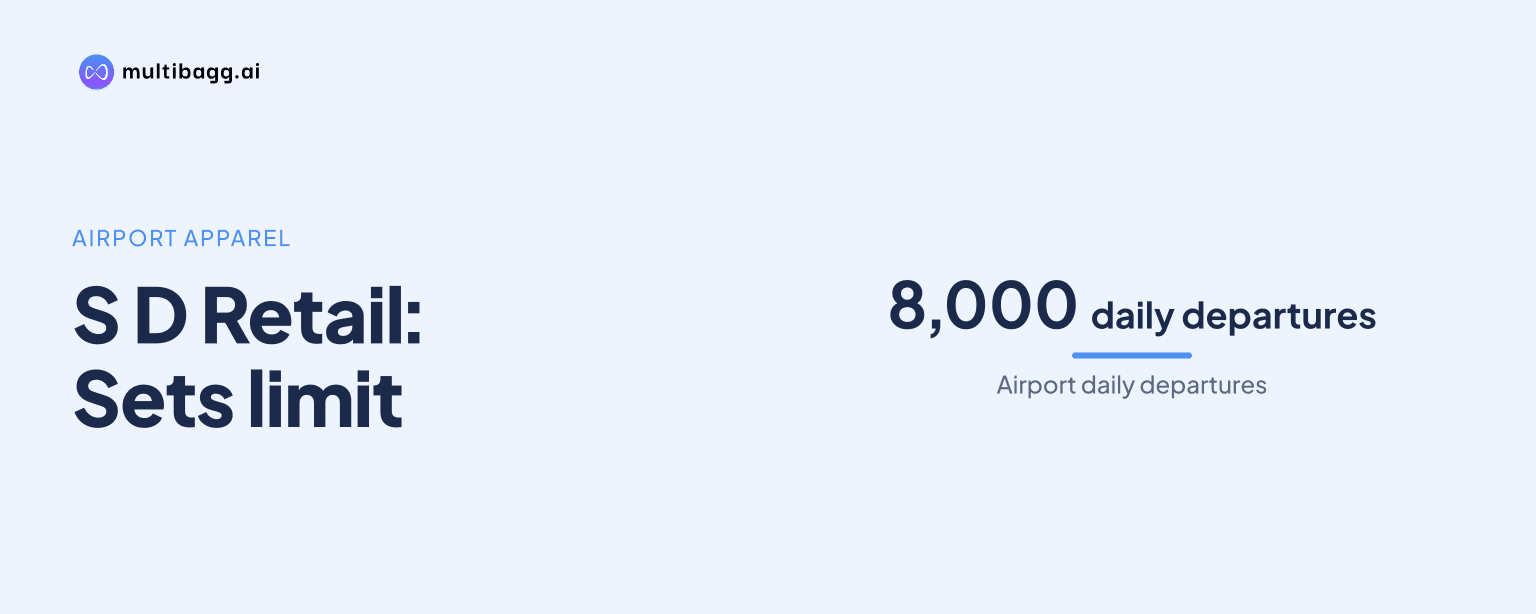
S D Retail Limited (S D Retail) adopted an 8,000-average-daily-departure screen for airport stores in H1 FY27 after closing its Vizag and Chennai airport outlets, whose stated capacity figures were 4,000 and about 2,500. It opened 15 stores and closed six, ending September 30, 2026 with 84 stores.
Know S D Retail inside out
Results, valuation, peers and who's buying, in one view.
Why did S D Retail close two airport stores?
S D Retail closed its Vizag Airport and Chennai Airport, Air India terminal, stores after management concluded that an airport with average daily departures below 8,000 does not make a profitable apparel venture. Management disclosed the threshold on the November 7, 2026 earnings call, citing Vizag's stated passenger capacity of 4,000 and Chennai's capacity of about 2,500 departures.
The two traffic-related exits were among three airport-store closures during H1 FY27. The third outlet was at Mumbai Airport, where the tenure ended rather than the site being identified as a traffic-led closure; management said it had been promised a new store allocation when space becomes available. The 8,000-departure criterion therefore arose from the Vizag and Chennai experience, not from the Mumbai closure.
S D Retail closed six stores in total while opening 15, producing a net addition of nine locations to reach 84 stores. Management described the closures as part of its learning process in the fourth year of retail operations and said it would take hard decisions where sites did not show a likelihood of turning profitable.
How will S D Retail choose new store locations?
S D Retail will first target the top-performing mall in a city, state or zone, then established high streets where other national brands already operate. Management said it evaluates about 30 to 40 locations each month and attempts to close three or four, a process that combines mall ranking with evidence from proven retail catchments.
The closure of the Shaheen Bagh, Delhi store shaped the high-street part of that approach. Management said a site outside an established market can require substantial time for the sleepwear category to penetrate, while continuing to spend on a slow-developing location is not worthwhile. It identified Lajpat Nagar, Imperial and Rajkot as main high streets that were performing well, without providing individual-store sales figures.
S D Retail said it has data covering more than 200 established high streets, including the sales numbers achieved by competing national brands. That gives management a stated reference point beyond geographic coverage alone. However, it did not disclose a specific sales threshold for malls or high streets comparable with the 8,000 daily-departure airport screen.
Got a follow-up? Ask IRIS
What changed in S D Retail's store mix?
S D Retail's exclusive brand outlets, or EBOs, increased sales by 65% in H1 FY27 and contributed more than one-third of revenue, compared with about one-quarter a year earlier. Management said multi-brand outlets, or MBOs, accounted for about half of the business in the preceding year and 38% in H1 FY27, reflecting an intentional shift toward company-operated stores.
Management attributed the EBO focus to the ability to present the full product range, control brand presentation and achieve better economics. The company reported revenue from operations of Rs 91.33 crore for H1 FY27, up 16.65% from Rs 78.30 crore a year earlier, while EBO growth of 65% exceeded the reported company-wide revenue growth.
The network rose by 20 stores from H1 FY26 to H1 FY27 and by 50 stores from H1 FY25 to H1 FY27. At September 30, 2026, North and West India accounted for 71 of S D Retail's 84 stores, while South and East India had 13. Management said future additions would remain focused on Tier 1 and Tier 2 markets, including selected airports, established high streets and premium malls lacking a dedicated sleepwear destination.
Are older S D Retail stores more productive?
S D Retail reported annualised sales of Rs 21,266 per square foot for like-to-like stores, defined as outlets operating for one year or more, compared with Rs 14,559 per square foot for other stores. The blended network average was Rs 17,647 per square foot, placing the mature-store figure Rs 6,707 above that of newer stores.
Management said same-store sales growth was positive and in double digits, and that older stores were making more money than those launched in the current or immediately preceding year. Its stated aim is for a new store to break even in its first season, although management said most stores are in the green after one year of operation.
The six H1 FY27 closures also carried a reported cost. S D Retail recorded an exceptional item of Rs 22 lakh for capital-expenditure write-offs on closed stores, while earnings before interest, tax, depreciation and amortisation before the exceptional item were Rs 2.06 crore, compared with Rs 2.18 crore a year earlier. The location-screening changes therefore relate both to network productivity and to limiting capital committed to sites that fail to develop as expected.
Conclusion
S D Retail's H1 FY27 actions show a store rollout strategy becoming more selective after six exits: airport locations now require management's 8,000 daily-departure benchmark, while high-street expansion depends on established market evidence. The company still expanded to 84 stores, and its 65% EBO sales growth alongside higher mature-store sales per square foot supports its emphasis on company-operated outlets in proven catchments.
The next issue to watch is execution against management's process of assessing 30 to 40 locations a month and seeking to close three or four, as well as its first-season break-even aim for new stores. Management also said it expects a Mumbai Airport allocation when space becomes available, while the airport threshold will remain relevant for any future airport location decisions.