










Saatvik adds Rs 1,030.206 crore in net borrowings for build-out
Key highlights
- Saatvik recorded Rs 1,030.206 crore of net borrowing proceeds in the half year ended September 30, 2026.
- Capital work-in-progress rose by Rs 500.069 crore to Rs 884.208 crore at September 30, 2026.
- Saatvik spent Rs 933.366 crore on assets, CWIP and capital advances during the half year.
- Operating activities used Rs 235.216 crore of cash, versus a Rs 197.854 crore inflow a year earlier.
powered by IRIS
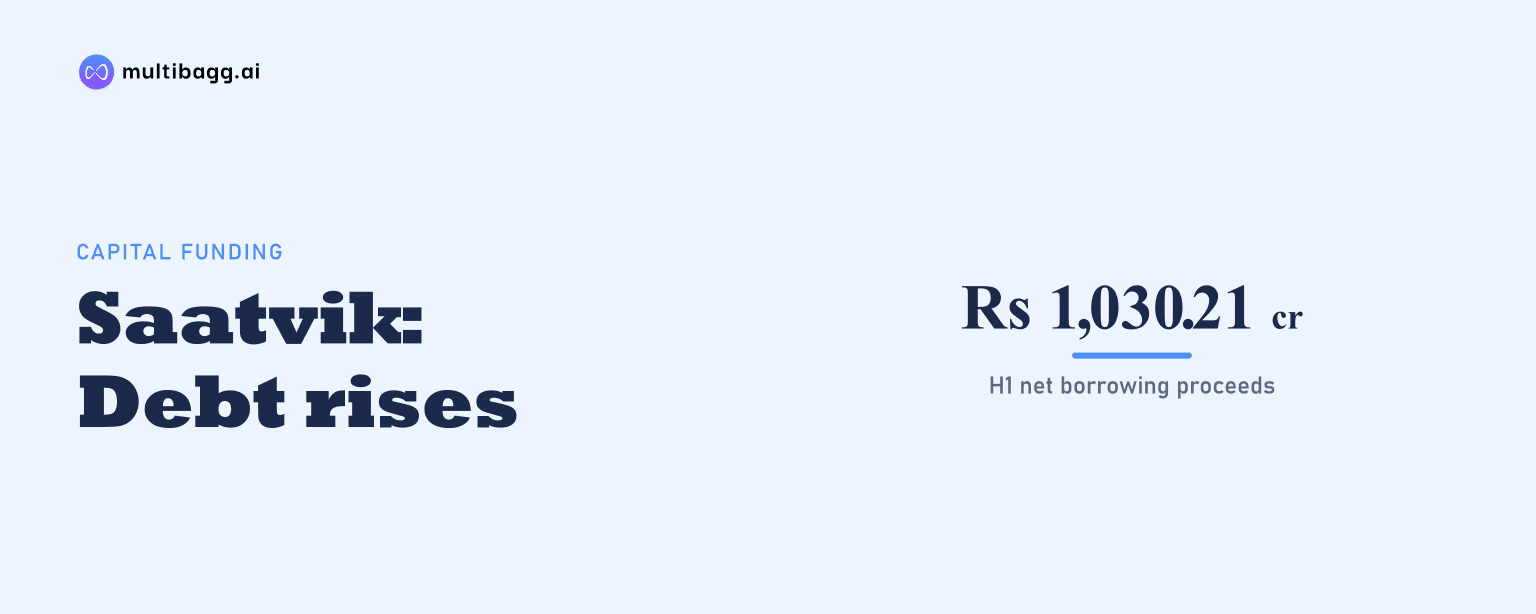
Saatvik Green Energy Limited (Saatvik) added Rs 1,030.206 crore of net borrowings in the half year ended September 30, 2026, funding Rs 751.688 crore of investing outflows as capital work-in-progress rose to Rs 884.208 crore from Rs 384.139 crore at March 31, 2026. Operating activities used Rs 235.216 crore of cash, compared with a cash inflow a year earlier.
Know Saatvik Green Energy inside out
Results, valuation, peers and who's buying, in one view.
How much did Saatvik borrow for the asset build-out?
Saatvik recorded Rs 1,030.206 crore of net proceeds from borrowings during the half year ended September 30, 2026, compared with Rs 70.476 crore in the corresponding 2025 period. Net cash generated from financing activities was Rs 984.351 crore, versus Rs 695.537 crore a year earlier, when the cash flow also included Rs 660.257 crore of fresh-equity proceeds net of share-issue expenses.
The balance sheet shows total current and non-current borrowings of Rs 1,911.501 crore at September 30, 2026, compared with Rs 881.296 crore at March 31, 2026. The Rs 1,030.205 crore balance-sheet increase is Rs 0.001 crore below the cash-flow borrowing inflow, reflecting the presentation precision in the two statements. Non-current borrowings accounted for Rs 768.067 crore of the increase, while current borrowings increased by Rs 262.138 crore.
Saatvik's finance costs rose to Rs 45.753 crore in the half year ended September 30, 2026 from Rs 32.678 crore in the restated corresponding period. The cash-flow statement separately records Rs 41.766 crore of interest expense on borrowings, credit discounting and other items, plus Rs 1.674 crore of interest cost on lease liabilities, showing the financing cost recorded through operating cash flow adjustments.
Where did Saatvik deploy its funding?
Saatvik used Rs 751.688 crore in investing activities in the half year ended September 30, 2026, compared with Rs 617.445 crore in the corresponding 2025 period. Acquisition of property, plant and equipment, intangible assets, capital work-in-progress and capital advances was Rs 933.366 crore, up from Rs 103.490 crore a year earlier. A Rs 165.303 crore net maturity of fixed deposits partly offset the acquisition spending in the investing cash flow.
Capital work-in-progress, or CWIP, increased by Rs 500.069 crore over six months to Rs 884.208 crore at September 30, 2026. Property, plant and equipment rose by Rs 161.373 crore to Rs 470.097 crore, while total non-current assets increased by Rs 959.360 crore to Rs 2,000.396 crore. Other non-current assets also rose to Rs 460.033 crore from Rs 187.454 crore.
The filing identifies a 4 gigawatt solar photovoltaic module manufacturing facility at Gopalpur Industrial Park in Odisha as a stated use of initial public offering, or IPO, proceeds. Saatvik had used Rs 377.881 crore of the Rs 477.227 crore allocated for this facility by September 30, 2026, leaving Rs 104.346 crore unutilised. That disclosed project provides a specific capacity plan alongside the increase in CWIP.
How are IPO proceeds supporting Saatvik's plans?
Saatvik had used Rs 588.236 crore of the Rs 700 crore IPO fresh issue by September 30, 2026, with Rs 111.764 crore unutilised. The unutilised proceeds were temporarily invested in fixed deposits of scheduled commercial banks maintained in the monitoring agency account and held in the public offer account, according to the filing.
Apart from the Odisha facility, Saatvik used Rs 166.436 crore to invest in Saatvik Solar Industries Private Limited for repayment or prepayment of that subsidiary's borrowings. It also used Rs 10.007 crore for repayment or prepayment of certain holding-company borrowings and Rs 37.640 crore for offer expenses. The prospectus allocation and revised allocation for the fresh issue both remained Rs 700 crore after actual IPO expenses were finalised at Rs 39.083 crore.
The disclosed spending means the 2026 half-year financing cash flow did not include a fresh equity-issue line, unlike the Rs 660.257 crore reported in the corresponding 2025 period. Instead, the statement reports Rs 1,030.206 crore of net borrowing proceeds, while the remaining IPO balance was held in the specified accounts and deposits at September 30, 2026.
Got a follow-up? Ask IRIS
Why did Saatvik's operating cash flow turn negative?
Saatvik reported net cash used in operating activities of Rs 235.216 crore in the half year ended September 30, 2026, compared with net cash generated of Rs 197.854 crore in the restated corresponding 2025 period. Cash generated from operations moved to an outflow of Rs 208.721 crore from an inflow of Rs 237.906 crore, despite operating cash flow before working-capital movements remaining positive at Rs 81.638 crore.
Inventory absorbed Rs 205.759 crore of cash, other assets absorbed Rs 150.303 crore and trade payables declined by Rs 101.276 crore. A Rs 213.549 crore reduction in trade receivables partly offset those movements. Contract liabilities declined by Rs 20.765 crore, compared with an increase of Rs 111.669 crore in the previous-year period, and income taxes paid were Rs 26.495 crore.
The balance sheet reflects parts of this movement. Inventories rose to Rs 907.352 crore at September 30, 2026 from Rs 701.592 crore at March 31, while trade receivables fell to Rs 485.462 crore from Rs 698.826 crore. Other current assets increased to Rs 417.615 crore from Rs 268.332 crore, and cash and cash equivalents ended the half year at Rs 25.349 crore, down from Rs 27.902 crore.
How did Saatvik's earnings change during the build-out?
Saatvik reported revenue from operations of Rs 1,413.515 crore for the half year ended September 30, 2026, down from Rs 1,583.757 crore in the restated corresponding period. Profit after tax declined to Rs 25.611 crore from Rs 201.316 crore. The prior-period comparison was restated after Saatvik changed its inventory valuation method from first-in, first-out to moving weighted average cost with effect from March 31, 2026.
The September 2026 quarter improved from the preceding June quarter but remained below the comparable 2025 quarter on profit. Revenue was Rs 902.605 crore in the September 2026 quarter, versus Rs 511.010 crore in June 2026 and Rs 768.029 crore in September 2025. Profit after tax was Rs 20.245 crore, compared with Rs 5.363 crore in June 2026 and Rs 84.715 crore a year earlier.
Saatvik describes its operations as a single reportable segment covering solar photovoltaic modules, transformers, engineering, procurement and construction services, solar photovoltaic water pumping systems, solar inverters, batteries, solar kits and independent power production. The filing therefore does not provide separate segment revenue, earnings or asset figures for the 4 gigawatt Odisha facility or any other product activity.
Conclusion
Saatvik's September 2026 consolidated statements show an asset expansion financed by a combination of debt and previously raised IPO proceeds. Net borrowing proceeds of Rs 1,030.206 crore accompanied Rs 933.366 crore of acquisitions of fixed assets, intangibles, CWIP and capital advances, while CWIP increased by Rs 500.069 crore. At the same time, operating cash flow moved from a Rs 197.854 crore inflow to a Rs 235.216 crore outflow.
The next disclosed item to watch is the use of Rs 104.346 crore still unutilised from the IPO allocation for the 4 gigawatt Odisha solar photovoltaic module facility. Saatvik also had Rs 111.764 crore of total fresh-issue proceeds unutilised at September 30, 2026, while the filing leaves open the pace at which CWIP converts into completed property, plant and equipment and how working-capital movements develop in subsequent results.