










Saatvik targets 8.8 GW module capacity by December 2026
Key highlights
- Saatvik targets 8.8 GW of module capacity by December 2026, compared with 6.1 GW live at its November 5 call.
- Saatvik began commercial production at a 1.3-GW Odisha module line on November 2, 2026.
- Saatvik’s 2.4-GW Odisha cell line entered trial runs, with production ramp-up targeted for December 2026.
- Saatvik reported a 6.68-GW confirmed order book on September 30, 2026, equal to about 110% of installed module capacity.
powered by IRIS
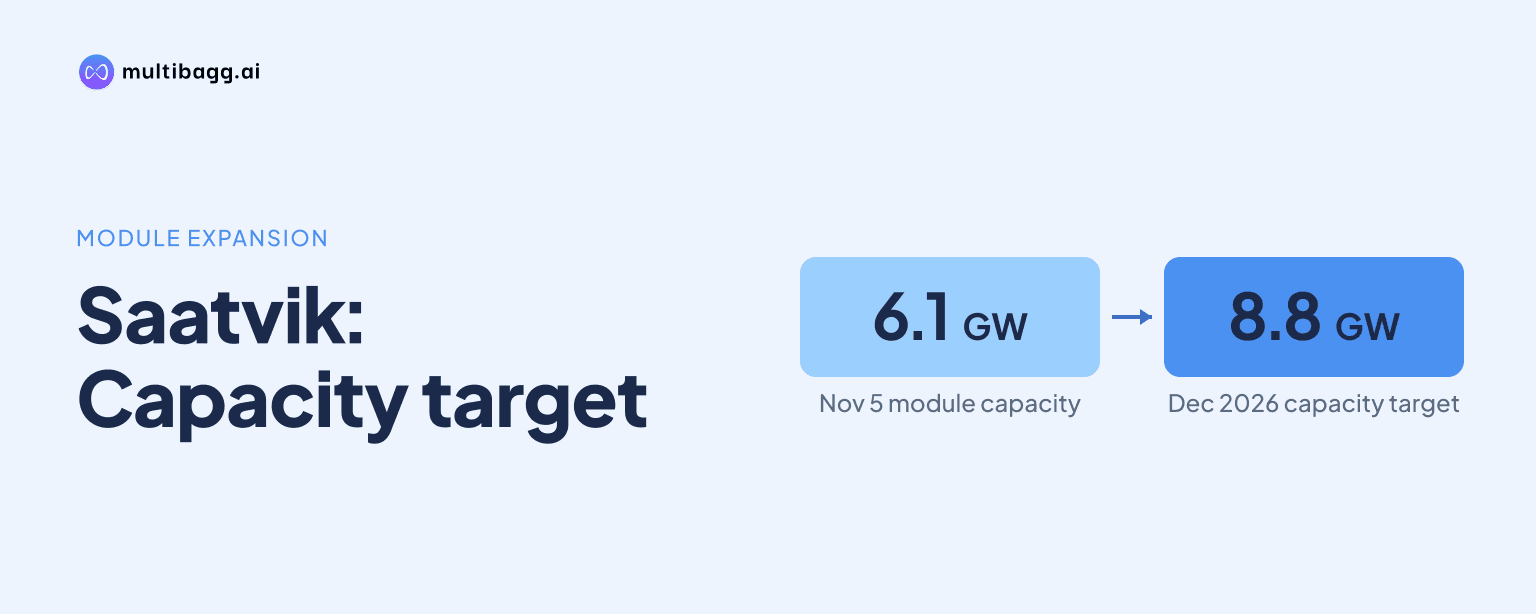
Saatvik Green Energy Limited expects operational module capacity to reach 8.8 GW by December 2026, up from 6.1 GW live at its November 5 earnings call, after commercial production began at Odisha’s 1.3-GW module line on November 2 and a 2.4-GW cell line entered trial runs.
Know Saatvik Green Energy inside out
Results, valuation, peers and who's buying, in one view.
When will Saatvik reach 8.8 GW of module capacity?
Saatvik expects module capacity to reach 8.8 GW by December 2026, combining its Ambala operations in Haryana with the Gopalpur site in Odisha. Ambala has 4.8 GW of module capacity, while the phase-one Odisha project includes 4 GW of module capacity and 2.4 GW of cell capacity across 57 acres.
Saatvik said its 1.3-GW Gopalpur module facility started commercial production on November 2, 2026, and management expects the full 4-GW Odisha module capacity to be in place by December. The company separately described 6.1 GW of module capacity as live during the November 5 call and said it would add 2.7 GW by December to reach 8.8 GW.
The December target would increase Saatvik’s module base by 2.7 GW from the live 6.1-GW level cited on the call. Management said locating cells and modules together in Odisha is intended to create a more integrated manufacturing platform and reduce reliance on externally sourced key inputs.
What is the status of Saatvik’s Odisha cell line?
Saatvik’s 2.4-GW Odisha cell manufacturing line has moved from installation to trial runs, with production ramp-up targeted for December 2026. Management said an Approved List of Models and Manufacturers, or ALMM, List-II inspection had been called for and was planned during November 2026.
The Odisha build is planned to continue beyond the first 2.4-GW cell line. Phase two, spread across 27 acres, envisages another 3.6 GW of cell capacity, taking total planned cell capacity to 6 GW, with completion targeted in FY 2028. Management said during the call that it had completed groundbreaking for the 3.6-GW phase.
Saatvik has also initiated planning for phase three, comprising 6 GW of ingot and wafer manufacturing capacity targeted for FY 2029. Management linked that timeline to ALMM List-III, which it said applies from June 2028 and requires wafer manufacturers seeking enlistment to have equivalent ingot capacity.
In response to an analyst’s question on announced Chinese controls related to technology transfer, management said it was monitoring developments expected around November 15. Management said it did not expect the policy to halt its cell or ingot-and-wafer projects because equipment alternatives, including sources in Germany, were available; this was management’s assessment rather than a quantified cost or timing forecast.
Got a follow-up? Ask IRIS
How are Saatvik’s production, sales and orders changing?
Saatvik produced 658 MW of modules in Q2 FY27, up from 408 MW in Q1 FY27 but below 792 MW in Q2 FY26. Module sales rose to 640 MW from 334 MW in the preceding quarter and 538 MW a year earlier, meaning sequential sales increased by 306 MW while production increased by 250 MW.
For H1 FY27, Saatvik produced 1,066 MW and sold 973 MW. Effective capacity utilisation was 58.5% in Q2 FY27, compared with 47.4% for H1 FY27, and management said the Odisha facility coming on stream created room to improve utilisation.
Average realisation was Rs 13.49 per watt-peak in Q2 FY27 and Rs 13.89 per watt-peak for H1 FY27, a difference of Rs 0.40 per watt-peak. Domestic customers contributed 96.7% of Q2 revenue, while management said exports accounted for about 3% of revenue and utility-scale customers represented about 52% to 55% of the revenue mix.
Saatvik’s confirmed order book stood at 6.68 GW on September 30, 2026, equal to about 110% of its then-installed 6.1-GW module capacity. It added 970 MW of new orders and executed 640 MW during Q2 FY27, increasing the order book from 6.35 GW at the quarter’s start by 330 MW.
For H1 FY27, new orders totalled 1.76 GW and executions were 970 MW. Orders cited by management included Rs 476 crore from Vikran Engineering in August, domestic module orders of about Rs 190 crore in August and Rs 297.5 crore in September, Rs 1,041 crore from Solar Energy Corporation of India in September, and Rs 100 crore from Maharashtra State Electricity Distribution Company in October.
How is Saatvik funding the Odisha expansion?
Saatvik reported Q2 FY27 revenue from operations of Rs 902.6 crore, up 77% sequentially from Rs 511 crore in Q1 FY27 and above Rs 768 crore in Q2 FY26. Earnings before interest, taxes, depreciation and amortisation, or EBITDA, were Rs 69.6 crore, compared with Rs 42.5 crore in Q1 FY27 and Rs 126.3 crore a year earlier.
The Q2 FY27 EBITDA margin was 7.7%, down from 8.3% in Q1 FY27. Profit after tax was Rs 20.2 crore, compared with Rs 5.4 crore in the prior quarter and Rs 84.7 crore in Q2 FY26; management attributed the sequential profit improvement primarily to higher sales volume.
H1 FY27 capital expenditure was Rs 500.1 crore, while capital work in progress reached Rs 884.2 crore on September 30, 2026, compared with Rs 384.1 crore in March 2026. Management said the assets would move into operations and begin contributing to revenue as Odisha is commissioned.
Debt to equity rose to 1.37 times on September 30 from 0.99 times in June and 0.44 times a year earlier, which management linked to the Odisha build-out. Inventories were Rs 907.4 crore, up from Rs 701.6 crore in March, while receivables fell to Rs 485.5 crore from Rs 698.8 crore.
Conclusion
Saatvik’s December 2026 plan combines a module-capacity increase from 6.1 GW live at the November call to 8.8 GW with a targeted ramp-up of 2.4 GW of cell capacity at the same Odisha location. The expansion is taking place as Q2 module sales reached 640 MW, up from 334 MW in Q1, and the September 30 order book stood at 6.68 GW.
The next disclosed milestones are the ALMM List-II inspection planned in November 2026, the December 2026 production ramp target for the 2.4-GW cell line and the full Odisha module-capacity target. Management also targets a further 3.6 GW of cell capacity in FY 2028 and 6 GW of ingot and wafer capacity in FY 2029.