










Saatvik expects Odisha cell margin gains to emerge in Q4
Key highlights
- Saatvik expects real Odisha cell-margin benefits from the fourth quarter after a very partial third-quarter contribution.
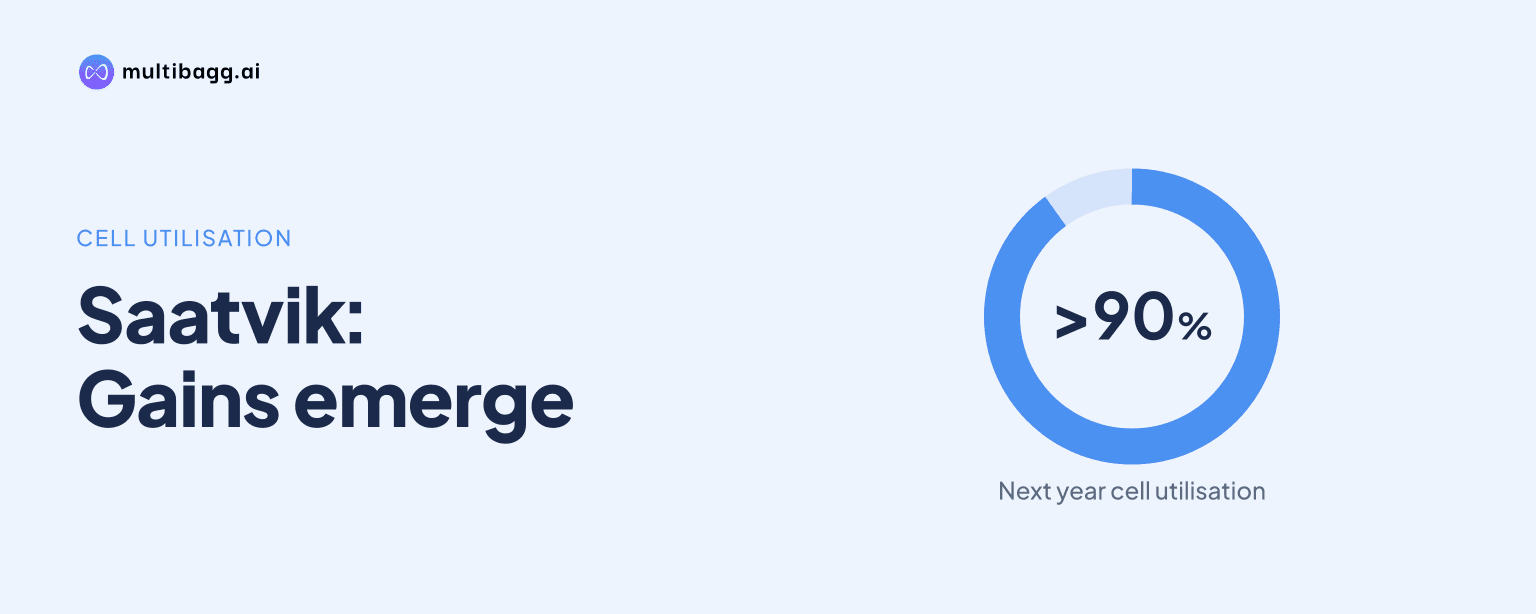
- Saatvik is targeting cell capacity utilisation above 90% next year.
- The Odisha facility has 2.4 gigawatts of cell capacity under ramp-up and a 4-gigawatt module line targeted for completion in December.
- Module utilisation was 85% last year and is about 50%-58% this year, with an 80% range aspiration for next year.
powered by IRIS
Saatvik Green Energy Limited expects its 2.4-gigawatt Odisha cell plant to deliver real margin benefits from the fourth quarter, after a very partial contribution in the third quarter. Saatvik said the full economic benefit should follow from the first quarter of next year, once the line reaches full yield and plant optimisation.
Know Saatvik Green Energy inside out
Results, valuation, peers and who's buying, in one view.
When will Saatvik’s Odisha cell margins show fully?
Saatvik expects the Odisha cell plant’s benefit to begin only “very, very partially” in the third quarter and to show real benefits from the fourth quarter. Management did not quantify the expected improvement in earnings before interest, taxes, depreciation and amortisation, or EBITDA, but said margins should be close to those reported by peers already manufacturing cells.
The complete benefit from the 2.4-gigawatt cell line is expected from the first quarter of next year, after full yield and plant optimisation. Management said it takes time for the entire 2.4-gigawatt line to reach a 97%-98% yield, which it expects in the last quarter of the current financial year.
Management also said cell commissioning should increase EBITDA in the last four months of the current financial year and affect the annual outcome. The transcript clarifies that its stated guidance of about Rs 6,000 crore in revenue and a 12% EBITDA margin applies to FY28, rather than FY27.
How far has Saatvik ramped the Odisha plant?
Saatvik had commissioned 1.3 gigawatts of the Odisha module line and received consent to operate from the government shortly before the November 5, 2026 call. Management said it was arranging the Approved List of Models and Manufacturers, or ALMM, inspection and expected Odisha module revenue after approval, which it hoped to receive within two to three weeks.
The balance of the Odisha module phase is scheduled for December, taking site module capacity to 4 gigawatts. In its closing remarks, management repeated its plan to ramp the Odisha module line to its full 4-gigawatt capacity by December, making the ALMM clearance a near-term requirement for revenue generation.
On cells, equipment for the 2.4-gigawatt line has been installed, and Saatvik said trial runs, production and ramp-up were under way. It said it was already producing cells in very small quantities, planned to call for the ALMM inspection after Diwali, and expected the inspection to be completed by the end of November.
Management expected the cell ramp-up to be established by the end of December, while distinguishing that milestone from reaching full production yield. This sequence explains why it expects a fourth-quarter margin contribution but places the entire benefit in the following first quarter, after reaching 97%-98% yield.
Got a follow-up? Ask IRIS
What cell and module utilisation does Saatvik target next year?
Saatvik is targeting cell capacity utilisation above 90% next year, citing what management described as huge demand for cells. The company is ramping 2.4 gigawatts of cell capacity in Odisha, while its second 3.6-gigawatt phase would take total cell capacity to 6 gigawatts.
Module utilisation is expected to recover, although management did not give a fixed forecast. It said module utilisation was 85% last year and is about 50%-58% this year, with improvement expected in the second half; for next year, management said it would like utilisation to return to the 80% range.
Management called the current year a realignment year because of the transition involving ALMM List-I and ALMM List-II, as well as commodity-price changes. It said the transition should be smoother next financial year, when domestic-content-requirement, or DCR, and non-DCR demand are expected to operate alongside expanded cell capacity.
How will Saatvik support its cell-margin strategy?
Saatvik plans to support cell production with long-term wafer contracts from tier-one Chinese suppliers until its own 6-gigawatt ingot-and-wafer facility in Odisha comes online. Management said wafer tie-ups and purchases had already been completed for the current 2.4-gigawatt cell ramp-up.
The longer-term supply-chain plan is linked to the government’s ALMM List-III policy, which management said is due to take effect in June 2028. Saatvik said its planned 6-gigawatt ingot-and-wafer operation is aligned with that policy change, while it expands encapsulant capacity from 2 gigawatts to 5 gigawatts.
Saatvik’s order book was 60% DCR and 40% non-DCR, giving the ramping cell business exposure to both demand categories. Management also referred to an industry pool of about 70-80 gigawatts of non-DCR orders and said the market is moving toward competition led by integrated cell and module manufacturing.
Saatvik’s integration plan also extends beyond cells and wafers. Management said non-solar-panel products contributed about 2.5%-3% of revenue in the first half of last year and 4% this year, and it targets about 15% within two years as it seeks to increase its share of a solar project from the 50%-60% represented by panels toward 70%-80% through allied products.
Conclusion
Saatvik’s margin outlook depends on the Odisha execution sequence: module approval and revenue generation, an established cell ramp-up by December, 97%-98% cell yield in the final quarter, and plant optimisation from the following first quarter. Management has not provided a numerical margin uplift, but expects backward integration to bring margins close to those of cell-manufacturing peers.
The next disclosed milestones are the expected end-November cell ALMM inspection, December completion of the 4-gigawatt module phase and cell ramp-up, and progress toward above-90% cell utilisation next year. Management also plans to execute its 6.68-gigawatt order book and expand encapsulant capacity from 2 gigawatts to 5 gigawatts.