










Saatvik targets 15% non-module revenue within two years
Key highlights
- Saatvik targets non-module businesses to contribute about 15% of revenue within two years, from 4% in H1 FY27.
- EPC, pumps, transformers, inverters, encapsulants and batteries generated Rs 63.4 crore in H1 FY27.
- Saatvik had about 85-90 B2C distributors across India as of November 5, 2026.
- Modules accounted for about 96% of Saatvik’s H1 FY27 revenue of Rs 1,413.6 crore.
powered by IRIS
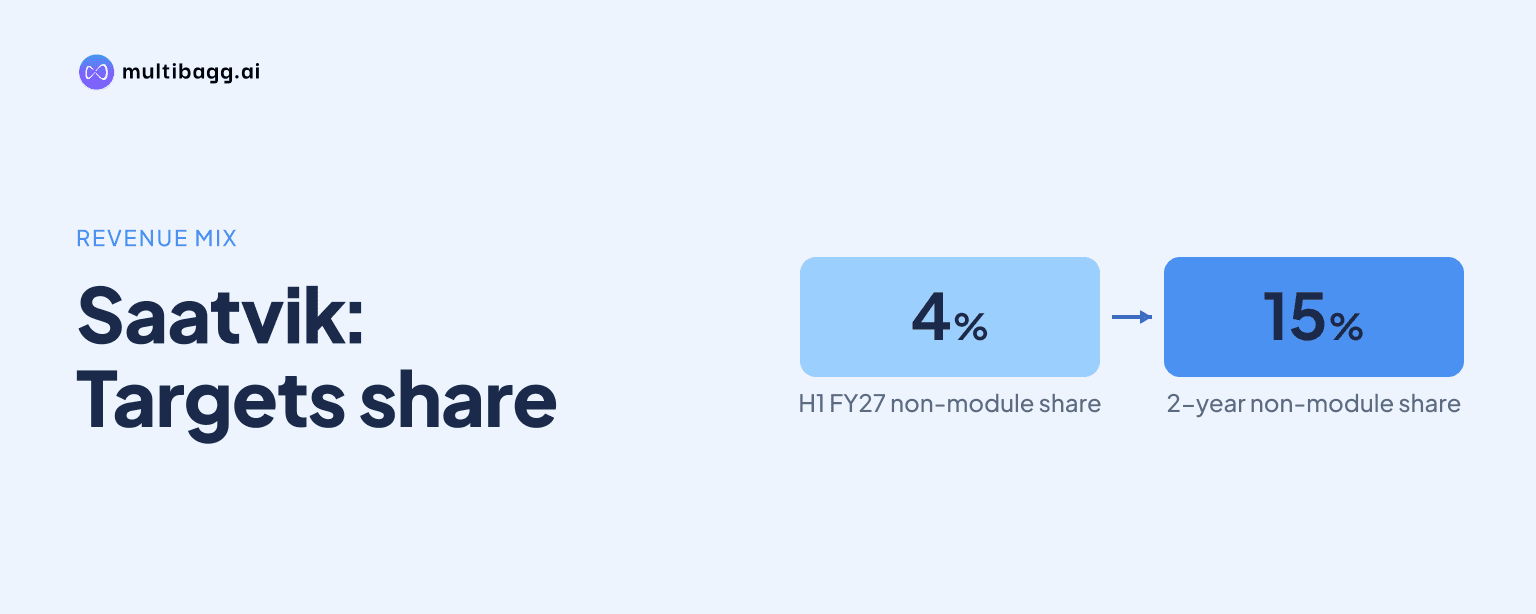
Saatvik Green Energy Limited is targeting non-module businesses to contribute about 15% of revenue within two years, up from 4% in H1 FY27, after these operations generated Rs 63.4 crore in the half year. Saatvik is expanding solar kits, inverters, transformers, pumps, batteries, encapsulants and engineering, procurement and construction services alongside module sales.
Know Saatvik Green Energy inside out
Results, valuation, peers and who's buying, in one view.
Why is Saatvik expanding beyond solar modules?
Saatvik is expanding beyond modules to increase its share of a solar project’s value from about 50%-60% to 70%-80%, management said. Panels typically represent 50%-60% of project cost, while inverters account for about 10%; transformers and other equipment create further sales opportunities around each installation.
Saatvik is combining sales of adjacent equipment with manufacturing integration. Its plans cover cell manufacturing, ingot and wafer manufacturing, and encapsulant production, which management said should provide greater control over inputs and help manage commodity-price, foreign-exchange and global-market volatility.
Saatvik’s stated aim is to become an integrated energy platform serving utility-scale, commercial and industrial, agricultural and residential customers. The proposed portfolio includes modules, inverters and transformers, with battery energy storage systems planned over time.
What is Saatvik’s non-module revenue contribution today?
Saatvik said non-module businesses represented 4% of H1 FY27 revenue, compared with roughly 2.5%-3% in the first half of the previous year. Management is targeting a 15% share within two years, while module sales still accounted for about 96% of H1 FY27 revenue.
Engineering, procurement and construction, or EPC, solar pumps, transformers, inverters, encapsulants and batteries generated Rs 40.8 crore in Q2 FY27 and Rs 63.4 crore in H1 FY27. Management described these businesses as small but growing, supported by recently introduced solar kits and hybrid inverters.
The diversification target will need to develop alongside a much larger module base. Saatvik reported H1 FY27 revenue from operations of Rs 1,413.6 crore, and management’s 96% module-sales estimate indicates that the new categories must grow materially to alter the revenue mix.
How is Saatvik selling solar kits and equipment?
Saatvik is selling its SuryaConnect solar kit to residential and small commercial customers through distributors and online ordering. Management said customers can buy a turnkey kit through either channel and use a local IEC-registered player for installation, creating a single-brand option for modules and allied equipment.
Saatvik had developed a business-to-consumer, or B2C, distributor, dealer and reseller network of about 85-90 distributors across India as of the November 5, 2026 call. Management said it was adding resellers and distributors and sought to expand distribution to every district and village, but did not specify a completion date.
The retail initiative is linked to the PM Surya Ghar rooftop-solar programme. Management said almost 57 lakh homes had been solarised under the scheme’s first phase, which targets one crore homes, while its prepared remarks said the government was targeting 75 lakh households by December 2026.
Saatvik has also launched the UDAY Plus hybrid inverter, lithium battery solutions and e-commerce sales. It unveiled Quad-Cut TOPCon 3.0 dual-glass bifacial modules at the Renewable Energy India Expo 2026; TOPCon means tunnel oxide passivated contact, a solar-cell technology. The call did not disclose sales volumes for these newer products.
Got a follow-up? Ask IRIS
What manufacturing plans support Saatvik’s diversification?
Saatvik’s integrated manufacturing plan comprises 8.8 gigawatt of module capacity and 6 gigawatt each of cell and ingot-wafer capacity, according to management. In Odisha Phase One, 1.3 gigawatt of module capacity had been commissioned before the November 5 call, while 2.4 gigawatt of cell capacity was under ramp-up.
Management expected the rest of the Odisha module phase to come online in December 2026. It expected the cell plant’s ramp-up to be established by the end of December, while reaching a 97%-98% yield across the full 2.4 gigawatt capacity was expected in the final quarter of the financial year.
Saatvik has also completed groundwork for a 3.6 gigawatt second cell phase, which would take cell capacity to 6 gigawatt. Management said it was monitoring China’s proposed technology-transfer measures but did not expect them to delay its cell or wafer plans because the first phase was ready and the second phase tie-up was in place.
For wafer supply, Saatvik said it was working on long-term contracts with tier-one Chinese suppliers while developing its own 6 gigawatt ingot and wafer facility in Odisha. It is also expanding encapsulant capacity from 2 gigawatt to 5 gigawatt, alongside an expected June 2028 implementation of Approved List of Models and Manufacturers List-III, or ALMM List-III.
What financial position frames Saatvik’s expansion?
Saatvik reported Q2 FY27 revenue from operations of Rs 902.6 crore, up 77% sequentially from Rs 511 crore in Q1 FY27 and above Rs 768 crore in Q2 FY26. H1 FY27 revenue, however, was Rs 1,413.6 crore, down from Rs 1,683.8 crore a year earlier, meaning the stronger second quarter did not offset the first-quarter decline.
Q2 FY27 earnings before interest, tax, depreciation and amortisation, or EBITDA, were Rs 69.6 crore, compared with Rs 42.5 crore in Q1 FY27 and Rs 126.3 crore in Q2 FY26. Profit after tax was Rs 20.2 crore, up from Rs 5.4 crore sequentially but below Rs 84.7 crore a year earlier; management attributed the quarter-on-quarter increase primarily to higher sales volume.
Saatvik’s debt-to-equity ratio was 1.37 times on September 30, 2026, compared with 0.99 times in June 2026 and 0.44 times a year earlier. H1 capital expenditure was Rs 500.1 crore and capital work in progress was Rs 884.2 crore, while inventories rose to Rs 907.4 crore from Rs 701.6 crore in March 2026 and receivables fell to Rs 485.5 crore from Rs 698.8 crore.
Conclusion
Saatvik is seeking to reduce its dependence on modules, which represented about 96% of H1 FY27 revenue, by selling more products and services that accompany a solar installation. The 15% non-module target depends on growth in kits, inverters, transformers, pumps, batteries, encapsulants and EPC, supported by a B2C network of about 85-90 distributors and online sales.
The next disclosures to watch are the remaining Odisha module commissioning in December 2026, the cell plant’s ALMM inspection and ramp-up, and the extent to which cell integration affects results from Q4. Management has also guided for FY28 revenue of about Rs 6,000 crore and an EBITDA margin of about 12%, while targeting more than 90% cell capacity utilisation and a return to module utilisation in the 80% range next financial year.