










SAFE launches Rs 20,000 financial-services course after placement
Key highlights
- SAFE's placement-linked BFSI programme has a total stated fee of Rs 20,000, with Rs 1,000 paid upfront.
- SAFE says about 20 students are in its first BFSI batch and several further batches are planned.
- SAFE reports about 150 BFSI vacancies in hand, mainly with NBFCs.
- SAFE has signed 6 college MOUs, with 10 to 15 more in the pipeline.
powered by IRIS
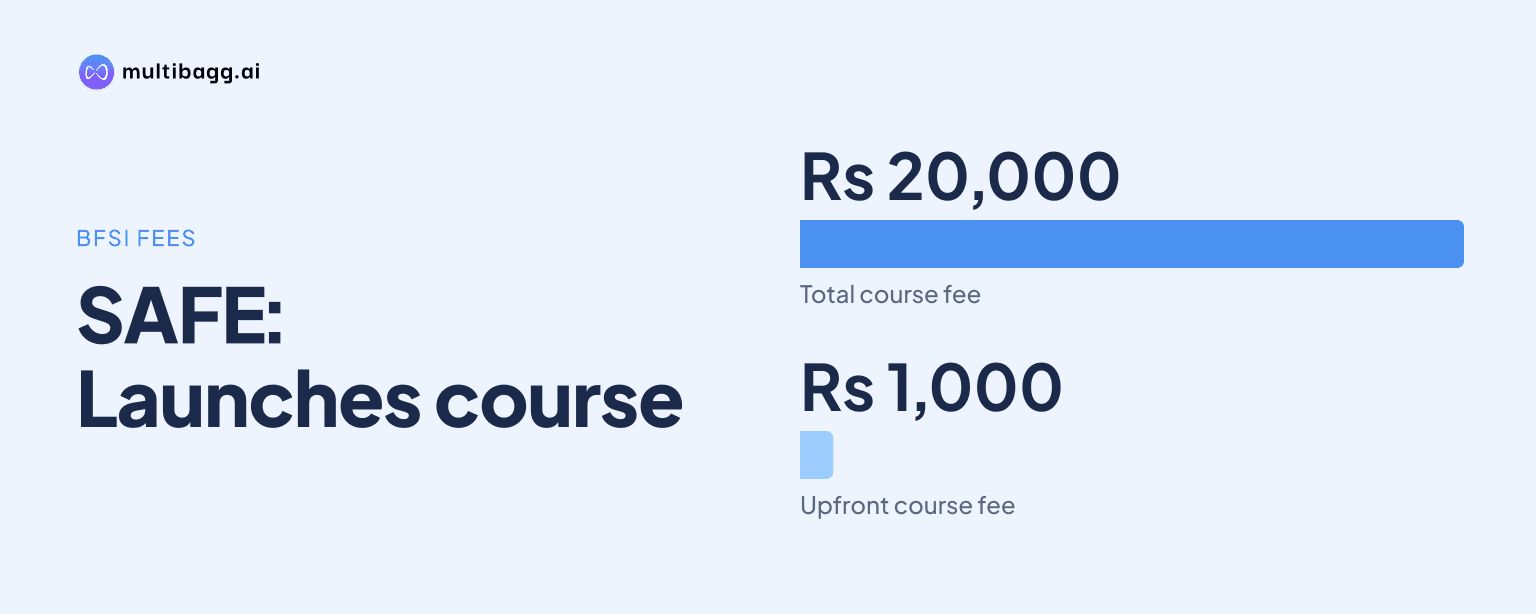
SAFE has launched a Rs 20,000 banking, financial services and insurance (BFSI) training programme in which students pay Rs 1,000 upfront and Rs 19,000 after placement, subject to final contract terms. The first batch has about 20 students, while SAFE reports about 150 open BFSI vacancies, mainly with non-banking financial companies (NBFCs).
Know Sodhani Academy of Fintech Enablers inside out
Results, valuation, peers and who's buying, in one view.
How does SAFE's placement-linked training fee model work?
SAFE's placement-linked BFSI programme requires a Rs 1,000 registration payment before a structured training programme lasting 15 to 30 days. SAFE then provides placement support by matching students with employers, and the Rs 19,000 balance is due after placement. The stated total fee is Rs 20,000 and remains subject to final contract terms.
SAFE has launched its first batch with about 20 students and says several further batches are planned in the upcoming months. Management presents the Rs 1,000 initial payment as a way to reduce the student's upfront cost and align the training process with an eventual job outcome, rather than collecting the Rs 20,000 fee before training begins.
The structure does not state that every student will be placed. SAFE says its process is to identify job needs, train candidates, assess their skills, connect eligible candidates with employers and track placement outcomes. The post-placement balance is therefore linked to placement under final contract terms, while referral, interview, offer and joining processes remain part of the employer-facing workflow.
What BFSI hiring demand does SAFE currently have?
SAFE says it has about 150 BFSI vacancies in hand, mainly from NBFCs, against an initial batch of about 20 students. On the figures disclosed, the vacancy pool is larger than the first cohort, although SAFE does not disclose how many vacancies have been filled, how many candidates have been referred or the expected timing of placements.
SAFE says it has several memoranda of understanding (MOUs) with large BFSI companies, with some partnerships active and others in the pipeline. Its employer process starts with understanding each employer's hiring requirements, followed by sourcing freshers, role-specific training, screening, referral and tracking of interviews, offers and joining.
SAFE identifies entry-level sales, customer relationship, operations and financial product distribution among the roles for which it can prepare candidates. The available vacancies are concentrated mainly in NBFCs, whereas the training proposition covers the wider BFSI category. The presentation does not provide a role-by-role vacancy count, salary details or employer-level vacancy data.
How will SAFE source students for its BFSI batches?
SAFE plans to source students through college partnerships as well as other channels, with six college MOUs already signed and a further 10 to 15 in the pipeline. This creates a potential campus-to-job route: SAFE signs an MOU, runs awareness sessions, delivers courses, selects students for job training and connects them with employers.
In Mumbai, SAFE says Bharati Vidyapeeth has an MOU in place, with training started in financial market and BFSI courses. Chetana College also has an MOU, training programmes have begun, and placements are running full-fledged, according to SAFE. These two institutions are the specifically named Mumbai examples within the six signed college MOUs.
In Rajasthan, SAFE cites partnerships such as Vishwakarma Skill University and says further MOU discussions are under way in Jaipur and nearby regions. The comparison between signed and pipeline relationships is material: six college MOUs are current agreements, while the 10 to 15 additional institutions remain prospective tie-ups.
Got a follow-up? Ask IRIS
How does BFSI training fit with SAFE's existing course business?
SAFE describes share market courses as its key income engine, while positioning BFSI training and placement as a new growth stream. Its share market offering includes Share Market Me Pehla Kadam, Zero to Hero, Technical Analysis and Fundamental Analysis, and SAFE says these courses build a base for BFSI training and placement.
The share market courses are being extended to more learners in Rajasthan with support from RKCL, a Government of Rajasthan organisation. SAFE says it is also exploring new share market course types. In contrast, the BFSI programme is built around employer-specific modules, practical job-oriented skills and the 15-to-30-day placement-linked training format.
SAFE's financial literacy activity may provide a longer-term student pipeline, but SAFE explicitly says its reach figures are not paid enrolments. Its National Financial Literacy Olympiad has reached more than 1 lakh students through social media and outreach and visited more than 1,500 schools and colleges, serving learners from Class 6 through college.
What could determine whether SAFE expands this model?
SAFE's ability to expand depends on converting its disclosed employer vacancies, college relationships and planned batches into completed placements. SAFE says it will grow its existing Jaipur and Mumbai presence, partner with more colleges in Rajasthan, add employers in high-demand regions and enter new Tier 1 and Tier 2 cities.
The training model also relies on employer demand for role-ready freshers. SAFE says employers want candidates who understand the role before joining and that practical training can make hiring faster and cheaper. Its process is designed around real entry-level job needs rather than classroom theory, but the presentation does not disclose placement rates, student completion rates or employer conversion rates.
Seasonality is another disclosed operating consideration. SAFE says about 75% of its training business typically comes in the fourth quarter, while corporate social responsibility work also peaks in the third and fourth quarters. Last year, management reported about Rs 20 lakh of corporate social responsibility project work with major corporates, a separate activity from the Rs 20,000 placement-linked student programme.
Conclusion
SAFE is shifting part of its training proposition toward a placement-linked fee structure: Rs 1,000 is collected at registration, while Rs 19,000 is due after placement under final contract terms. The launch combines an initial cohort of about 20 students with about 150 BFSI vacancies, mainly in NBFCs, and a college network of six signed MOUs.
The next items to watch are the several planned upcoming batches, conversion of the 10 to 15 college MOU prospects, and evidence of placements from the first batch. SAFE also targets a 31 December 2026 launch for its training app, while its plan calls for expansion beyond Jaipur and Mumbai into additional Tier 1 and Tier 2 cities.