










Safety Controls H1 FY27 revenue rises 33% as EBITDA margin falls
Key highlights
- Safety Controls reported H1 FY27 revenue from operations of Rs 58.42 crore, up 33.35% year on year.
- Safety Controls’ H1 FY27 EBITDA margin fell to 25.44% from 31.65%, a decline of 6.21 percentage points.
- Safety Controls’ H1 FY27 net profit rose 36.89% to Rs 10.32 crore.
- Safety Controls recorded negative H1 FY27 operating cash flow of Rs 19.03 crore.
powered by IRIS
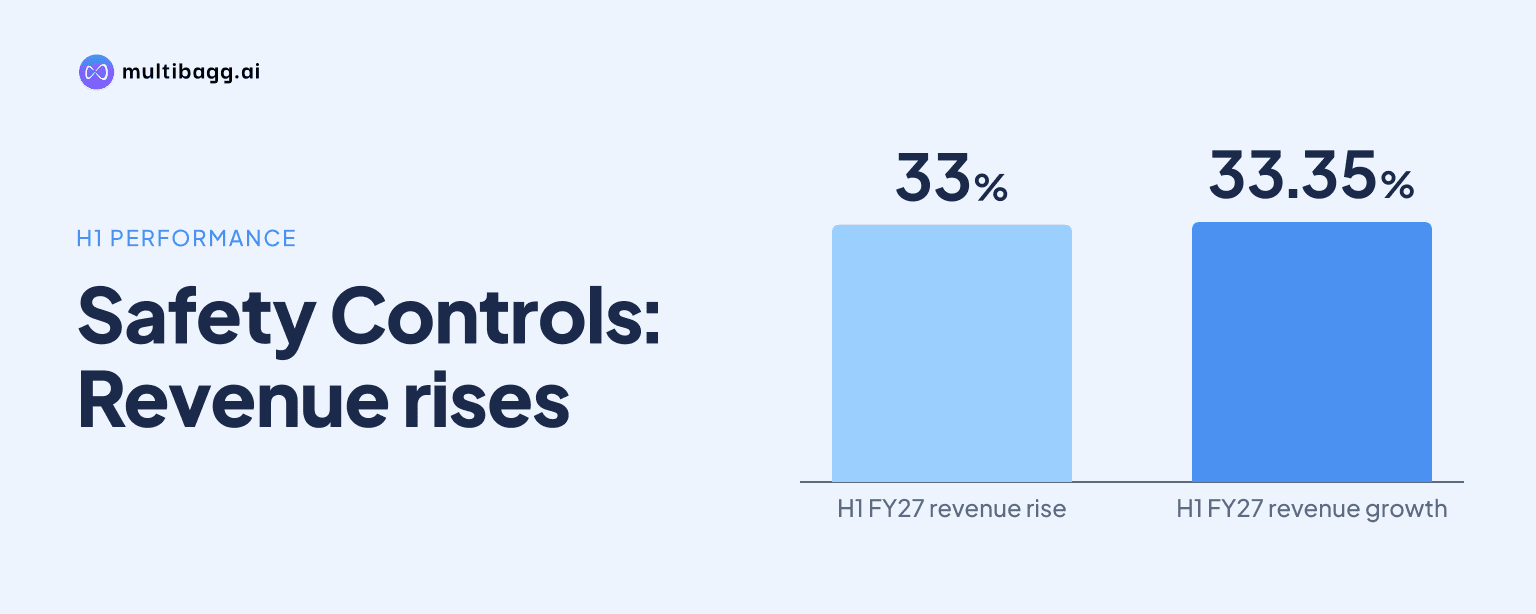
Safety Controls & Devices Ltd. reported H1 FY27 revenue from operations of Rs 58.42 crore, up 33.35% year on year, while EBITDA margin fell to 25.44% from 31.65% in H1 FY26. EBITDA increased 6.52% to Rs 14.93 crore, lagging the increase in sales.
Know Safety Controls & Devices inside out
Results, valuation, peers and who's buying, in one view.
How did Safety Controls perform in H1 FY27?
Safety Controls reported revenue from operations of Rs 58.42 crore in H1 FY27, compared with Rs 43.81 crore in H1 FY26. Total revenue, including other income, rose 32.48% to Rs 58.69 crore. Other income declined to Rs 26.79 lakh from Rs 48.93 lakh, meaning revenue from operations grew slightly faster than total revenue.
Earnings before interest, tax, depreciation and amortisation (EBITDA) rose 6.52% to Rs 14.93 crore from Rs 14.02 crore. Profit before tax increased to Rs 12.02 crore from Rs 10.03 crore, while net profit rose 36.89% to Rs 10.32 crore from Rs 7.54 crore. Financial costs declined to Rs 2.72 crore from Rs 3.81 crore during the half year.
Safety Controls’ net profit grew faster than profit before tax because current tax expense fell to Rs 1.69 crore from Rs 2.49 crore. Deferred tax was Rs 1.06 lakh in H1 FY27, compared with Rs 7,000 in H1 FY26. The presentation does not give an operational explanation for the lower current-tax expense.
Why did Safety Controls’ EBITDA margin decline in H1 FY27?
Safety Controls’ EBITDA margin declined by 6.21 percentage points to 25.44% in H1 FY27 from 31.65% in H1 FY26. EBITDA of Rs 14.93 crore was generated on total revenue of Rs 58.69 crore, compared with Rs 14.02 crore on Rs 44.30 crore a year earlier. Revenue therefore increased substantially faster than EBITDA.
Cost of materials consumed rose to Rs 37.70 crore from Rs 26.05 crore, employee benefit expense rose to Rs 1.81 crore from Rs 1.27 crore, and other expenses increased to Rs 4.25 crore from Rs 2.96 crore. These three operating cost lines totalled Rs 43.76 crore in H1 FY27, compared with Rs 30.28 crore in H1 FY26.
Materials represented the largest absolute expense increase, rising by Rs 11.65 crore against the Rs 14.61 crore increase in revenue from operations. The income statement records these movements but does not identify product mix, pricing, procurement costs or other management explanations for the lower EBITDA margin.
Safety Controls’ net profit margin nevertheless rose to 17.58% from 17.02%. This differed from the EBITDA-margin movement because financial costs fell by Rs 1.09 crore and current tax expense declined by Rs 80.88 lakh. Depreciation and amortisation expense increased to Rs 19.63 lakh from Rs 18.12 lakh.
Got a follow-up? Ask IRIS
How does H1 FY27 compare with Safety Controls’ full-year results?
Safety Controls’ H1 FY27 revenue from operations of Rs 58.42 crore was close to half of FY26 revenue of Rs 117.01 crore. FY26 revenue increased 14.09% from Rs 102.56 crore in FY25, while FY25 revenue was Rs 44.71 crore in FY24. The H1 FY27 result extends the company’s reported revenue growth across those annual periods.
FY26 EBITDA was Rs 27.46 crore, compared with Rs 17.98 crore in FY25 and Rs 8.27 crore in FY24. The FY26 EBITDA margin was 23.47%, above 17.53% in FY25 and 18.50% in FY24. H1 FY27’s EBITDA margin of 25.44% was above the FY26 full-year margin but below the 31.65% recorded in H1 FY26.
Safety Controls’ FY26 net profit reached Rs 14.42 crore, compared with Rs 7.64 crore in FY25 and Rs 4.01 crore in FY24. FY26 net profit margin was 12.33%, versus 7.45% in FY25. The H1 FY27 net profit margin of 17.58% exceeds the FY26 full-year level, although the presentation does not provide seasonal sales or cost data for a direct half-year-to-full-year comparison.
What do Safety Controls’ balance sheet and cash flows show?
Safety Controls reported total equity of Rs 111.82 crore at H1 FY27, compared with Rs 58.76 crore at FY26. Reserves and surplus rose to Rs 91.99 crore from Rs 44.93 crore, while share capital increased to Rs 19.83 crore from Rs 13.83 crore. Total equity and liabilities were Rs 203.27 crore, compared with Rs 195.88 crore at FY26.
Short-term borrowings declined to Rs 26.74 crore at H1 FY27 from Rs 44.29 crore at FY26, while long-term borrowings fell to Rs 2.44 crore from Rs 4.83 crore. Trade receivables decreased to Rs 109.26 crore from Rs 158.71 crore, but remained the largest current-asset line, ahead of inventory of Rs 9.28 crore and cash and bank balances of Rs 35.74 lakh.
Safety Controls recorded negative net cash flow from operating activities of Rs 19.03 crore in H1 FY27, compared with negative Rs 11.22 crore in FY26. Net financing cash flow was an inflow of Rs 20.08 crore, while investing cash flow was an outflow of Rs 92.02 lakh. Cash and cash equivalents consequently increased by Rs 13.65 lakh to Rs 35.74 lakh at the end of H1 FY27.
The FY26 trade receivables turnover ratio was 0.48 times, down from 0.76 times in FY25 and 1.03 times in FY24. The current ratio was 1.34 times in FY26, compared with 1.37 times in FY25. The presentation does not disclose H1 FY27 versions of these ratios or a working-capital bridge for the H1 FY27 operating cash outflow.
Conclusion
Safety Controls combined H1 FY27 revenue growth of 33.35% with net profit growth of 36.89%, but EBITDA growth was limited to 6.52% and the EBITDA margin fell by 6.21 percentage points. Higher material consumption, employee expenses and other expenses coincided with the operating-margin decline, while lower financial costs and current tax supported net profit.
The next H2 FY27 result will show whether Safety Controls can maintain sales growth while changing the relationship between operating costs and revenue. Management did not provide an H2 FY27 target, margin guidance, project plan or scheduled event in this presentation, leaving the drivers of the margin decline and negative H1 FY27 operating cash flow unresolved.