










Saksoft Limited Targets $500 Million via M&A and Partners
Key highlights
- Saksoft reported H1 FY27 operating income of Rs 497 crore, down 2% year on year.
- Saksoft had net cash of Rs 244 crore on September 30, 2026, about Rs 95 crore above the prior year.
- Management said Saksoft has completed more than eight acquisitions over the past 10 years.
- Saksoft indicated around Rs 1,100 crore of FY27 revenue if non-linear opportunities do not materialise.
powered by IRIS
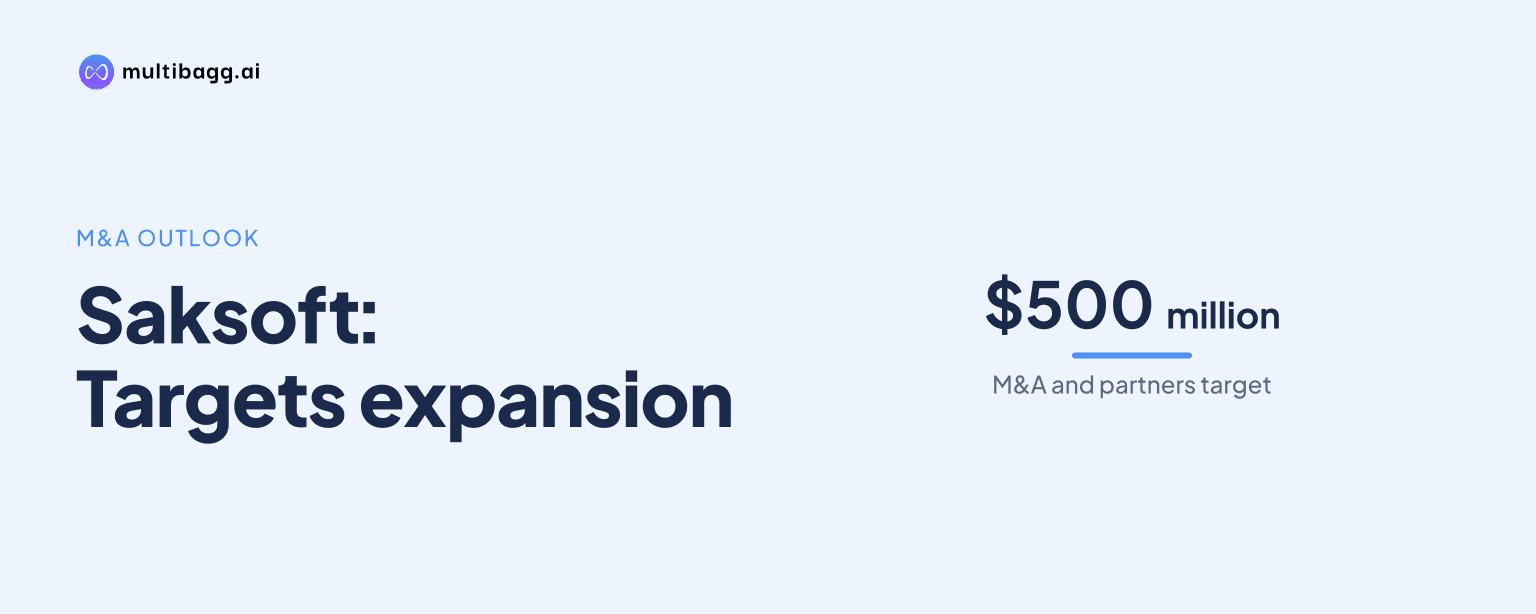
Saksoft Limited aims to reach, or get close to, $500 million of revenue by 2030 through acquisitions and greater partner-led sales, while avoiding equity dilution and excessive debt. The strategy starts from H1 FY27 operating income of Rs 497 crore, down 2% year on year, following four predominantly flat quarters.
Know Saksoft inside out
Results, valuation, peers and who's buying, in one view.
How does Saksoft plan to reach $500 million by 2030?
Saksoft plans to use two non-linear growth levers: acquisitions and more business sourced through technology partners. Chairman and Managing Director Aditya Krishna said the $500 million goal appeared large from the current base and required growth materially ahead of the previous four quarters, which management described as predominantly flat. An analyst estimated trailing-12-month revenue at about Rs 1,000 crore and the growth needed to reach the target at about 39% annually by FY31.
The acquisition route would add revenue inorganically, while the partnership route is intended to increase customer demand without buying businesses. Management said Saksoft had historically relied more on direct, or “push”, sales and had not fully captured referrals from partners. The new chief executive officer, who had joined about three weeks before the November 5, 2026 call, is focused on building this partner-pull model alongside sales campaigns.
Saksoft identified ServiceNow and Salesforce as the principal partnerships it wants to monetise more effectively. Management said it already had the relevant capabilities, so incremental partner-sourced business would not require the capital needed for an acquisition. It did not disclose a split between organic and acquired revenue in the $500 million objective, the value of its acquisition pipeline, or a timetable for partner-led revenue to emerge.
Will Saksoft fund acquisitions without issuing equity?
Saksoft says it plans to fund acquisitions mainly through internal cash and structured payouts, without diluting equity or taking excessive debt. Krishna said the company had completed more than eight acquisitions over the past 10 years, generally using its own capital and cash, with debt used occasionally. Management said that track record gave it confidence in its approach to assessing and financing inorganic targets.
The company reported net cash of Rs 244 crore as of September 30, 2026, after excluding long-term and short-term debt. That balance was about Rs 95 crore higher than a year earlier, but management did not specify how much of it was earmarked for acquisitions. The balance therefore indicates available financial resources, rather than a disclosed acquisition budget or commitment.
Management distinguished the capital needs of the two growth routes. An acquisition requires capital, while greater business from ServiceNow and Salesforce referrals should not, according to Krishna, because Saksoft already possesses the delivery capabilities. He said partner-led demand would begin to contribute, but characterised the unknowns as the timing and pace rather than offering a quantified forecast.
What does Saksoft expect for H2 FY27 revenue?
Saksoft expects H2 FY27 to perform better than H1 FY27, and management indicated revenue of around Rs 1,100 crore for FY27 if non-linear opportunities do not materialise. An analyst asked whether the company was still pursuing Rs 1,200 crore of FY27 revenue. Krishna called that outcome a tough ask after the first two quarters, but said acquisitions or partnership opportunities could materially help the company reach it.
The first-half performance shows the scale of the required recovery. H1 FY27 operating income was Rs 497 crore, down 2% year on year, while operating earnings before interest, tax, depreciation and amortisation, or EBITDA, fell 8% to Rs 89 crore. EBITDA margin contracted by 107 basis points to 17.93%, while profit after tax was Rs 61 crore and the margin was 12.35%.
In Q2 FY27, revenue from operations was about Rs 249 crore and broadly unchanged from Q1, while EBITDA declined 4% sequentially to about Rs 44 crore. Management said nearly half of Q3 had elapsed by the November 5 call and it had a good handle on that quarter, expecting improvement to begin in Q3. It did not provide the value of the sales pipeline on the call.
Got a follow-up? Ask IRIS
How is AI affecting Saksoft’s revenue and margins?
Saksoft is accepting some near-term revenue cannibalisation from artificial intelligence, or AI, as it shifts towards outcome-based delivery. Management gave an example of reducing a 50-member client team to 30 people by using AI while delivering greater efficiency. Fewer billable people can reduce current revenue, but management expects the approach to improve its standing as a co-innovation partner and expand customer spending over time.
Management said AI productivity gains of 30% to 50% in product engineering and 20% to 30% in managed services remained broadly accurate. It expects spending from an affected customer to first recover to its earlier level and then increase, although it said immediate gains in wallet share were still too early to see. That expectation is a management view rather than a disclosed financial projection.
Krishna said outcome-based work was stickier than people-based delivery because the company assumes responsibility for a defined result rather than supplying individuals who can be replaced or insourced. He said EBITDA margins could return to the 19% to 20% range over two to three years through better pricing and reduced workforce needs. He also said that would not happen in the next two quarters because of leadership and sales investment, as well as the delivery-model transition.
What operating base supports Saksoft’s strategy?
Saksoft is adding senior commercial leadership while operating with a 57% offshore revenue mix in H1 FY27. Over the preceding 12 months, it had appointed a chief growth officer for the United States, and over the preceding four months it had added a chief growth officer for the United Kingdom before appointing a new chief executive officer. Management said these costs arrive before the associated revenue and could cause a minor margin impact for one or two quarters.
The company employed 2,393 people at the end of Q2 FY27, comprising 2,203 technical professionals and 190 support staff. Employee utilisation, excluding trainees, was 84%. Its onsite-offshore revenue mix was 43% and 57%, respectively, which gives Saksoft an existing offshore delivery base for AI-enabled and partner-sourced projects.
The United States accounted for 51% of H1 FY27 revenue, Europe contributed 28%, and Asia-Pacific and other regions supplied 21%. By sector, emerging verticals represented 45% of revenue, banking and financial services 30%, logistics 16%, and digital commerce 9%. Saksoft had 16 clients generating more than $1 million annually; its top 10 customers generated 58% of revenue and the top 20 generated 72%, making expansion within existing accounts part of management’s stated growth route.
Conclusion
Saksoft’s $500 million ambition depends on two different mechanisms: acquisitions that management plans to finance through cash, structured payouts and limited debt, and ServiceNow and Salesforce partner-led sales that it says need no incremental capital. The need for these levers is clear in H1 FY27, when operating income declined 2% to Rs 497 crore and EBITDA fell 8% to Rs 89 crore.
The next measure is whether the expected H2 FY27 improvement delivers revenue closer to management’s around Rs 1,100 crore indication if non-linear options do not materialise. Management also expects leadership costs to affect margins for one or two quarters, while Q3 FY27 was already nearly half complete on November 5, 2026. Disclosed acquisition activity, evidence of partner referrals and sustained top-line growth are the stated markers of progress toward 2030.