










Saksoft accepts revenue cannibalisation in AI contract shift
Key highlights
- Saksoft cited an AI-enabled proposal to reduce a client team from 50 people to 30 people.
- Management cited AI productivity gains of 30% to 50% in product engineering and 20% to 30% in managed services.
- First-half financial year 2027 revenue was about Rs 497 crore, down 2% year on year.
- Saksoft reported 84% employee utilisation and about Rs 244 crore of net cash on September 30, 2026.
powered by IRIS
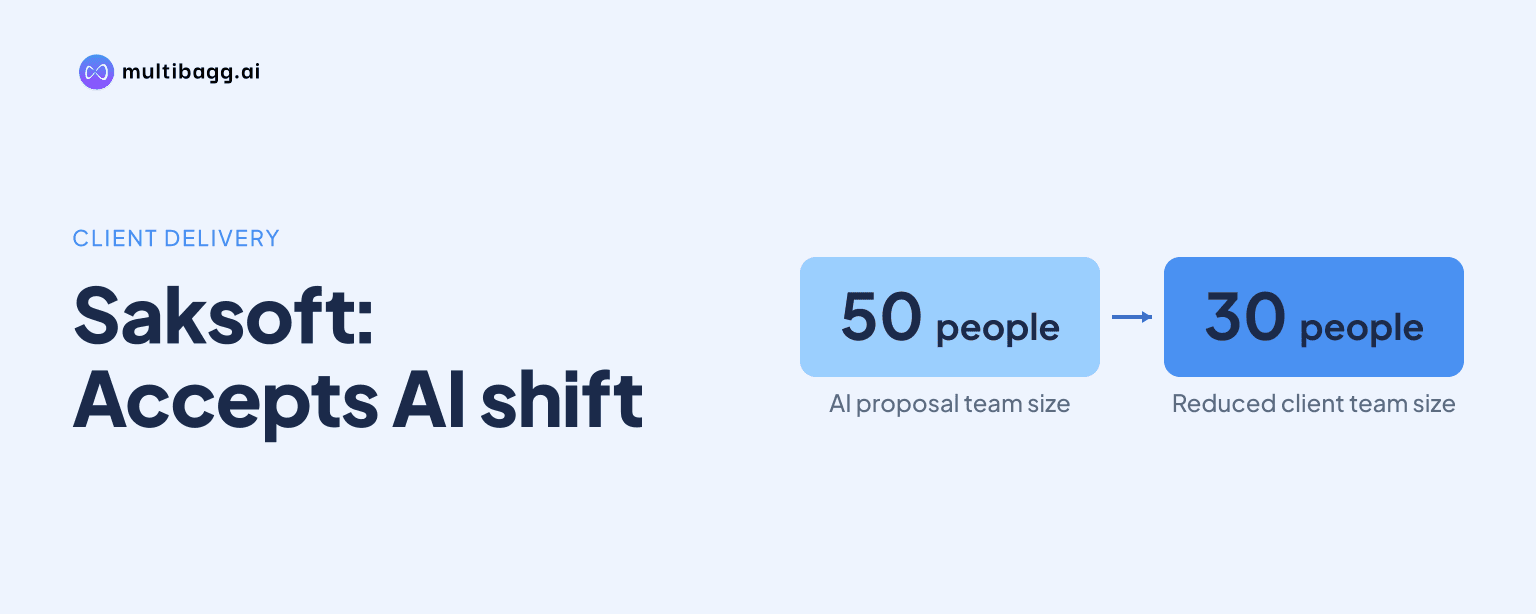
In the second quarter of financial year 2027, Saksoft accepted revenue cannibalisation as artificial intelligence reduced a cited client team from 50 to 30 people. Management said the lower near-term billable headcount should support outcome-based work, better pricing in some cases and larger client engagements over the medium term.
Know Saksoft inside out
Results, valuation, peers and who's buying, in one view.
Why is Saksoft accepting AI-driven revenue cannibalisation?
Saksoft is accepting lower near-term revenue because it is offering clients AI-led productivity improvements before a competitor or the client’s own captive operation does so. Management described a proposal to reduce a 50-member delivery team to 30 while improving efficiency, saying this makes Saksoft a co-innovation partner rather than a supplier retaining an older staffing model.
The immediate revenue effect comes from fewer billable people, not from reported contract-rate cuts. Management said productivity gains of 30% to 50% in product engineering and 20% to 30% in managed services remain broadly accurate. It said a hypothetical 40% efficiency gain can shrink a team by the same proportion, while higher prices cannot fully replace the resulting revenue loss.
This policy coincides with muted reported growth. Revenue from operations was about Rs 249 crore in the second quarter of financial year 2027, broadly flat from the first quarter, while first-half revenue was about Rs 497 crore, down 2% year on year. Management said maintaining quarterly revenue while AI reduces client team requirements represents progress that is not yet visible in top-line growth.
How will Saksoft make outcome-based contracts more central?
Saksoft plans to make outcome-based delivery more central by owning a defined client result rather than principally providing named employees. Management said this model is stickier than people-based delivery because clients can hire, replace or insource staff, whereas an outcome arrangement leaves Saksoft responsible for the agreed operational or project result.
Management did not disclose the current percentage of revenue generated under outcome-based contracts or set a dated mix target. It said one internal indicator is the number of customers that do not interview individual Saksoft employees, because that suggests Saksoft controls the project outcome. Management said this indicator has increased significantly but will provide a quantified outcome-based figure later.
Management expects the model to support margins over time through better pricing and reduced workforce requirements. However, it said margins are unlikely to return to the 19% to 20% range in the next two quarters because Saksoft is investing in sales and leadership while making the delivery transition. It expects a possible slight effect from these costs over the next one or two quarters.
What customer demand supports Saksoft's AI transition?
Saksoft said customers are moving from AI experimentation towards enterprise use, although it is too early to see immediate gains in wallet share. The company is using AI accelerators and platforms in client discussions, alongside free proof-of-concepts, to show how its product engineering and managed-services delivery can be made more efficient.
Management identified engineering and operations as the two service areas seeing the most demand. Engineering work can be a one-time development project or a maintenance extension, while managed operations includes infrastructure and application support. Management said operations engagements can last two, three or even five years, potentially providing a longer contract duration than individual engineering projects.
The transition must be applied across a relatively concentrated set of major accounts. Saksoft reported 16 clients generating annual revenue above USD1 million each, and its top 10 customers accounted for about 58% of revenue. Management said it cannot stagger AI proposals among major customers because delaying the offer raises the risk that another supplier will introduce the productivity change first.
Got a follow-up? Ask IRIS
What do Saksoft's results show about the transition cost?
Saksoft’s first-half financial results show pressure on both revenue and operating profitability. Operating earnings before interest, tax, depreciation and amortisation, or EBITDA, were about Rs 89 crore in the first half of financial year 2027, down 8% year on year. The EBITDA margin contracted by 107 basis points to 17.93%, while profit after tax was about Rs 61 crore and its margin fell 111 basis points to 12.35%.
The second quarter had a different sequential pattern despite revenue remaining broadly flat at about Rs 249 crore. Quarterly EBITDA was about Rs 44 crore, down 4% from the first quarter, and the EBITDA margin moderated by 66 basis points to 17.6%. Profit after tax, however, rose 10% sequentially to about Rs 32 crore, with the margin increasing by 114 basis points to 12.92%.
Saksoft did not attribute the current performance to low delivery utilisation. Employee utilisation excluding trainees was 84%, while total headcount was 2,393, comprising 2,203 technical professionals and 190 support staff. Net cash, excluding long-term and short-term debt, stood at about Rs 244 crore on September 30, 2026.
Can Saksoft improve growth while changing its delivery model?
Management said the second half of financial year 2027 will be better than the first half, with improvement expected quarter by quarter. It also said that if its non-linear initiatives do not materialise, full-year revenue could be around Rs 1,100 crore. Management called the earlier revenue ambition difficult after two broadly flat quarters, rather than withdrawing its longer-term growth plans.
The stated growth plan combines acquisitions with partner-led demand. Management said Saksoft has partnerships with ServiceNow and Salesforce but has historically not captured enough business through those relationships. Partner-led work should not require acquisition capital because the needed capabilities already exist, while acquisitions would be funded primarily through internal cash and structured payouts, management said.
United States conversion is a key operational issue because the region supplied 51% of first-half revenue, compared with 28% from Europe and 21% from Asia-Pacific and other regions. Management said conversions have been good in the United Kingdom and Europe but slower than expected in the United States. The new chief executive officer’s location in the New York region is intended to add follow-up discipline to that pipeline.
Conclusion
Saksoft is deliberately accepting AI-related revenue cannibalisation to change its commercial position with clients. The 50-to-30 team example and productivity gains of up to 50% in product engineering explain why reported revenue can remain flat even as management seeks deeper relationships, outcome ownership and additional client work. First-half revenue of about Rs 497 crore and a 17.93% EBITDA margin show that the transition’s near-term cost remains visible.
Next, management’s plan calls for better second-half financial year 2027 performance, stronger United States pipeline conversion and more partner-led demand through ServiceNow and Salesforce. Saksoft has also said it will provide a quantified measure of outcome-based work, while the next one or two quarters may still reflect sales, leadership and delivery-model investment costs.