










Saksoft resets US sales as pipeline conversion remains too slow
Key highlights
- Saksoft said US pipeline conversion is slower than expected, while UK and Europe conversions have been good.
- Saksoft wants the US to contribute at least 55% of revenue in the near term.
- Sales cost is roughly 3% of Saksoft’s total cost, and management plans to increase it in phases.
- Management cited AI productivity gains of around 30% to 50% in product engineering and 20% to 30% in managed services.
powered by IRIS
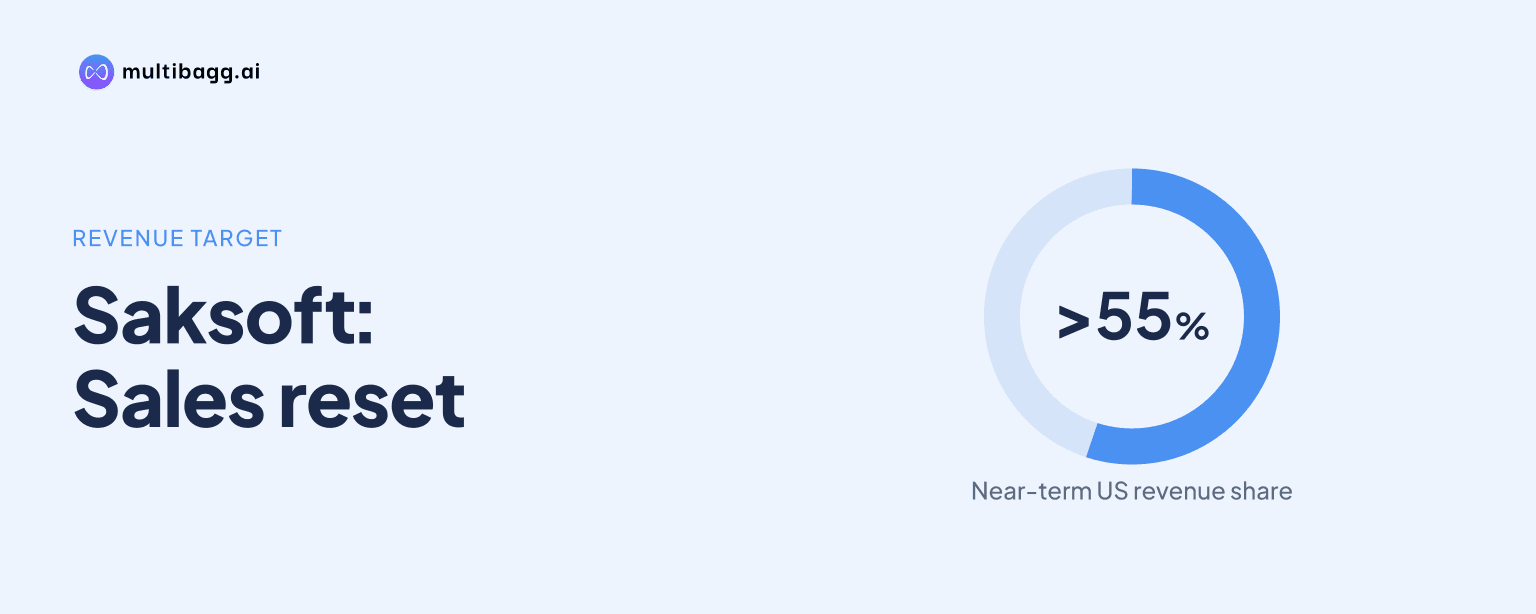
In the first half of fiscal year 2027 (H1 FY27), Saksoft said its United States (US) pipeline was converting too slowly and will reinforce executive follow-up, refresh US client-partner coverage and raise sales spending from roughly 3% of total cost. Management still wants the US to provide at least 55% of revenue in the near term.
Know Saksoft inside out
Results, valuation, peers and who's buying, in one view.
Why is Saksoft resetting its US sales approach?
Saksoft is resetting US sales because its pipeline has not turned into business at the pace management expected. Aditya Krishna said conversions had been good in the United Kingdom (UK) and Europe, but US opportunities were taking longer to materialise despite the pipeline remaining available.
Management said the problem was its own conversion rigour rather than a disappearance of opportunities. Krishna said more personal follow-up was needed and cited having a chief executive officer based in the Northeast as part of that effort, adding that he expected the second half of FY27 to be better than the first half.
The gap between the US and UK-Europe is central to the company’s diagnosis. Saksoft reported good conversions in the latter two markets, while identifying slower US conversion as the area that “has to change,” indicating an execution issue in its largest intended growth geography rather than a broad pipeline shortage.
How important is the US to Saksoft’s growth plan?
Saksoft wants the US to contribute at least 55% of revenue in the near term. Avantika Krishna said US growth is the focus alongside the UK and Europe, while management did not disclose the current exact US revenue contribution for H1 FY27 during the call.
The company’s other geographic priority is Asia-Pacific (APAC), particularly global capability centres (GCCs) in India and Singapore. Saksoft already works with some GCCs in India, but management said this had not been a focus previously and that Gurmeet’s GCC experience would support the effort.
Management said it would concentrate on the US, UK, Europe and APAC rather than add another geography. There is no plan to appoint APAC leadership now, which leaves the immediate sales build concentrated on the US, where the company is planning new client-partner talent and front-end sales investment.
What changes is Saksoft making to US sales?
Saksoft plans to refresh US client-partner staffing and increase sales investment in phases. Management said one client partner had left and been replaced, and that the US, more than Europe, would see further changes as the company brings in talent it considers more relevant.
Sales cost is roughly 3% of Saksoft’s total cost, and management said it wants to raise that proportion. Krishna said the increase would be phased as the company sees better quarter-on-quarter performance, rather than committed to a disclosed fixed spending target.
Gurmeet’s physical presence in the New York region is also intended to improve opportunity follow-up. Krishna said the US pipeline had not “fallen off” and attributed the conversion problem to insufficient rigour, making leadership attention, client-partner coverage and additional sales capacity the management-stated mechanisms for improvement.
Got a follow-up? Ask IRIS
What is holding back Saksoft’s near-term revenue growth?
Saksoft said artificial intelligence (AI)-driven efficiency and customer insourcing are reducing near-term revenue in some work. Management cited AI productivity gains of around 30% to 50% in product engineering and 20% to 30% in managed services, which can reduce client team sizes.
Management said clients are not imposing contract rate cuts; rather, revenue declines when AI allows the same work to be delivered by fewer people. Saksoft can offset part of that reduction through higher rates, but Krishna said pricing could not fully compensate for a hypothetical 40% reduction in team size in the short term.
Some customers have also moved work, or are moving work, to captives in India or other locations. Separately, management said retail weakness reflected a few projects ending with existing customers, not the loss of a client, and it expects outcome-based work and AI-enabled delivery to help address these effects.
Which services are producing Saksoft’s pipeline?
Saksoft said product and platform engineering are producing the most traction, followed by managed operations. Management identified infrastructure and application support as operations areas where contracts can run for two, three or sometimes five years, compared with engineering projects that can be one-time assignments or extend into maintenance.
About 50% of Saksoft’s work comes from product and platform engineering, according to management. It described this work as AI-related because customers are positioning AI in their products, while operations work uses AI to reduce ticket volumes and ticket data.
Saksoft is also seeking more outcome-based work, but did not disclose its current share or a fiscal year 2028 or fiscal year 2029 target. Management said it tracks the number of customers that do not interview individual employees as one indicator of delivery control, and said that number has increased without providing a figure.
How could the sales reset affect Saksoft’s margins?
Saksoft expects sales and leadership hiring to create a minor margin impact for the next one or two quarters. Niraj Kumar Ganeriwala said costs arrive before related revenue, but that revenue should rise with the investments and the effect should subsequently stabilise.
Management said earnings before interest, tax, depreciation and amortisation (EBITDA) margin could return to 19% to 20% over the next two to three years. It said that range would not be reached in the next two quarters because of sales and leadership investment and the move toward an outcome-based model.
Saksoft also said it is working on non-linear options to get close to its Rs 1,250 crore FY27 revenue guidance if those options work. Management did not define those options or provide a probability of reaching the target, leaving US conversion and the pace of sales investment as important variables.
Conclusion
Saksoft’s disclosed issue is an execution gap between a continuing US pipeline and the pace at which it becomes revenue. The company is addressing that gap through executive follow-up, changes to US client-partner coverage and phased sales spending above the current roughly 3% of total cost, while AI efficiency and customer insourcing affect current revenue.
The next event to watch is management’s expected improvement in the second half of FY27 relative to the first half. Saksoft’s progress can be assessed through US conversion against the at-least-55% revenue objective, the planned sales-cost increase, any update on outcome-based work, and management’s ability to approach the Rs 1,250 crore FY27 revenue target.