










Sambhv targets Rs 2,000 crore FY28 stainless sales at Kesda
Key highlights
- Sambhv said its 360,000-tonne Kesda stainless-steel facility remains on track for March 2027 operations.
- Management aspires to add about Rs 2,000 crore of FY28 stainless-steel sales from 100,000 to 120,000 tonnes.
- Kesda will target 0.1 mm to 0.4 mm coil, compared with Sambhv’s existing 0.4 mm to 0.9 mm range.
- Management targets 30% to 35% Kesda utilisation in the first year and 60% to 65% by FY29.
powered by IRIS
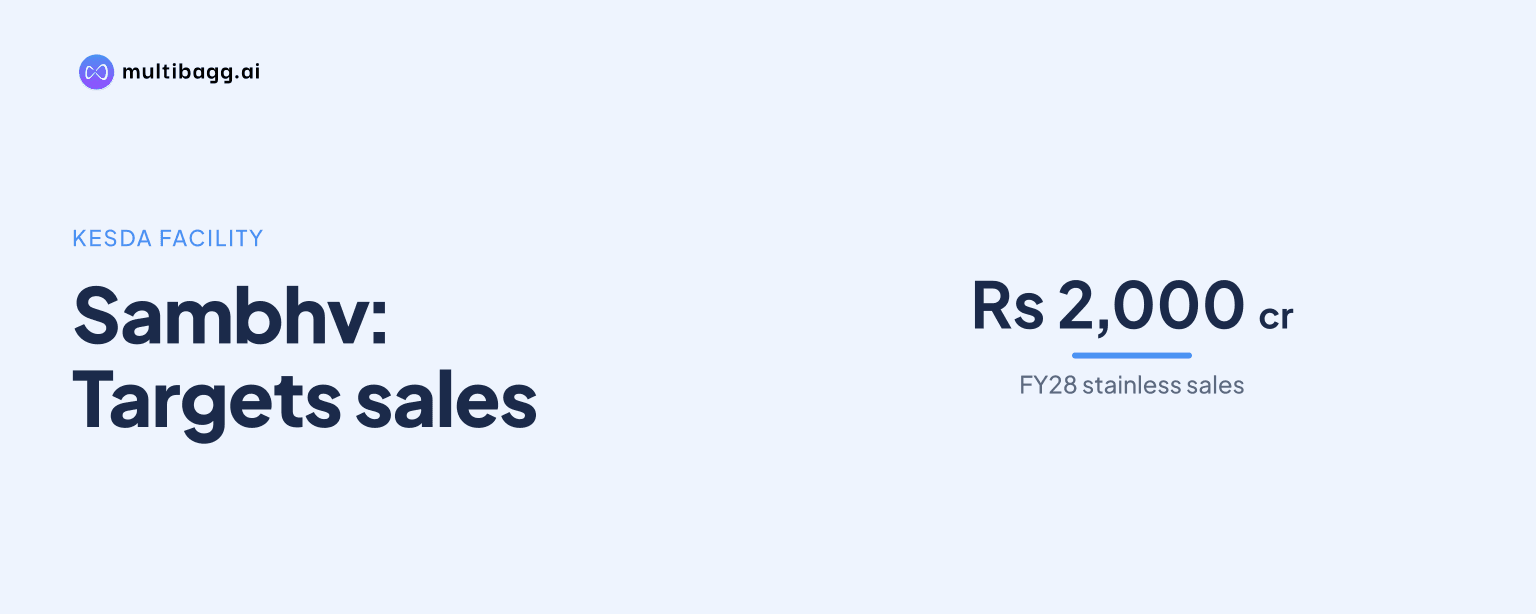
Sambhv Steel Tubes expects its 360,000-tonne Kesda stainless-steel facility to add about Rs 2,000 crore of sales in FY28, based on planned stainless-steel sales of 100,000 tonnes. Management said the March 2027 project will make 0.1 mm to 0.4 mm coil, a range it says India currently imports.
Know Sambhv Steel Tubes inside out
Results, valuation, peers and who's buying, in one view.
What is Sambhv building at Kesda and when will it start?
Sambhv is building a 360,000-tonne integrated stainless-steel facility at Kesda that management said is on track to be operational by March 2027. The project is part of the company’s current capital-expenditure cycle, which also includes additions in pipe manufacturing and captive power, but Kesda is the stainless-steel expansion intended to supply thinner coil grades.
The existing stainless-steel operation makes cold-rolled coils from 0.4 mm to 0.9 mm thick and runs at about 60% capacity utilisation, according to management. Kesda will move into the 0.1 mm to 0.4 mm range, with coil width of about 600 mm, creating a product range that differs from the current facility rather than simply duplicating it.
Sambhv expects Kesda to operate at about 30% to 35% utilisation in its first year and to reach 60% to 65% by FY29. Management said integrated stainless-steel coil manufacturers globally operate at roughly 60% to 65% utilisation, while adding that lower thickness products tend to have lower utilisation. The FY28 sales plan therefore reflects an initial ramp-up rather than full use of the 360,000-tonne capacity.
Why is Sambhv targeting thin-gauge stainless-steel imports?
Sambhv says Kesda is aimed at import substitution in 0.1 mm to 0.4 mm stainless-steel coil, which management described as currently imported into India. Its present 0.4 mm to 0.9 mm product range serves an adjacent segment, while the proposed 600 mm-wide Kesda output is intended to address specifications that management says are unavailable from domestic suppliers.
Management said India has three integrated stainless-steel coil manufacturers but lacks a complete domestic product spectrum. It identified utensil, water-bottle, decorative-product and certain pipe manufacturers as downstream users that rely on imported coil where Indian supply does not match their requirements. This is Sambhv’s stated rationale for adding capacity despite imports of 200-series stainless steel remaining a market consideration.
Sambhv also expects shorter supply lead times to support customer adoption. Management said import-dependent buyers may pay traders in advance and wait two to three months for material, whereas the company expects to offer delivery in about 15 days from the new facility, along with payment facilities. These are management’s intended commercial arrangements, not disclosed customer contracts or committed order volumes.
The potential product mix differs from Sambhv’s current sales profile. Management said current stainless-steel sales are about 90% 200 series and 10% 300 series, and indicated that this remains the existing mix. For its Rs 2,000 crore FY28 illustration, however, management used a 50-50 split between 200-series and 300-series products, implying a different mix for the incremental sales assumption.
Got a follow-up? Ask IRIS
How does Sambhv arrive at its Rs 2,000 crore FY28 target?
Sambhv’s approximately Rs 2,000 crore FY28 stainless-steel sales target is based on an assumed 100,000 tonnes of sales with an equal mix of 200-series and 300-series material. Management separately said it aspires to add 100,000 to 120,000 tonnes of stainless-steel sales in FY28. The figure is a management aspiration associated with the Kesda ramp-up, not reported sales or a completed order book.
The stainless-steel estimate is the largest component of management’s wider FY28 projection for the current capital-expenditure programme. Sambhv said an additional 50,000 tonnes of mild-steel pipe sales from its direct forming technology, or DFT, mill could add about Rs 300 crore. It consequently estimated total additional FY28 sales of about Rs 2,300 crore to Rs 2,400 crore from the ongoing projects.
Management also cited a production-linked incentive, or PLI, scheme as part of its Kesda commercial case. Sambhv said it expects an incentive equivalent to around 10% of sales revenue from the Government of India for the new stainless-steel plant. Management said this could give it scope to undercut Chinese imports to some extent, although it did not disclose a realised incentive amount, payment schedule or final pricing policy.
What could determine whether Sambhv meets the Kesda ramp-up plan?
Sambhv’s FY28 sales aspiration depends first on commissioning Kesda by March 2027 and then reaching its stated 30% to 35% initial utilisation level. Management confirmed the project was on track as of the call, but it expects the 60% to 65% utilisation range only by FY29. Product qualification and customer acceptance will also matter because the company is entering the 0.1 mm to 0.4 mm coil segment.
Imports and regulatory conditions remain relevant to the stainless-steel market. Management said stainless-steel earnings before interest, tax, depreciation and amortisation, or EBITDA, were about Rs 12,000 to Rs 13,000 per tonne in the second quarter despite imported products being available in the market. It said it considered that range sustainable in the third and fourth quarters, but this was management’s view and was linked to prevailing market conditions.
The expansion cycle is also expected to lift leverage from the first-half level. Management said net debt to operating EBITDA was 1.04x in the first half and could increase to about 1.4x to 1.5x as Kesda comes online. That projected change coincides with the commissioning of the 360,000-tonne facility and the broader programme’s targeted FY28 sales additions of up to Rs 2,400 crore.
Conclusion
Sambhv is positioning Kesda as a shift into thinner, imported stainless-steel coil grades rather than an extension of its existing 0.4 mm to 0.9 mm range. Management’s Rs 2,000 crore FY28 sales aspiration rests on early sales of 100,000 tonnes, a planned 50-50 product mix between 200 and 300 series, and its expectation of a PLI benefit worth around 10% of sales.
The next disclosed milestone is the planned March 2027 commissioning, followed by the first-year 30% to 35% utilisation ramp and management’s FY29 target of 60% to 65%. Investors can also watch whether Sambhv delivers its stated 100,000 to 120,000 tonnes of FY28 stainless sales and whether net debt to operating EBITDA remains within management’s indicated 1.4x to 1.5x range.