










Sambhv Steel Tubes Q2 EBITDA per tonne normalises to Rs 8,200
Key highlights
- Sambhv Steel Tubes reported Q2 FY27 blended EBITDA of Rs 8,200 per tonne, versus about Rs 8,800 in Q1 FY27.
- Sambhv Steel Tubes reported Q2 FY27 revenue of Rs 840 crore, EBITDA of Rs 105 crore and profit after tax of Rs 61 crore.
- Sambhv Steel Tubes said MS Pipes & Tubes and coated-product EBITDA reached Rs 9,000 and Rs 7,000 per tonne, respectively.
- Sambhv Steel Tubes said value-added-product sales volume rose 27% year on year in Q2 FY27.
powered by IRIS
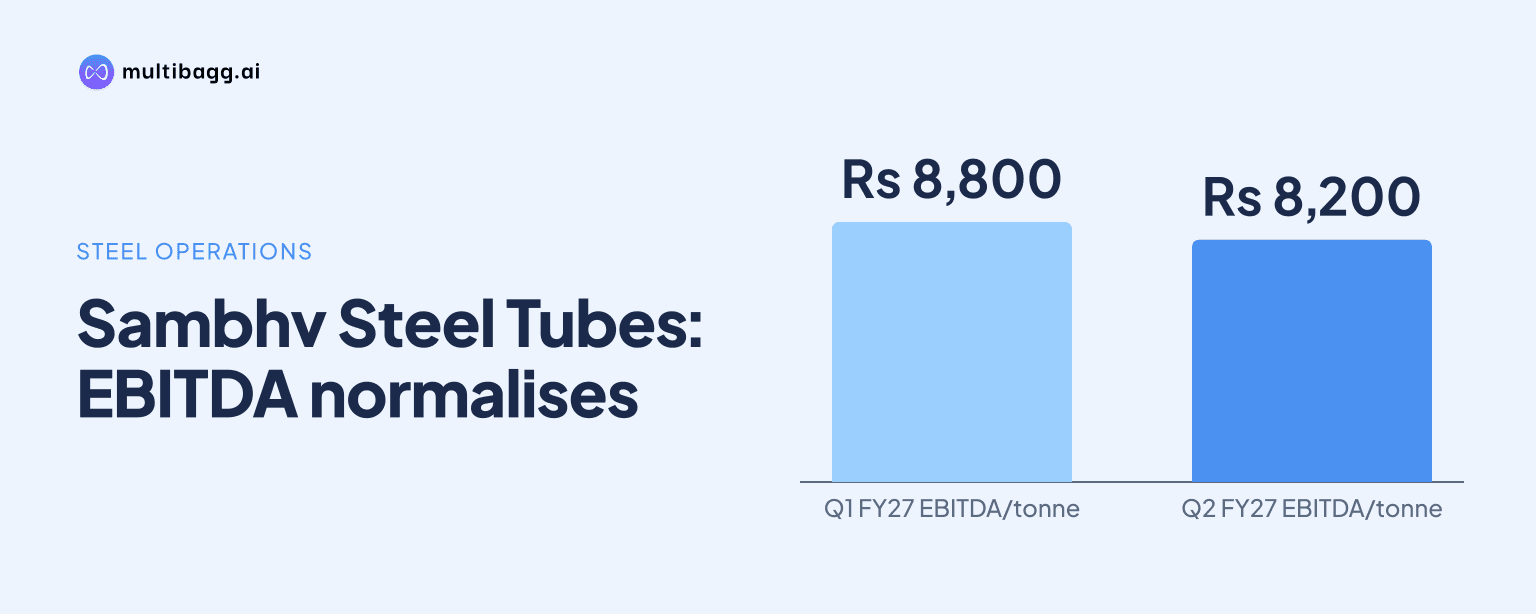
Sambhv Steel Tubes Limited reported Q2 FY27 blended EBITDA of Rs 8,200 per tonne, versus about Rs 8,800 in Q1 FY27, as monsoon-related raw-material yield effects and Chinese stainless-steel imports reduced the blended result. Sambhv Steel Tubes nevertheless reported Rs 105 crore of EBITDA on Rs 840 crore of revenue in the quarter.
Know Sambhv Steel Tubes inside out
Results, valuation, peers and who's buying, in one view.
Why did Sambhv Steel Tubes' Q2 EBITDA per tonne decline?
Management attributed the roughly Rs 600-per-tonne sequential reduction primarily to monsoon-related raw-material yield effects, stainless-steel pricing pressure and normalisation after an unusual Q1 FY27 pricing period. It said moisture in raw material during the monsoon raises costs through the yield factor, while the largest incremental sales-volume growth in Q2 came from the MS Pipes & Tubes segment.
An analyst noted that value-added products accounted for about 93% of Q2 FY27 volume, compared with about 94% in Q1 FY27, while intermediate sales rose to roughly 9,100 tonnes from 6,600 tonnes. Sambhv Steel Tubes did not quantify how much either movement affected the Rs 600-per-tonne change. Management said the blended figure reflected an unweighted average of product-level EBITDA and sales volumes.
Management described Q1 FY27 as an outlier because a war-related period lifted selling prices while its raw-material costs did not rise to the same extent. It said prices began normalising in Q2 FY27 and were continuing to normalise in Q3 FY27. On that basis, management called the Q2 outcome a sustainable number for the market conditions then prevailing.
Which products supported Sambhv Steel Tubes' Q2 margins?
MS Pipes & Tubes and coated products supported Q2 FY27 margins, with management saying their EBITDA per tonne increased to Rs 9,000 and Rs 7,000, respectively. These segment figures were above the Rs 8,200 blended result because stainless steel experienced a separate pricing and margin pressure. Management said other product categories had sales volumes that were almost identical to Q1 FY27.
Stainless steel was the principal counterweight to the higher MS and coated-product figures. Sambhv Steel Tubes said relaxed Quality Control Order, or QCO, requirements and heavy imports from China of 200-series and 300-series coils forced it to lower stainless-steel prices. Management described the Chinese material as being sold below production cost and said the company still generated about Rs 12,000 to Rs 13,000 per tonne of EBITDA in stainless steel.
The Q2 FY27 movement was therefore not a uniform weakening across product lines. MS Pipes & Tubes supplied most incremental volume, while imported stainless-steel coil affected domestic stainless pricing. Separately, Sambhv Steel Tubes reported that value-added-product sales volume increased 27% year on year during the quarter, consistent with management's stated focus on product mix.
Got a follow-up? Ask IRIS
Is stainless-steel demand holding up for Sambhv Steel Tubes?
Management said stainless-steel demand was holding up, with double-digit growth, despite lower pricing caused by imported supply in Q2 FY27. It estimated Indian stainless-steel coil demand at around 4 million tonnes to 5 million tonnes a year. According to management, domestic production remains below this consumption level, making imports necessary to avoid an abnormal domestic price increase.
Sambhv Steel Tubes distinguished demand conditions from supply-side competition. It said the government was balancing imports and domestic production, while the production-linked incentive, or PLI, scheme encourages alloy and stainless-steel output. At the same time, management said imports of Chinese 200-series and 300-series coil were causing price pressure in the domestic market.
Management said it expected the government to take a hard call by March 2027 on allowing low-priced imports. It said authorities were, to its knowledge, evaluating a minimum import price for 200-series material, anti-dumping action specifically for 300-series material and restrictions involving other stainless-steel raw materials made in India. These were management's views on potential policy measures, not announced government actions.
How does integration affect Sambhv Steel Tubes' margin outlook?
Sambhv Steel Tubes said more than 80% of its coil requirement is produced in house, reducing its exposure to outside coil availability. Management said it procures less than 4,000 tonnes to 5,000 tonnes of coil from the market, mainly for pipes and tubes above 5 inches and coated products. It said this limited external requirement meant it was not facing an availability issue in hot-rolled coil.
Management linked the integrated model to its ability to operate during reported market shortages. Its position was that internally made coil gives it supply-chain control when buyers dependent on a small number of external coil producers face tighter availability. The call did not quantify how much in-house coil production contributed to Q2 FY27 EBITDA.
The wider Q2 FY27 financial results provide context for that explanation. Sambhv Steel Tubes reported Rs 840 crore of revenue, Rs 105 crore of EBITDA, Rs 61 crore of profit after tax and Rs 213 crore of operating cash flow. It also reported EBITDA margin of more than 12% and profit-after-tax margin of more than 7%, while management said Q2 is traditionally a lower-margin quarter for steel companies because of monsoon conditions.
Conclusion
Sambhv Steel Tubes' Q2 FY27 blended EBITDA reduction of about Rs 600 per tonne reflected several disclosed factors: monsoon-related yield costs, normalisation from Q1's exceptional selling-price conditions and lower stainless-steel pricing amid Chinese coil imports. Segment performance differed, as MS Pipes & Tubes and coated products recorded Rs 9,000 and Rs 7,000 of EBITDA per tonne, respectively, while stainless steel faced import-led price pressure.
The next disclosures to watch are any policy action by March 2027 on low-priced stainless-steel imports and progress at the Kesda and Sarora expansions. Sambhv Steel Tubes aims to increase finished-product capacity from 0.6 million tonnes to more than 2 million tonnes by 2030, and has announced a Rs 148 crore stainless-steel seamless-pipes and tubes project with annual capacity of 14,400 tonnes.