










Sambhv Steel Tubes Plans 14,400-Tonne Seamless Pipe Plant
Key highlights
- Sambhv Steel Tubes plans 14,400 tonnes per year of seamless-pipe capacity with Rs 148 crore of initial investment.
- The first phase will use domestic round bars and in-house piercing and pilgering lines.
- Management expects about 1.5 years for construction and the start of production.
- Management estimated 10,000 tonnes of FY30 output could generate about Rs 400 crore of revenue.
powered by IRIS
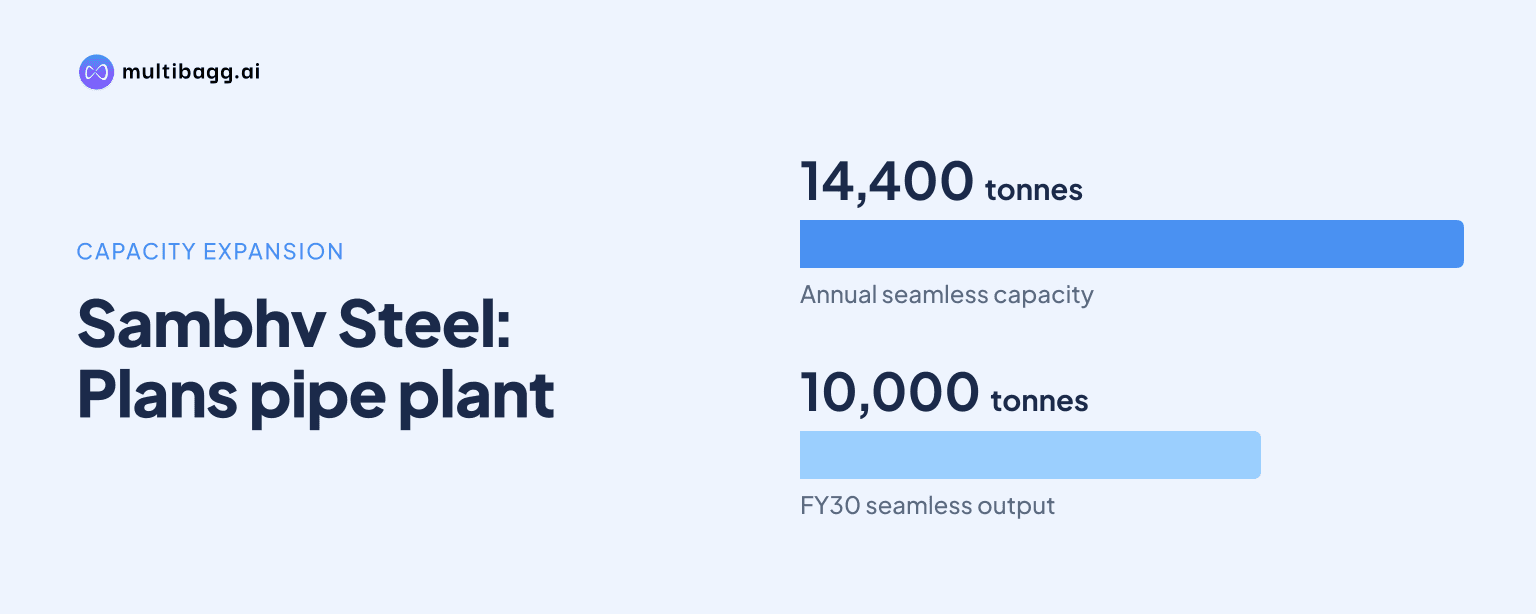
Sambhv Steel Tubes Limited plans a 14,400-tonne-per-year stainless-steel seamless-pipe plant with initial investment of Rs 148 crore, using piercing and pilgering lines while purchasing round bars from domestic suppliers. Management said on its Q2 FY27 call that production is expected to begin after roughly 1.5 years of project execution.
Know Sambhv Steel Tubes inside out
Results, valuation, peers and who's buying, in one view.
Why is Sambhv Steel Tubes entering seamless pipes?
Sambhv Steel Tubes is entering seamless pipes because management expects rising demand from domestic engineering and industrial projects over the next decade. On the Q2 FY27 call, management cited semiconductor facilities, data centres, green hydrogen, coal gasification, aerospace, defence and nuclear power as potential demand areas for stainless-steel and alloy seamless pipes.
The company also identified established applications in oil and gas, food processing, pharmaceuticals, fertiliser, power generation and automotive manufacturing. Management estimated the documented Indian market for seamless pipes at 2 lakh to 3 lakh tonnes a year, while saying an unquantified latent market exists where users employ carbon seamless pipes when stainless-steel or alloy pipes are unavailable.
Management said traditional industrial users are adding capacity and have replacement requirements, while overseas oil exploration and energy-security activity is supporting demand in Russia, Europe, the United States and Latin America. These are management views on market demand, rather than a forecast of Sambhv Steel Tubes’ sales or market share.
The proposed plant broadens Sambhv Steel Tubes’ stainless-steel activity from flat products into seamless pipes. Management said the first phase will focus on 300-series products, particularly 304 and 316 grades, and cited domestic and export demand for 304L and 316 pipes. Martensitic and nickel-alloy seamless pipes are not part of the initial plan.
How will Sambhv Steel Tubes manufacture seamless pipes?
Sambhv Steel Tubes will use piercing followed by pilgering to manufacture seamless pipes in the first phase. Management said piercing and extrusion products are accepted by government agencies, high-value engineering companies and end users, but described piercing as more capital-efficient and lower in conversion cost than extrusion.
The first phase will include the company’s own piercing line and pilgering line. Sambhv Steel Tubes will procure stainless-steel round bars, convert them into mother hollows through piercing, and then make seamless pipes through the pilgering process. This gives the company control over hollow making and pipe conversion, but not over round-bar manufacturing.
Management said domestic round-bar producers have available capacity and can supply the required grades and sizes. It also said the company does not intend to import round bars for the initial 14,400-tonne project, noting that round bars have uses across wire, bars, hexagonal bars, square bars, angles and channels.
A later phase could add a steel melting shop, round mill and captive power plant, according to management. The company said full backward integration would be considered in Phase 2 or Phase 3, rather than being included in the initial mother-hollow and pipe-making project.
What is Sambhv Steel Tubes spending and when could output begin?
Sambhv Steel Tubes has identified Rs 148 crore of initial investment for the 14,400-tonne seamless-pipe facility, although management also referred to the project as a Rs 150 crore investment during the call. Management said this project is separate from the previously announced Rs 1,200 crore capital-expenditure programme.
The company said technical studies for the project had been conducted for 2 to 3 years and land acquisition was at a final stage during the Q2 FY27 call. Management said it was close to signing for plant and machinery and had received Rs 25 crore in warrant proceeds for plant-and-machinery and land-acquisition payments.
Management expects about 1.5 years to spend the initial capital expenditure, construct the facility and start production. It separately said that customer approvals from original equipment manufacturers, or OEMs, and critical-equipment manufacturers could take another 1 to 2 years after output begins.
For FY30, management indicated that production could reach at least 10,000 tonnes, compared with installed annual capacity of 14,400 tonnes. At that output level, management estimated about Rs 400 crore of revenue, a 15% to 16% normalised earnings before interest, tax, depreciation and amortisation, or EBITDA, margin, and Rs 60 crore to Rs 70 crore of EBITDA by the second year of full operations.
Got a follow-up? Ask IRIS
How will Sambhv Steel Tubes sell its first seamless pipes?
Sambhv Steel Tubes expects to start with the commercial replacement and trader market, where specified OEM approvals may not be required. Management said it had spent 1 to 2 years identifying sales, marketing and liaison staff and building market touchpoints before the planned production start.
The company said it expects to pursue domestic OEM and critical-equipment approvals after production begins, with approvals potentially taking 1 to 2 years. Its stated sequence is commercial sales first, followed by supplies to approved domestic customers and engagement with international warehouse operators, traders and other market participants.
Management said Sambhv Steel Tubes has received approval under the Production-Linked Incentive, or PLI, scheme and signed a memorandum of understanding under PLI 1.2 for seamless-pipe sales to priority sectors. It said sales to sectors such as data centres, semiconductors, defence and nuclear applications could receive an incentive of about 13% of revenue, but did not disclose the eligible revenue base or total incentive amount.
The company cited current seamless-pipe delivery lead times of 6 to 8 months as part of its market rationale. Management said India has four to five producers with capacity above 10,000 tonnes, another 7 to 10 producers with capacity between 2,000 and 10,000 tonnes, and predominantly imported supply for pipes above 6 inches.
What could later expansion involve?
Sambhv Steel Tubes said a further Rs 400 crore of investment in the seamless-pipe business is an aspiration rather than an approved commitment. Management said the amount could be used for backward integration and for scaling up the 14,400-tonne capacity after the initial facility starts production and its performance can be assessed.
Management said later funding could be split equally between internal accruals and debt or a future equity-raising event. It also said capacity could be doubled or tripled if the market accepts the products and the company obtains major domestic and international customer approvals.
The seamless-pipe expansion is over and above Sambhv Steel Tubes’ Vision 2030 plan to increase finished-product capacity from 0.6 million tonnes to more than 2 million tonnes. Management said the seamless-pipe project will be housed in a subsidiary and that any larger integrated expansion would be considered after the first 14,400-tonne facility is operational.
Conclusion
Sambhv Steel Tubes’ entry plan is a staged move into stainless-steel seamless pipes: a 14,400-tonne annual facility using in-house piercing and pilgering, initially supplied by domestic round-bar manufacturers. The Rs 148 crore first phase limits the initial upstream investment while targeting commercial replacement demand before OEM-approved and critical-application sales.
The next disclosed milestones are completion of land acquisition, signing of plant-and-machinery contracts and progress toward production in roughly 1.5 years. Management’s potential Rs 400 crore expansion, backward integration and possible doubling or tripling of capacity remain dependent on initial project performance, market acceptance and customer approvals.