










Sambhv Steel Tubes targets September 2027 capacity launch
Key highlights
- Kesda's 3.6 lakh-tonne stainless-steel facility and 25 MW power plant are scheduled to be live by March 2027.
- Sambhv's 30 MW Sarora captive-power plant is planned for September 2027 and targets Rs 60 crore to Rs 70 crore of annual savings.
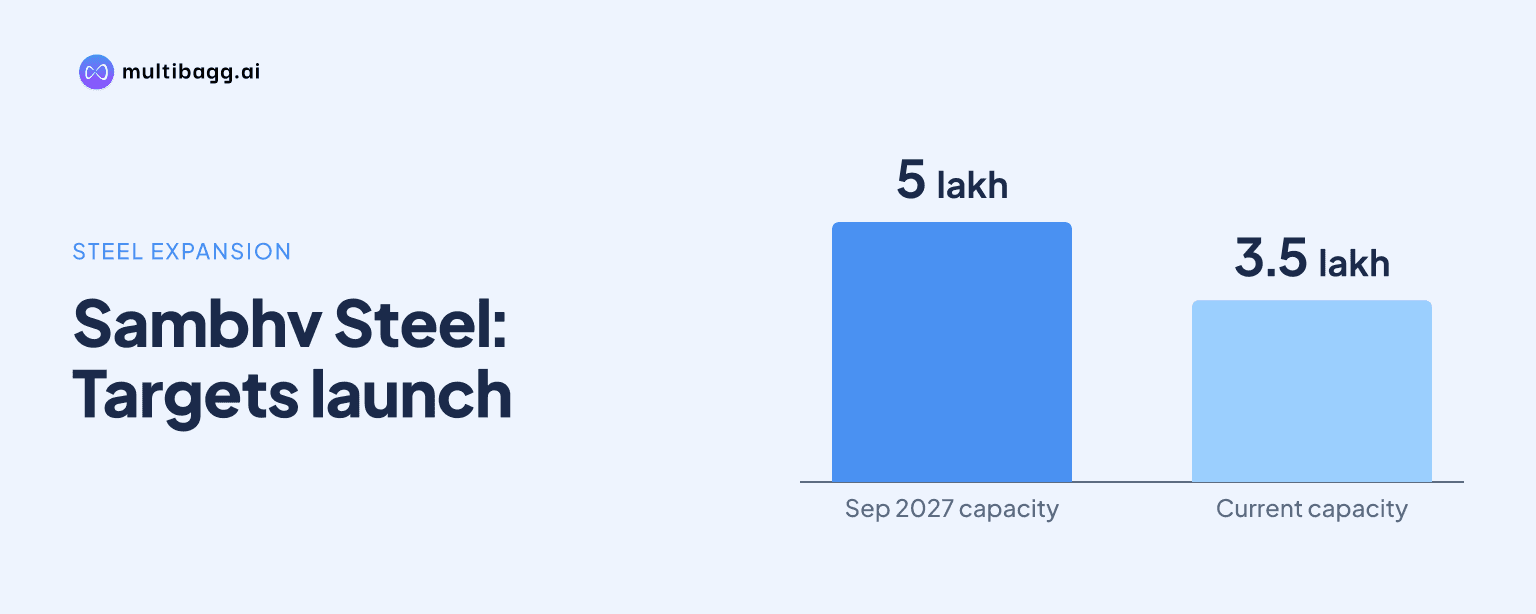
- The DFT pipe expansion is scheduled for September 2027 and will raise capacity to 5 lakh tonnes from 3.5 lakh tonnes.
- Management expects the current capex cycle to add about Rs 2,300 crore to Rs 2,400 crore of FY28 sales.
powered by IRIS
Sambhv Steel Tubes said its 30-megawatt Sarora captive-power plant and 1.5 lakh-tonne DFT pipe expansion are scheduled to be live by September 2027, following the March 2027 launch planned for its 3.6 lakh-tonne Kesda stainless-steel facility. Management expects Sarora alone to reduce annual costs by at least Rs 60 crore to Rs 70 crore.
Know Sambhv Steel Tubes inside out
Results, valuation, peers and who's buying, in one view.
What is Sambhv's capex commissioning timetable?
Sambhv has set March 2027 for the Kesda integrated stainless-steel facility and September 2027 for both the Sarora power project and the DFT-route pipe expansion. The Kesda project combines 3.6 lakh tonnes of stainless-steel capacity with a 25-megawatt power plant intended to meet that facility's energy requirement. Management said the Kesda project was on track when asked about its timing.
The September 2027 projects address two operating needs: electricity sourcing at Sarora and pipe-making capacity. Management said the Sarora unit currently procures around 50% of its electricity requirement from the grid at Rs 7.50 to Rs 8. Separately, the brownfield DFT expansion will lift total pipe-manufacturing capacity to 5 lakh tonnes from 3.5 lakh tonnes, adding 1.5 lakh tonnes.
The sequence places the seamless-pipe manufacturing plant later, with March 2028 as its planned live date. Management described that project as approximately six quarters away from commissioning and said it would manufacture seamless pipes up to 12 inches. Sambhv said it would provide more clarity on Phase 2 and Phase 3 of its Vision 2030 programme after Kesda becomes operational in March 2027.
How much could Sambhv save from Sarora captive power?
Sambhv expects the Rs 150 crore, 30-megawatt Sarora power plant to deliver at least Rs 60 crore to Rs 70 crore of annual cost savings after it becomes live in September 2027. The mechanism is reduced grid dependence, as management said Sarora is energy-deficit and buys around half of its electricity requirement externally.
Management gave a broader estimate for group captive power: sourcing more than 90% of electricity internally could add about 1% to 1.5% to earnings before interest, tax, depreciation and amortisation, or EBITDA, margin. It put the potential power-cost benefit at Rs 1,000 to Rs 1,500 per tonne. These are management targets rather than reported savings and depend on the plants being commissioned and operated as planned.
Sambhv also outlined longer-term cost initiatives under study for Phase 2 and Phase 3, including a syngas plant and acid-regeneration, oxygen and nitrogen plants. Management estimated those facilities could save Rs 3 crore to Rs 4 crore a month at production of 20 lakh tonnes, while adding about 1 percentage point to margin. Alongside captive power and other cost actions, management is targeting 2.5% to 3% of EBITDA-margin accretion by 2030.
Got a follow-up? Ask IRIS
What will the Kesda stainless-steel plant add?
Sambhv's Kesda project is intended to add 3.6 lakh tonnes of integrated stainless-steel capacity from March 2027, with management aspiring to sell an additional 1 lakh tonnes to 1.2 lakh tonnes of stainless steel in FY28. On the 1 lakh-tonne assumption, with an even split between 200-series and 300-series products, management estimated about Rs 2,000 crore of additional FY28 sales from stainless steel.
The facility is designed to manufacture coil with a thickness of 0.1 millimetres to 0.4 millimetres and a width of approximately 600 millimetres. Sambhv said its existing facility produces coil from 0.4 millimetres to 0.9 millimetres, so the new project extends into thinner products. Management characterised the thinner-gauge range as imported into India and said the project is aimed at import substitution, alongside faster delivery and payment facilities for downstream customers.
Management expects Kesda to operate at about 30% to 35% utilisation in its first year and reach 60% to 65% by FY29. It also said the plant would receive a production-linked incentive, or PLI, of around 10% of sales revenue, according to management. The stated incentive and utilisation path are forward-looking and will determine how quickly the new capacity contributes to sales and earnings.
How does the DFT expansion change Sambhv's pipe business?
Sambhv's DFT-route project will increase integrated pipe-manufacturing capacity by 1.5 lakh tonnes, to 5 lakh tonnes from 3.5 lakh tonnes, by September 2027. Management described it as a small brownfield expansion. It is separate from both the March 2028 seamless-pipe project and the Kesda stainless-steel expansion.
For FY28, management expects the DFT mill to contribute about 40,000 tonnes to 50,000 tonnes to value-added-product sales. In a separate response, it estimated that 50,000 tonnes of mild-steel pipe sales from the DFT mill could add about Rs 300 crore of revenue. That compares with management's estimate of about Rs 2,000 crore from 1 lakh tonnes of added stainless-steel sales, reflecting the different product mix and realisations discussed on the call.
Management said it aspires to sell around 5.5 lakh tonnes of value-added products in FY28, compared with its current 4.2 lakh tonnes. The target includes about 1 lakh tonnes from the stainless-steel coil division and 40,000 tonnes to 50,000 tonnes from DFT pipe capacity. Sambhv associated the FY28 volume target with EBITDA above Rs 550 crore; once Kesda is fully utilised, management said volume could exceed 7 lakh tonnes and EBITDA could exceed Rs 750 crore.
Conclusion
The commissioning plan links product expansion with cost control: Kesda is designed to extend Sambhv's stainless-steel coil range, DFT increases pipe capacity, and Sarora is intended to lower exposure to externally purchased electricity. Management's FY28 aspirations for 5.5 lakh tonnes of value-added sales and EBITDA above Rs 550 crore depend on the planned ramp-up of both stainless steel and DFT production.
The next disclosed milestones are Kesda's planned March 2027 start and the September 2027 commissioning targets for Sarora and the DFT expansion. Management has also set a 30% to 35% first-year utilisation target for Kesda and said it will provide Phase 2 and Phase 3 details after Kesda goes live, leaving the scope and timetable of those later projects unresolved.