










GSPL Transmission says GITL halted expansion, no PNGRB penalties
Key highlights
- GTL said GITL had incurred zero PNGRB penalties thus far despite not pursuing its earlier larger expansion plan.
- GTL said GITL is profitable on a standalone basis, without disclosing its profit amount or utilisation.
- GIGL had approximately Rs 100 crore to Rs 110 crore of capex under execution, which GTL said would be revenue-accretive from day one.
- GTL targets completion of the Anjar-Palanpur project by March 2028.
powered by IRIS
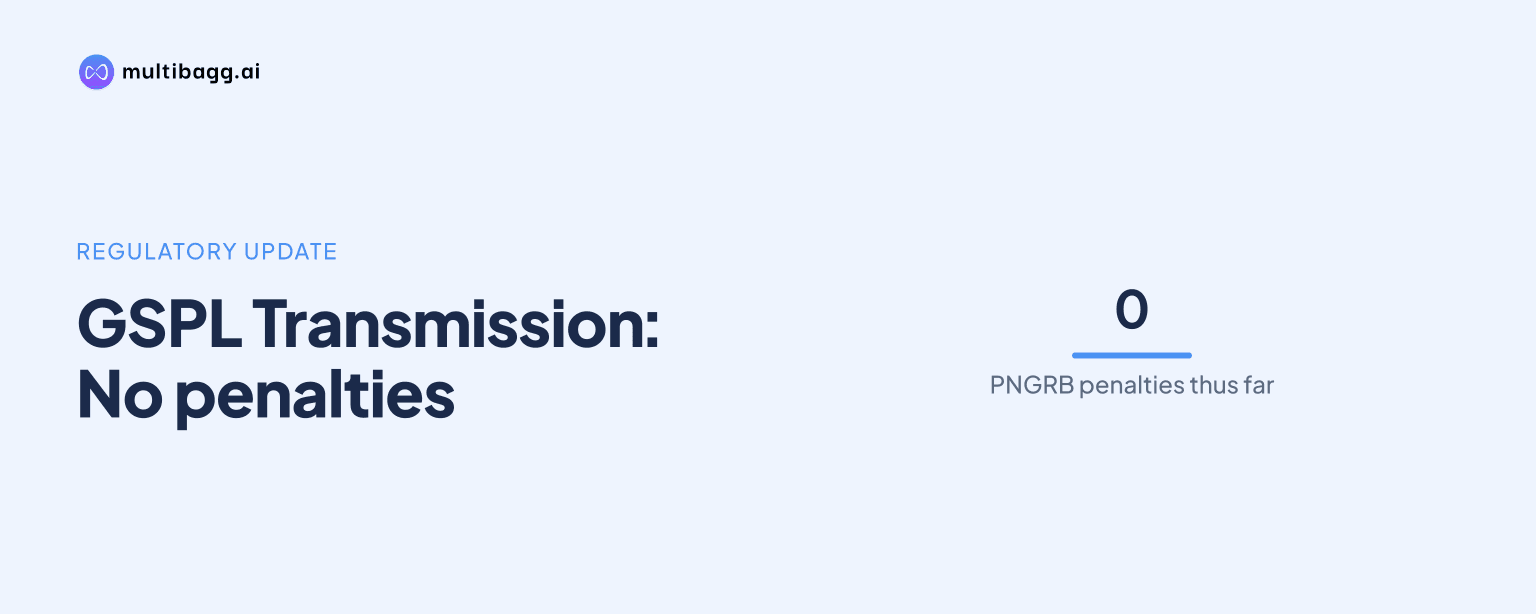
In the earnings-call discussion, GSPL Transmission (GTL) said GITL halted major expansion after KG Basin sourcing problems and had incurred zero Petroleum and Natural Gas Regulatory Board (PNGRB) penalties thus far. GTL said the decision protected capital because it did not want to construct pipeline infrastructure without dependable gas supply or customers along the route.
Know GSPL Transmission inside out
Results, valuation, peers and who's buying, in one view.
Why did GTL halt GITL's larger expansion plan?
GTL halted major GITL investment because KG Basin sourcing issues created uncertainty over whether the proposed pipeline would have gas and customers. An analyst said GITL had originally planned a materially larger pipeline network, and management agreed that it had not made major investments because of what it called the KG Basin “disaster.” Management said its restraint was intended to protect capital.
The commercial mechanism described by GTL was direct: pipeline investment needs both available gas and customer offtake. GTL said it did not wish to enter a scenario in which GITL invested in infrastructure but did not find customers “on way.” The company therefore linked its capital-allocation decision to two unresolved matters, the source of gas and the customer base that could use the network.
GTL did not say that GITL's larger pipeline plan had been permanently cancelled. Management said it continues to evaluate the situation and remains willing to invest if circumstances support it. However, the call did not disclose a revised project cost, a replacement route, a volume threshold, a commissioning date or a timetable for restarting major expansion.
The distinction between a pause and an abandonment matters because GITL remains an operating subsidiary. GTL said GITL is profitable on a standalone basis despite the absence of major new investment. That statement supports the view that management is preserving an existing business while withholding additional capital until the supply and demand conditions for a larger network become clearer.
Has GTL's GITL received PNGRB penalties for delayed investment?
No, GTL said PNGRB had imposed no penalties on GITL thus far for not undertaking the larger investment plan. Management gave that answer directly when asked whether GITL was facing penalties related to performance bonds or failure to meet its capital-expenditure requirement. The disclosed penalty amount was therefore zero at the time of the call.
GTL also said it remains engaged with PNGRB on GITL's position. Management said the regulator is better updated than outside participants about current gas-sourcing conditions and the available customer base. This indicates that the regulatory discussion is continuing, rather than that the matter has been formally resolved.
The absence of penalties does not amount to a management forecast that none can arise later. GTL limited its answer to “none thus far,” while also saying it was still evaluating sourcing and customer conditions. The transcript does not disclose the amount of any performance bond, the original deadline for the larger network, or any PNGRB decision that would formally amend GITL's earlier development expectations.
GTL's approach separates regulatory compliance from commercial viability. It said its continuing engagement with PNGRB sits alongside a decision not to invest where supply is uncertain and customers may not materialise. That position avoids treating construction spending as an objective in itself, but the call provided no detail on whether the regulator has sought a revised construction schedule.
Got a follow-up? Ask IRIS
Is GITL profitable and how does it compare with GIGL?
Yes, GTL said GITL is profitable on a standalone basis, while GIGL is still working toward breakeven over another couple of years, according to management. GTL did not provide GITL's revenue, profit amount, throughput, utilisation or return measure in this discussion. The standalone-profitability disclosure therefore cannot establish the scale or durability of GITL's earnings.
GIGL was discussed under a different operating and capital-spending profile. GTL said GIGL had approximately Rs 100 crore to Rs 110 crore of outstanding capital expenditure under execution, and that this work would be revenue-accretive from day one. Management said GIGL would have no major near-term infrastructure requirement beyond that remaining programme.
An analyst asked whether completion of the Rs 100 crore to Rs 110 crore GIGL programme would mean infrastructure was no longer a constraint, leaving customer volumes as the main issue. GTL agreed. This contrasts with GITL, where management identified the supply source as well as customers as the issues that have prevented major incremental investment.
GTL also said the combined capacity of its two subsidiaries was approximately 44 million metric standard cubic metres per day (MMSCMD). The call did not allocate that capacity between GITL and GIGL, nor did it disclose either subsidiary's utilisation. As a result, the capacity figure cannot be used to calculate GITL's current throughput or the potential volume impact of a resumed expansion.
What could make GTL resume major GITL investment?
GTL indicated that dependable sourcing and identifiable customers would be needed before it resumes major GITL investment. Management said it was not unwilling to invest, but did not want to build a network without customers along the route. It did not disclose a minimum contracted volume, tariff condition or return target that would trigger a decision to proceed.
The wider pipeline programme described on the call shows how GTL distinguished GITL's uncertainty from projects with more defined supply concepts. GTL said Anjar-Palanpur was the major project extending to March 2028 and that it had almost all approvals in place. Management said the project would use additional gas from the Mundra liquefied natural gas terminal to benefit GIGL and GTL.
GTL also discussed the Jamnagar-Dwarka pipeline as a route intended to transport gas from an offshore Dwarka field operated by Sun Petro, with other entities negotiating common infrastructure. These projects were part of a broader Rs 3,500 crore capital programme discussed with a 700-kilometre network. By contrast, GTL did not attach a fresh capital figure or project date to GITL's deferred expansion.
Management said all projects currently being executed were pre-approved through PNGRB and that most approvals were in place for projects on the ground. It added that costs incurred during execution would be capitalised and treated as pass-through costs. Those comments related to active projects and do not establish that GITL's paused larger plan has the same approval status or cost treatment.
Conclusion
GTL's disclosure is that GITL remains profitable on a standalone basis while management has avoided major new investment because KG Basin sourcing problems and uncertain customer demand could leave pipeline capacity without use. The company described that restraint as capital protection and confirmed that PNGRB had levied zero penalties on GITL thus far.
The next issue to watch is whether GTL identifies a dependable gas source and customer base that support renewed GITL construction, or discloses a changed PNGRB position. Separately, management targets completion of Anjar-Palanpur by March 2028, while GIGL has Rs 100 crore to Rs 110 crore of remaining work that GTL said would be revenue-accretive from day one.