










GSPL Transmission Links Rs 3,500 Crore Plan to Gas Supply
Key highlights
- GSPL linked Jamnagar-Dwarka to offshore Dwarka field production expected at a minimum 2.5 million, with the unit undisclosed.
- GSPL said Anjar-Palanpur would benefit from additional volumes from the Mundra LNG terminal.
- An analyst described the expansion as Rs 3,500 crore and 700 kilometres; management did not confirm a financial year 2029 revenue start.
- GSPL reported high-pressure-network volume of around 36 in the second quarter, versus roughly 31.4 to 31.5 used in the last tariff revision.
powered by IRIS
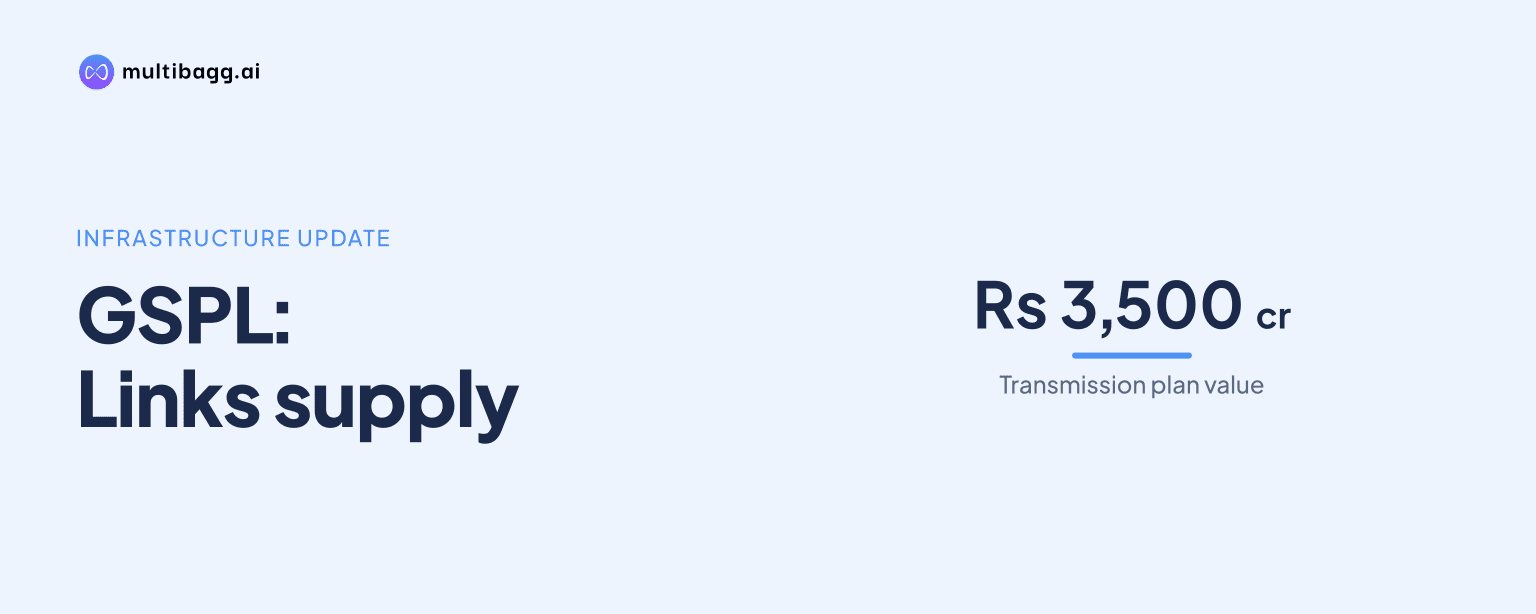
GSPL Transmission linked the Rs 3,500 crore pipeline programme discussed on the call to offshore Dwarka gas expected at a minimum 2.5 million, with the unit undisclosed, and incremental Mundra liquefied natural gas volumes. GSPL said the Jamnagar-Dwarka line would carry prospective field output, while Anjar-Palanpur would draw on the Mundra terminal.
Know GSPL Transmission inside out
Results, valuation, peers and who's buying, in one view.
What will supply the Jamnagar-Dwarka pipeline?
GSPL said the proposed Jamnagar-Dwarka pipeline is intended to transport gas from an offshore Dwarka field to Jamnagar. Management identified Sun Petro as the operator of the offshore field and said other entities were negotiating common infrastructure. Jamnagar was described as the point where the gas source would be connected to the proposed pipeline.
Management put the field's minimum expected production at 2.5 million and said the volume could rise with further success. The transcript did not state the unit for the 2.5 million figure, a production start date, a reserves estimate or a contracted transportation volume. The line's disclosed supply case is therefore expected field production rather than an operating supply stream.
The stated mechanism differs from a pipeline built around a named downstream customer. The Jamnagar-Dwarka route would provide transportation for gas expected to be produced offshore Dwarka, while GSPL said elsewhere in the call that it transports gas and does not own it as a commodity. No customer-level demand forecast for this line was disclosed.
An analyst described the wider programme as Rs 3,500 crore and 700 kilometres, and suggested that its revenue could begin in financial year 2029. Management did not directly confirm that revenue timing. It instead said several global liquefaction projects could begin supplying gas in the 2028 to 2030 period, although some Qatari projects could be delayed.
How will Mundra LNG support the Anjar-Palanpur pipeline?
GSPL said the Anjar-Palanpur pipeline is intended to benefit from additional gas volumes arriving through the Mundra LNG terminal. Management's plan is to transport incremental gas from Mundra into the GIGL and GTL networks. Liquefied natural gas, or LNG, is therefore the stated supply source for this corridor.
This differs from the Jamnagar-Dwarka route in both source type and disclosed volume information. Jamnagar-Dwarka is linked to the Sun Petro-operated offshore Dwarka field and a minimum expectation of 2.5 million, with no unit stated. Anjar-Palanpur is linked to additional imported LNG at Mundra, but management gave no volume target, contracted capacity or start date.
Management did not identify individual customers for Anjar-Palanpur when discussing the Rs 3,500 crore programme. It said only that additional Mundra LNG would be transported through GIGL and GTL. That leaves the call without a customer-by-customer throughput forecast or a stated utilisation level for the new corridor.
GSPL's broader view of gas availability rested on prospective market supply rather than disclosed firm procurement agreements. Management said projects in the United States, Qatar, Canada and Argentina could supply gas in the 2028, 2029 and 2030 timeframe. It also noted possible delays to some Qatari projects, making delivered LNG volumes and customer offtake relevant to future utilisation.
Got a follow-up? Ask IRIS
How do the new lines compare with existing network volumes?
GSPL operates high-pressure, low-pressure and HAPi networks, according to management. It reported high-pressure-network volume of around 36 in the second quarter, compared with roughly 31.4 to 31.5 used by the Petroleum and Natural Gas Regulatory Board, or PNGRB, in the last tariff revision. The transcript did not specify the unit in this exchange.
Management said volumes above the applicable threshold can earn a benefit for 50% of the incremental volume. It said the benefit is credited where it is used for capital purposes. GSPL did not say that this mechanism applies specifically to Jamnagar-Dwarka or Anjar-Palanpur, but it described the arrangement while explaining the 36 volume level against the 31.4 to 31.5 tariff assumption.
The combined capacity of GSPL's two subsidiaries was stated as approximately 44 to 45 million metric standard cubic metres a day, or MMSCMD. That figure gives context for the existing network, but it is not a forecast for the two proposed corridors. The 2.5 million offshore Dwarka expectation cannot be compared directly with 44 to 45 MMSCMD because management did not state its unit.
For GIGL, management said Rs 100 crore to Rs 110 crore of capex remained under execution and would be revenue accretive from day one. It said no major near-term infrastructure spending was expected beyond that work. Management characterised the remaining requirement as customers ramping up gas use, rather than a further stated connectivity shortfall.
What execution and regulatory matters could affect the programme?
GSPL said projects under execution had been pre-approved by PNGRB and that most approvals were in place for projects already on the ground. Management said implementation at a large scale can still face challenges, including land-access concerns raised by an analyst. It said it would take steps to mitigate such execution issues.
Management also said costs incurred on the approved projects are capitalised and treated as pass-through costs. That statement describes the treatment management expects for the programme, not its final cost or completion date. No construction-progress figure was provided for either the Jamnagar-Dwarka or Anjar-Palanpur line within the Rs 3,500 crore programme.
The GITL experience shows why source availability remains material for pipeline investment. Management said GITL had not made major investments because of sourcing issues following the KG Basin disruption, seeking to avoid investing before finding customers along the route. It said GITL was profitable on a standalone basis and had faced no PNGRB penalties thus far.
GIGL had not faced penalties for volume projections, management said, because all customer requirements along its route were being met. Even so, management estimated that GIGL could take another couple of years to reach breakeven as new industries emerge. The contrast with GITL supports management's focus on identified supply points at Dwarka and Mundra before expanding transportation capacity.
Conclusion
GSPL's disclosed rationale for the Rs 3,500 crore programme rests on two separate supply mechanisms: expected offshore Dwarka production for Jamnagar-Dwarka and incremental LNG from Mundra for Anjar-Palanpur. The offshore route has a stated minimum expectation of 2.5 million, without a disclosed unit, while the LNG route has no stated throughput target or customer list.
The next disclosures to watch are construction progress on the 700-kilometre programme cited by the analyst, the production unit and start timing for the offshore Dwarka field, and evidence of additional Mundra LNG moving through GIGL and GTL. Management also pointed to potential global liquefaction supply between 2028 and 2030, while flagging that some Qatari projects may be delayed.