










GTL grid links all Gujarat LNG terminals, carries 23% of imports
Key highlights
- GTL connects all four operational LNG terminals in Gujarat and transports about 23% of India’s LNG imports.
- Gujarat’s four operational LNG terminals have 37.7 MMTPA of capacity, equal to about 65% of India’s 57.7 MMTPA total.
- GTL’s approximately 2,900 km network covers 26 Gujarat districts and had 40 MMSCMD of FY26 contractual volume.
- CGD contributed 41% of GTL’s revenue from operations in Q2FY27, ahead of refineries at 20%.
powered by IRIS
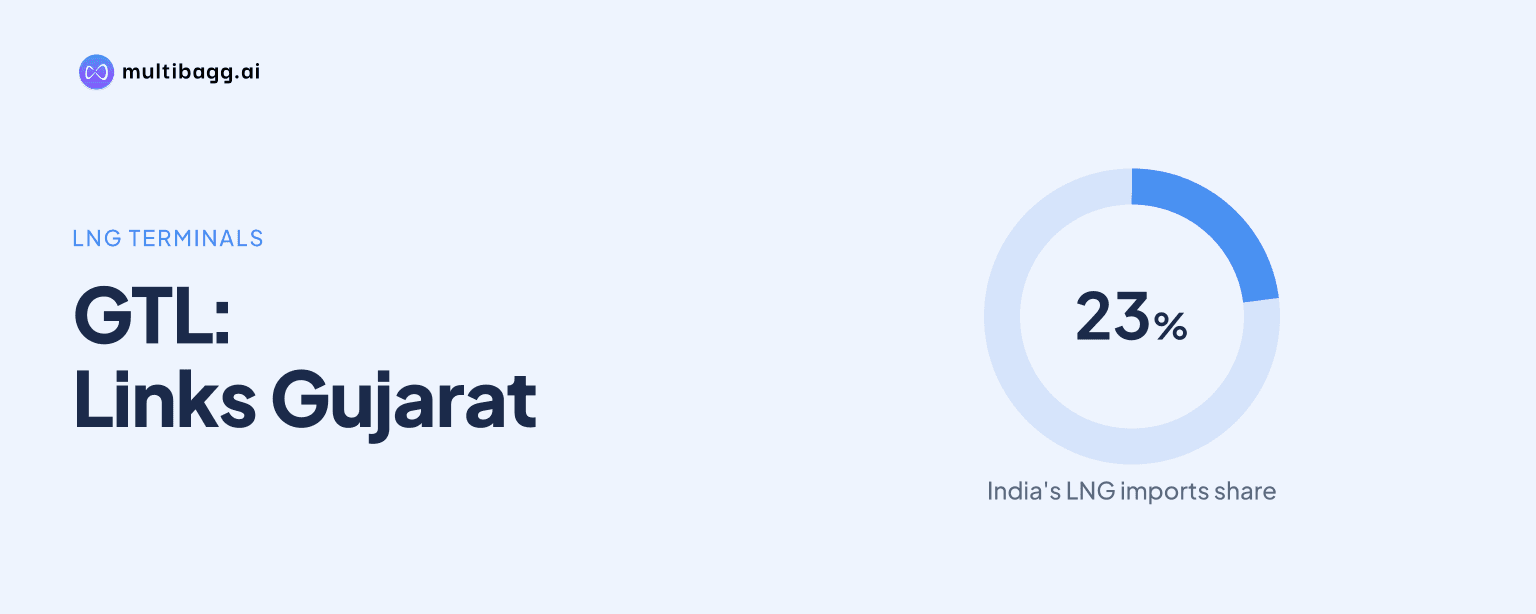
GSPL Transmission Limited (GTL) is the only grid connected to all four operational liquefied natural gas (LNG) terminals in Gujarat and says it transports about 23% of India’s LNG imports. Its approximately 2,900 km Gujarat network connects these supply gateways with customers across 26 districts, in a state that accounted for about 22% of national gas consumption in FY26.
Know GSPL Transmission inside out
Results, valuation, peers and who's buying, in one view.
How does GTL connect Gujarat's LNG terminals?
GTL is the only grid connected to all four operational LNG gateways in Gujarat: Dahej, Hazira, Mundra and Chhara. Together, these terminals have 37.7 million tonnes per annum (MMTPA) of regasification capacity, compared with India’s total operational capacity of 57.7 MMTPA. Gujarat therefore accounts for about 65% of the country’s operating LNG regasification capacity, while GTL provides the transmission connection to each operating gateway.
GTL says approximately 23% of India’s LNG imports are transported through its network, linking terminal deliveries to gas users rather than selling the gas itself. Dahej is the largest of Gujarat’s four terminals, with 22.5 MMTPA of capacity and utilisation exceeding 90% in FY26. The presentation describes Dahej as a cornerstone of India’s LNG supply chain because of its connectivity to demand centres.
Why does Gujarat matter to GTL's network?
Gujarat mattered to GTL’s network position because the state accounted for approximately 22% of India’s natural-gas consumption in FY26. In September 2026, Gujarat consumed 42.17 million metric standard cubic metres a day (MMSCMD), against total reported Indian consumption of 194.74 MMSCMD. GTL’s high-pressure network operates within this consumption centre, connecting imported LNG and domestic supply points with users in the state.
Gujarat’s gas share in its energy mix is approximately 25%, according to GTL, while the network covers 26 Gujarat districts. GTL describes its approximately 2,900 km Gujarat network as India’s second-largest natural-gas transmission network, based on a Petroleum and Natural Gas Regulatory Board (PNGRB) report. The grid also connects with other national pipeline networks, extending supply links beyond the state.
What supplies and customers does GTL's grid link?
GTL links LNG imports and domestic natural gas with city gas distribution (CGD), refineries, fertiliser plants, power producers, steel, chemical and other industrial users. The network is designed for bi-directional flows and uses supervisory control and data acquisition (SCADA)-led operations, with 24-hour remote monitoring and emergency controls. GTL also says approximately 41% of Krishna-Godavari Basin volumes are transported through its network, adding a domestic-supply connection to its west-coast LNG links.
GTL has more than 100 customers and more than 200 customer exit points, which are locations where gas can be delivered to users. This footprint serves several end markets rather than one single sector. The presentation projects Indian gas demand to rise from 188 MMSCMD in FY26 to approximately 297 MMSCMD by 2030, led by CGD, industrial, refinery and fertiliser demand.
Got a follow-up? Ask IRIS
How is GTL's transmission business structured?
GTL operates as a pure-play, open-access gas transmission platform, carrying gas under gas transmission agreements (GTAs) between suppliers, marketers or LNG terminals and users. The agreements range from one month to 20 years and define quantity, quality, scheduling, payment, security, default and remedy terms. Ship-or-pay provisions apply to booked capacity under GTL’s contractual framework.
The PNGRB tariff framework reflects costs, capacity and stipulated returns, according to GTL. GTL reported 40 MMSCMD of contractual volume in FY26, while its pipeline business had gross investments of Rs 7,500 crore. As of September 30, 2026, GTL was debt free and held a CARE AA+/A1+ credit rating.
Which customer sectors contribute to GTL's revenue?
CGD was GTL’s largest revenue-from-operations category in Q2FY27 at 41%, followed by refineries at 20%, other industrial customers at 19%, fertiliser at 13% and power at 7%. CGD and refineries together represented 61% of the reported mix, compared with 39% for industrial customers, fertiliser and power. The composition links GTL to both urban gas distribution and large industrial consumption points.
CGD geographical coverage in Gujarat had reached 84% as of June 2026. CGD gas consumption grew 21% year on year to 5,003 million metric standard cubic metres (MMSCM) in Q1 FY27, according to the presentation. At the national level, CGD accounted for 23% of FY26 gas consumption, compared with 29% for fertilisers, 12% for power, 8% for refineries, 6% for petrochemicals and 22% for other uses.
What could expand GTL's network reach?
GTL has an expansion-led capital expenditure plan of approximately Rs 3,500 crore covering more than 10 pipeline and connectivity projects aggregating approximately 700 km. The company says these additions would take the network from approximately 2,900 km to more than 3,600 km, adding capacity and access to new geographical areas. Listed projects include the 284 km Anjar-Palanpur line, the 98 km Jamnagar-Dwarka line, the 71 km Vapi-Tarapur line and the 36 km Dahej-Bhadbhut line.
Management’s stated priorities include securing anchor demand from CGD, industrial and power customers before adding capacity, and using flexible access, balancing and short-term transport to improve throughput. The plan also identifies eight new Gujarat Industrial Development Corporation areas, along with further customer connections and spur lines. Project timing, approvals, right-of-way acquisition and delivery remain relevant to the eventual network expansion.
Conclusion
GTL’s network position combines direct access to Gujarat’s four operating LNG gateways with connections to domestic supply and a diversified base of CGD and industrial customers. The presentation places that position in a state with 37.7 MMTPA of operating LNG regasification capacity and a 22% share of India’s FY26 gas consumption.
The main disclosed development to watch is the execution of GTL’s approximately Rs 3,500 crore expansion programme, including around 700 km of planned additions. Progress on the Anjar-Palanpur, Jamnagar-Dwarka, Vapi-Tarapur and Dahej-Bhadbhut projects, as well as management’s plan to secure demand before adding capacity, will determine how the network develops.