










GTL plans Rs 3,500 crore pipeline expansion beyond 3,600 km
Key highlights
- GTL's approximately Rs 3,500 crore plan covers more than 10 pipeline and connectivity projects totalling about 700 km.
- GTL's network is planned to rise from approximately 2,900 km to more than 3,600 km.
- Anjar–Palanpur is GTL's longest named project at 284 km, ahead of the 98 km Jamnagar–Dwarka line.
- CGD accounted for 41% of GTL's Q2FY27 revenue from operations, compared with 20% for refineries.
powered by IRIS
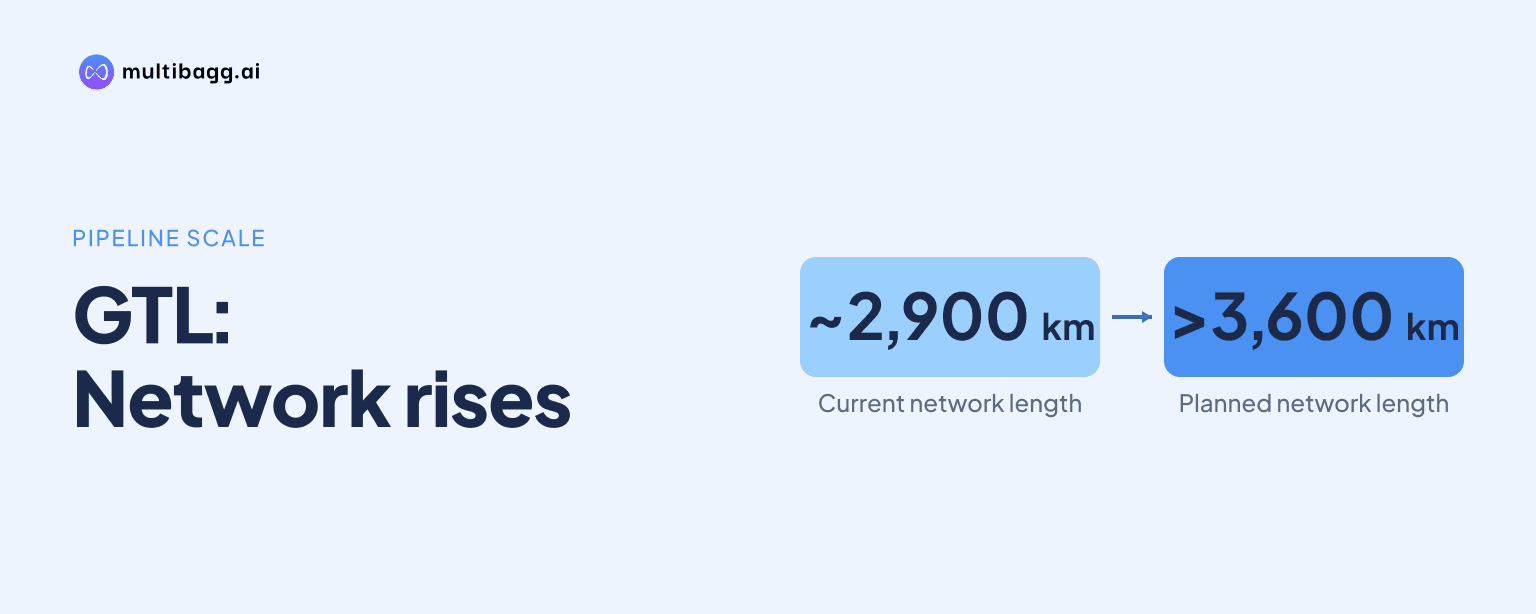
GTL is pursuing an approximately Rs 3,500 crore capital-expenditure plan covering more than 10 pipeline and connectivity projects of about 700 km, which would increase its existing approximately 2,900 km network to more than 3,600 km. The portfolio includes the 284 km Anjar–Palanpur pipeline, its longest disclosed project.
Know GSPL Transmission inside out
Results, valuation, peers and who's buying, in one view.
What does GTL's Rs 3,500 crore expansion plan add?
GTL's current plan adds about 700 km to an existing network of approximately 2,900 km, taking the pipeline grid beyond 3,600 km. GTL says the approximately Rs 3,500 crore programme is underway and is intended to enhance capacity, extend reach into new geographical areas and expand capacity on its existing pipeline system.
The portfolio consists of more than 10 pipeline and connectivity projects, rather than a single trunk line. GTL says the additional infrastructure is intended to support future tariff growth and earnings before interest, tax, depreciation and amortisation (EBITDA) growth, but it does not disclose a completion date, project-by-project budget or expected capacity addition for the approximately Rs 3,500 crore plan.
The planned addition is roughly one-quarter of the existing 2,900 km grid, based on the rounded lengths disclosed by GTL. That scale combines new geographical reach with capacity expansion, while GTL's execution framework calls for demand-backed projects and a balance between investment in the network and its subsidiaries.
Which GTL pipeline projects are under implementation?
GTL identifies Anjar–Palanpur as the largest named project, at 284 km, followed by the 98 km Jamnagar–Dwarka line. The four projects for which GTL gives a length total 489 km, while the wider portfolio of more than 10 projects aggregates approximately 700 km and also includes smaller spur lines and customer connections.
The 284 km Anjar–Palanpur line accounts for more than half of the 489 km disclosed for the four measured projects. GTL does not provide individual lengths for the Vantewad–Rajpipla, Botad–Jasdan, Mundra–Mandvi, Amreli–Kunkavav, Bhayla or Borosil connections, so the presentation does not permit a project-level allocation of the remaining approximately 211 km between the listed 489 km and the approximately 700 km overall portfolio.
How does GTL plan to execute the expansion?
GTL says it will seek anchor demand from city gas distribution (CGD), industrial and power customers before adding capacity. This approach links the approximately 700 km build-out to identified customer demand, while GTL also plans to use flexible access, balancing and short-term transport to improve throughput on the broader 3,600+ km network.
For delivery, GTL identifies optimisation of engineering, procurement and construction (EPC) contracts, competitive bidding, rights-of-way acquisition and approvals as key execution actions. The company also identifies automation and preventive pipeline maintenance as asset-integrity measures, alongside a capital-discipline policy that prioritises demand-backed projects and returns within the approximately Rs 3,500 crore programme.
The presentation frames these measures as intended actions rather than completed milestones. It does not quantify the number of customer commitments attached to the 284 km Anjar–Palanpur project or the other approximately 700 km of additions, and it does not set a commissioning schedule for the more than 10 projects.
Got a follow-up? Ask IRIS
What demand base supports GTL's additional capacity?
GTL reported a diversified second-quarter financial year 2027 (Q2FY27) revenue mix: CGD represented 41%, refineries 20%, other industrial customers 19%, fertiliser 13% and power 7%. CGD was therefore the largest reported revenue segment, ahead of refineries by 21 percentage points and ahead of power by 34 percentage points.
The company serves more than 100 customers through more than 200 customer exit points across power, fertiliser, refinery, chemical, steel and industrial users, as well as gas suppliers, marketers, traders and local distribution companies. This customer base is relevant to the expansion plan because GTL specifically identifies CGD, industrial and power customers as areas where it seeks anchor demand before building capacity.
GTL's gas transmission agreements run from one month to 20 years and specify quantity, quality, scheduling, payment, security, default and remedy terms. The agreements include ship-or-pay provisions for booked capacity, while payment security is supported by bank guarantees or letters of credit; these mechanisms define the contractual framework around transportation capacity rather than guaranteeing future utilisation of the approximately 700 km additions.
How does GTL's Gujarat expansion fit its wider pipeline footprint?
The 3,600+ km target refers to GTL's existing approximately 2,900 km network plus its planned approximately 700 km additions, not to all pipeline kilometres operated by its subsidiaries. Separately, GSPL India Gasnet Limited (GIGL), in which GTL holds 52%, operates approximately 1,439 km across Gujarat, Rajasthan, Haryana and Punjab and has approximately 120 km under construction.
GIGL recorded transportation volume of 5.49 million metric standard cubic metres per day (MMSCMD) in Q2FY27, up 27% year on year, and transportation revenue of Rs 81.49 crore, up 13% year on year. The presentation says higher volumes and network utilisation can support future tariff determination within the regulated framework, but it provides no forecast of how GTL's own approximately 700 km programme will affect tariffs.
GSPL India Transco Limited (GITL), also 52% owned by GTL, operates approximately 365 km from Kothapalli/Tadepalligudem in Andhra Pradesh to a fertiliser plant at Ramagundam in Telangana. GITL transported 1.68 MMSCMD in Q2FY27, up 137% year on year, and reported transportation revenue of Rs 26.29 crore, up 18% year on year; GTL says ongoing capital expenditure is intended to support revival and utilisation ramp-up of that network.
Conclusion
GTL's disclosed expansion is a defined approximately Rs 3,500 crore programme rather than a general growth objective: it spans more than 10 projects, approximately 700 km and an eventual network exceeding 3,600 km. Anjar–Palanpur at 284 km is the largest named component, while the 98 km Jamnagar–Dwarka, 71 km Vapi–Tarapur and 36 km Dahej–Bhadbhut lines show that the plan is distributed across several corridors and customer connections.
The next disclosures to watch are project commissioning dates, spending progress and capacity added for the approximately Rs 3,500 crore programme, none of which are specified in the presentation. GTL's stated plan to secure CGD, industrial and power anchor demand before adding capacity, alongside GIGL's 27% volume growth and GITL's 137% volume growth in Q2FY27, provides the operating context for measuring subsequent utilisation progress.