










GTL subsidiaries report Q2FY27 volume growth of 27% and 137%
Key highlights
- GIGL transported 5.49 MMSCMD in Q2FY27, up 27% year on year.
- GITL transported 1.68 MMSCMD in Q2FY27, up 137% year on year.
- GIGL and GITL reported combined Q2FY27 transportation revenue of Rs 107.78 crore.
- GTL’s approximately Rs 3,500 crore plan includes about 700 kilometres of pipeline additions.
powered by IRIS
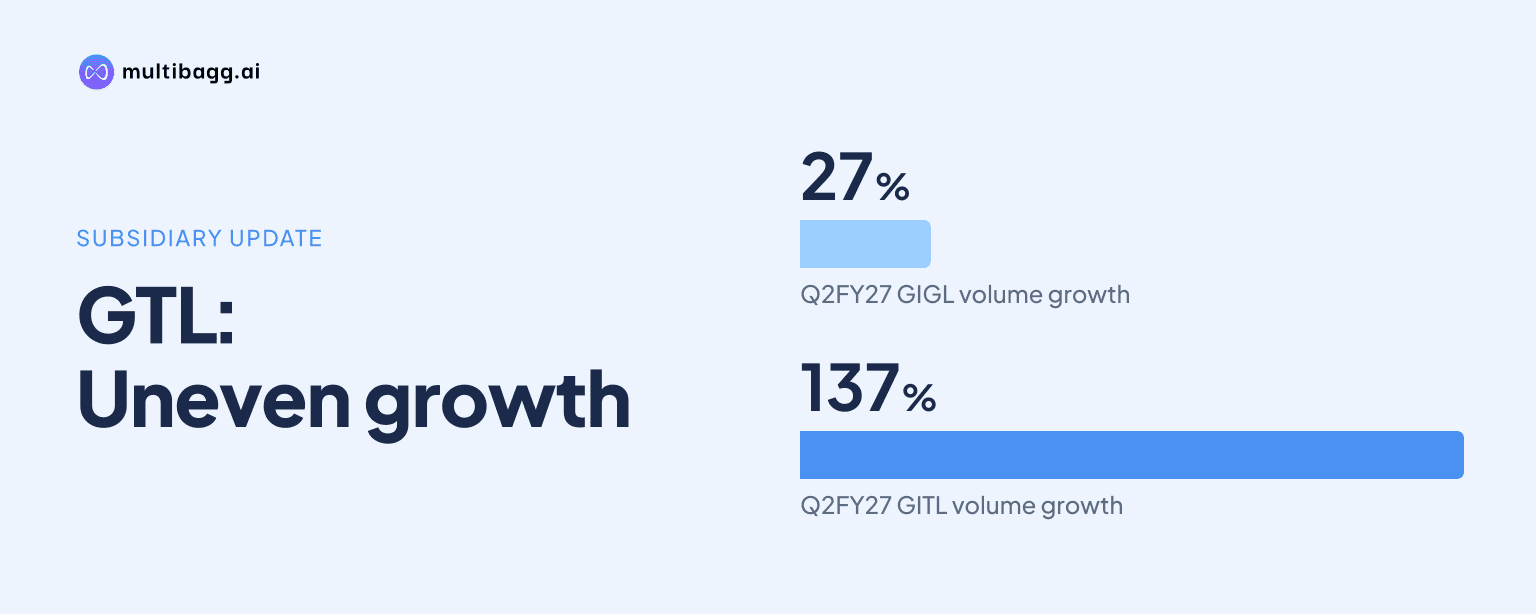
GTL’s subsidiaries GIGL and GITL reported Q2FY27 transportation-volume growth of 27% and 137% year on year, respectively, taking their combined throughput to 7.17 million metric standard cubic metres per day, or MMSCMD. GIGL transported 5.49 MMSCMD and GITL transported 1.68 MMSCMD during the quarter.
Know GSPL Transmission inside out
Results, valuation, peers and who's buying, in one view.
How fast did GTL’s subsidiaries grow in Q2FY27?
GTL’s two subsidiaries reported volume growth faster than GTL’s core network in Q2FY27, with GIGL carrying 5.49 MMSCMD, up 27% year on year, and GITL carrying 1.68 MMSCMD, up 137%. Their combined throughput was 7.17 MMSCMD, compared with GTL’s 45.5 MMSCMD across its own grid network in the same quarter.
Transportation revenue also rose at both subsidiaries, though by less than their reported volume growth. GIGL recorded Q2FY27 transportation revenue of Rs 81.49 crore, up 13% year on year, while GITL recorded Rs 26.29 crore, up 18%. The combined total was Rs 107.78 crore, calculated from the two reported subsidiary figures.
The presentation does not disclose quarter-specific tariff rates or explain the difference between volume and revenue growth at either subsidiary. It states that higher pipeline volumes and greater network utilisation support future tariff determination under the regulated framework, but does not assign a tariff outcome to Q2FY27.
Where do GIGL and GITL operate beyond Gujarat?
GIGL operates approximately 1,439 kilometres of cross-country pipeline across Gujarat, Rajasthan, Haryana and Punjab, with approximately 120 kilometres under construction. This places GIGL in GTL’s northern and western India footprint and extends the group’s operating network beyond Gujarat.
GITL operates approximately 365 kilometres of pipeline from Kothapalli and Tadepalligudem in Andhra Pradesh to the RFCL fertiliser plant at Ramagundam in Telangana. The pipeline operates on an open-access basis and forms part of the proposed Mallavaram–Bhopal–Bhilwara–Vijaipur pipeline system.
Both GIGL and GITL are 52% owned by GTL, while the balance in each entity is held by Indian Oil Corporation Limited, Bharat Petroleum Corporation Limited and Hindustan Petroleum Corporation Limited, according to the presentation. GIGL’s four-state network and GITL’s Andhra Pradesh-Telangana route serve different geographic parts of the multi-state platform.
GTL identifies city gas distribution, or CGD, refinery, fertiliser and industrial demand centres as the connectivity base for the subsidiary platform. The presentation places GIGL and GITL across northern, western, central and southern India, although it does not provide a separate Q2FY27 customer-sector mix for either subsidiary.
Got a follow-up? Ask IRIS
How does subsidiary growth compare with GTL’s grid growth?
GTL’s total grid volume rose to 45.5 MMSCMD in Q2FY27 from 40.4 MMSCMD in Q2FY26, while gas transmission revenue, net of gas transmission expenses, increased to Rs 243 crore from Rs 220 crore. The 5.1 MMSCMD increase in GTL’s total grid volume compares with combined GIGL and GITL throughput of 7.17 MMSCMD in Q2FY27.
GTL’s high-pressure grid transported 36.7 MMSCMD in Q2FY27, up 9.3% year on year, while its low-pressure grid carried 7.8 MMSCMD, up 30.8%. HAPi Grid volume was 1.0 MMSCMD, up 16.5%, making GITL’s 137% increase the largest reported percentage volume change among the two subsidiaries and GTL’s three grid categories.
CGD remained GTL’s largest demand segment at 41% of Q2FY27 sector mix, compared with 39% in Q2FY26 and 47% in Q1FY27. Refineries represented 20%, fertilisers 13%, power 7% and other industrial customers 19% in Q2FY27, but the presentation does not split these categories between GIGL and GITL.
What expansion plans support GTL’s multi-state platform?
GTL has an expansion-led capital-expenditure plan of approximately Rs 3,500 crore covering more than 10 pipeline and connectivity projects aggregating approximately 700 kilometres. The plan is intended to add capacity, serve new geographical areas and expand capacity on the existing network.
GTL’s existing network is approximately 2,900 kilometres, and the planned additions would take it beyond 3,600 kilometres, according to the presentation. The largest listed project is the 284-kilometre Anjar–Palanpur pipeline, followed by the 98-kilometre Jamnagar–Dwarka line, the 71-kilometre Vapi–Tarapur line and the 36-kilometre Dahej–Bhadbhut line.
Other listed spur lines and customer connectivities include Vantewad–Rajpipla, Botad–Jasdan, Mundra–Mandvi, Amreli–Kunkavav, Bhayla and Borosil. Alongside GTL’s approximately 700 kilometres of additions, GIGL has approximately 120 kilometres under construction and GITL has ongoing capital expenditure intended to support network revival and utilisation ramp-up.
Management’s stated approach is to secure anchor demand from CGD, industrial and power customers before adding capacity. It also identifies flexible access, balancing and short-term transport as mechanisms to improve throughput, while citing engineering, procurement and construction contract optimisation, competitive bidding, right-of-way acquisition and approvals as project-delivery measures.
Conclusion
GTL’s Q2FY27 results show that GIGL and GITL are contributing growing transmission volumes outside Gujarat, with 5.49 MMSCMD at GIGL and 1.68 MMSCMD at GITL. GIGL provides a 1,439-kilometre operating network across four states, while GITL operates a 365-kilometre route to the RFCL fertiliser plant, broadening the group’s geographic reach through subsidiaries that are each 52% owned.
The next disclosed developments to watch are GIGL’s approximately 120 kilometres under construction, GITL’s stated revival and utilisation ramp-up, and GTL’s approximately Rs 3,500 crore plan to add about 700 kilometres. The presentation links volume and utilisation to future tariff determination, but does not disclose project completion dates, capital-allocation details or tariff outcomes.