










GSPL Transmission Says Tariff Credits Remain Prospective
Key highlights
- GTL expects its next tariff revision around 2028, following the April 2024 revision.
- Any credit from earlier tariff claims would be recovered through future transportation rather than retrospective billing.
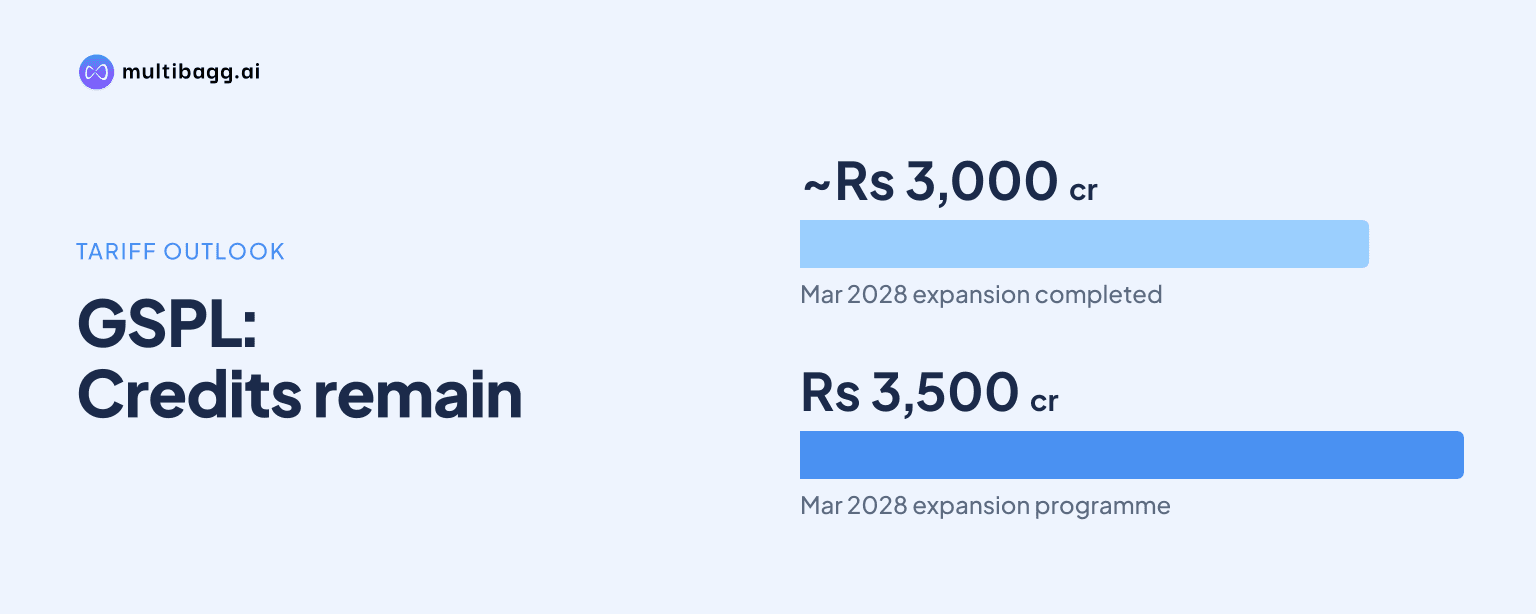
- GTL plans to complete about Rs 3,000 crore of its Rs 3,500 crore expansion programme by March 2028.
- GTL expects capacity to rise by about 8 to 9 MMSCMD from the current 36.5 MMSCMD.
powered by IRIS
GSPL Transmission (GTL) expects its next tariff revision around 2028, but management said any credit arising from earlier tariff claims would be recovered only through future transportation services rather than retrospective billing for past gas supplies. GTL’s previous tariff revision took effect in April 2024 after a 2023 filing.
Know GSPL Transmission inside out
Results, valuation, peers and who's buying, in one view.
When will GTL seek its next tariff revision?
GTL expects to seek its next tariff revision around 2028. Management said the prior revision was implemented in April 2024 following a 2023 filing, and that the company would typically return for a revision after five years unless it had good reasons to do so earlier.
The timetable also coincides with GTL’s Rs 3,500 crore expansion programme. Management plans to complete about Rs 3,000 crore of that programme by March 2028, with some of the balance potentially spilling into April, May or June 2028. It said the pending appeal before the Petroleum and Natural Gas Regulatory Board, or PNGRB, was another reason an earlier revision request might not make sense.
What does prospective recovery mean for GTL’s tariff claims?
Prospective recovery means GTL cannot apply a revised tariff to transportation services that were already completed in earlier years. Management illustrated the mechanism using a tariff entitlement of Rs 1 where PNGRB had allowed 50 paise: the 50-paise balance could be recovered later through subsequent transportation rather than charged on prior supplies.
This mechanism means a favourable true-up or appeal outcome would create a credit for an earlier period but would not result in historical invoices being reissued to the customers that used the pipeline then. Management said the credit would be reflected through future transportation, and added that the unified tariff regime means the eventual payment effect is not confined to the original customer.
GTL said its challenge to the 2024 PNGRB order remained before the PNGRB appellate tribunal, which had not issued an order on the appeals at the time of the call. Management also said it had not received adjudication on its previous PNGRB matters, leaving both the outcome and the amount of any prospective credit unresolved.
How could GTL’s expansion affect the 2028 tariff filing?
GTL expects transmission capacity to increase by about 8 to 9 million metric standard cubic metres per day, or MMSCMD, from the current 36.5 MMSCMD. The disclosed range implies capacity of about 44.5 to 45.5 MMSCMD after the additions, although management did not provide a tariff estimate for the next regulatory review.
The Anjar-Palanpur project is the main project expected to extend to March 2028, while GTL said its other projects were targeted for completion earlier. Management said almost all approvals for Anjar-Palanpur were in place, and an analyst’s understanding that a tariff refiling would follow its completion was described as a reasonable presumption.
GTL identified supply and demand links for the projects. The Jamnagar-Dwarka pipeline is intended to carry gas from an offshore Dwarka field operated by Sun Petro, for which management cited a minimum expected volume of 2.5 million. The Anjar-Palanpur line is intended to bring additional gas from the Mundra liquefied natural gas terminal into the GTL and GIGL networks.
Got a follow-up? Ask IRIS
Why is GTL not seeking a tariff revision before 2028?
GTL said a tariff request before 2028 may not be appropriate because its appeal remains pending and revisions are normally sought after five years. The April 2024 revision and the plan to complete about Rs 3,000 crore of capex by March 2028 together set the management’s current timetable.
Management did not say that a 2028 review would automatically result in a tariff increase. In discussing pipeline lives, it said pipeline sections initially have a typical useful life of 30 years, subject to recertification, and that PNGRB typically permits a life extension of up to 10 years in a single tranche.
GTL’s management said it did not believe a useful-life extension would reduce tariffs. It acknowledged that the framework uses a 12% return on current net asset value, but said asset retirement value and operating expenditure are also factors. That explanation is management’s interpretation of the tariff mechanics, not a PNGRB decision disclosed on the call.
How will GTL report volumes during the tariff process?
GTL has shifted its investor reporting from physical gas volumes to contractual volumes that correspond more closely with transportation revenue. Management said the revised approach incorporates revenue-bearing take-or-pay or ship-or-pay commitments rather than reporting only the physical molecules moving through the network.
For a 5 MMSCMD contract with an 80% take-or-pay level, GTL said it would report 4 MMSCMD even if physical transmission were only 3 MMSCMD. Management said this change should help investors correlate revenue with disclosed volumes, although gross calorific value differences can still prevent an exact tariff-to-volume calculation.
The distinction also applies to the fixed-tariff subsidiaries discussed during the call. GTL said the two subsidiaries together have capacity of about 44 to 45 MMSCMD, but that additional customers and volumes are required for break-even. Management estimated GIGL may need another couple of years to reach break-even as industrial and city gas distribution demand develops.
Conclusion
GTL’s expected 2028 tariff filing brings its Rs 3,500 crore expansion programme and unresolved regulatory matters onto the same timeline. A favourable appeal or true-up could provide recovery for earlier periods, but management’s explanation makes clear that the benefit would be collected prospectively through subsequent transportation rather than through retrospective customer billing.
The next disclosed milestones are completion of about Rs 3,000 crore of capex by March 2028 and the planned addition of 8 to 9 MMSCMD to the current 36.5 MMSCMD capacity. Investors will also watch for an appellate tribunal order on the 2024 PNGRB appeal and for GTL’s eventual tariff filing, for which management did not offer a tariff target.