










GTL targets Rs 3,000 crore capex completion by March 2028
Key highlights
- GTL plans to complete about Rs 3,000 crore of its Rs 3,500 crore capex programme by March 2028.
- GTL expects capacity to increase by 8-9 MMSCMD from approximately 36.5 MMSCMD.
- GTL spent about Rs 300 crore on capex in H1 FY27.
- GTL was debt-free with about Rs 1,800 crore of net cash on September 30, 2026.
powered by IRIS
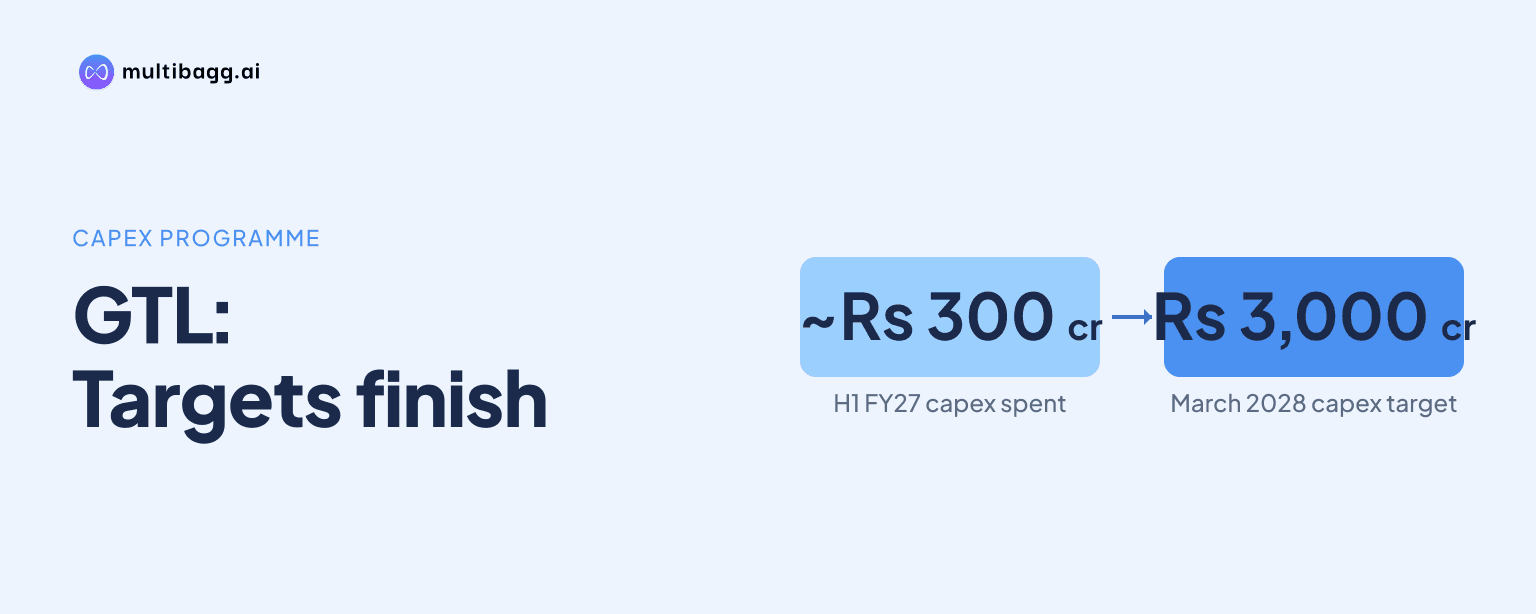
GTL plans to complete about Rs 3,000 crore of its Rs 3,500 crore expansion programme by March 2028, lifting gas-transmission capacity by around 8-9 million metric standard cubic metres a day, or MMSCMD, from 36.5 MMSCMD. Management did not forecast the regulated tariff effect and said that decision rests with the regulator.
Know GSPL Transmission inside out
Results, valuation, peers and who's buying, in one view.
What is GTL’s capex completion target for March 2028?
GTL aims to complete approximately Rs 3,000 crore of its announced Rs 3,500 crore programme by March 2028. Management said the balance could spill into April, May or June 2028, while describing the March 2028 target as achievable.
The projects are already under execution, rather than remaining at the planning stage, according to management. GTL said all the projects have board approval and are at various stages of implementation. It spent about Rs 300 crore on capital expenditure in H1 FY27, which management said was in line with its announced programme.
The Anjar-Palanpur project is the principal project expected to run through March 2028. GTL said it targets completion of the other projects before that date and has almost all approvals in place for Anjar-Palanpur, but it did not disclose a project-wise spending allocation within the Rs 3,500 crore programme.
How much capacity will GTL add by March 2028?
GTL expects to add around 8-9 MMSCMD of transmission capacity to its current capacity of approximately 36.5 MMSCMD. MMSCMD is the gas-industry measure for million metric standard cubic metres transported a day.
The planned expansion would imply capacity of roughly 44.5-45.5 MMSCMD, based on management’s current capacity and planned addition. The increase would be about 22%-25% of the existing 36.5 MMSCMD base, but GTL did not provide expected utilisation, customer commitments or capacity additions for individual projects.
GTL distinguished its own capacity plan from its two subsidiaries, which have a combined capacity of approximately 44-45 MMSCMD. Management said those subsidiaries remain below break-even because their contracted customers are not yet sufficient, and it expects customer development for the infrastructure projects to take more time.
The company has also changed the way it presents transmission volumes. GTL now reports contractual volumes that reflect revenue, rather than only physical gas transported. Management illustrated that a 5 MMSCMD contract with an 80% take-or-pay provision would result in 4 MMSCMD being reported if actual physical transmission was 3 MMSCMD.
Got a follow-up? Ask IRIS
How does GTL expect to fund the Rs 3,500 crore programme?
GTL expects internal accruals and existing cash balances to support the Rs 3,500 crore investment programme, although management retained the option of limited borrowing. As of September 30, 2026, GTL was debt-free, had net worth of approximately Rs 7,150 crore and held about Rs 1,800 crore of net cash including deposits.
Management said it already has significant financing approvals and does not need further approvals to execute the projects. It did not commit to a fixed debt-to-equity mix. In response to an analyst’s reference to a 70:30 debt-to-equity structure, management said financing would depend on internal cash flows and the future project pipeline.
GTL’s H1 FY27 operating figures provide context for that funding approach. Standalone revenue from operations rose 4.5% year on year to Rs 567 crore from Rs 542 crore, while standalone profit after tax increased to Rs 258 crore from Rs 255 crore. Q2 FY27 revenue was Rs 290 crore, up 8% from Rs 267 crore a year earlier.
Earnings before interest, tax, depreciation and amortisation, or EBITDA, excluding non-operating income, was about Rs 169 crore in Q2 FY27, compared with Rs 168 crore in Q2 FY26. H1 FY27 EBITDA was Rs 362.9 crore versus Rs 363.5 crore in H1 FY26, while the H1 margin was 64%; these results do not determine the eventual amount of debt funding.
When could GTL seek its next tariff revision?
GTL said it would likely seek its next tariff revision around 2028, after the previous revision in April 2024 following a 2023 filing. Management said tariff revision requests are typically made after five years unless there are reasons to seek one earlier.
Management did not estimate the tariff outcome from the targeted Rs 3,000 crore completion or the 8-9 MMSCMD capacity addition. When asked for a rough tariff assessment for 2028, GTL said it would focus on executing the projects and leave the tariff decision to the regulator.
An appeal related to the previous tariff process remains pending before the Petroleum and Natural Gas Regulatory Board, or PNGRB, appellate tribunal, according to management. GTL said that if an entitlement is recognised later, recovery would occur prospectively through future transportation, rather than by revising charges on past supplies.
Management also said pipeline sections are initially assigned useful lives of about 30 years, subject to review and recertification. PNGRB typically permits an increase in pipeline life of up to 10 years in a single tranche. GTL said it would obtain required certifications before a tariff filing and does not expect the process to reduce tariffs, which is management’s view rather than a regulatory decision.
Conclusion
GTL has set a defined execution target: about Rs 3,000 crore of its Rs 3,500 crore programme is planned for completion by March 2028, with capacity set to increase by 8-9 MMSCMD from 36.5 MMSCMD. The company has spent about Rs 300 crore in H1 FY27 and says its projects are approved, under implementation and primarily supported by internal resources and cash balances.
The next milestones are progress on Anjar-Palanpur, completion of most programme spending by March 2028 and any spillover into April-June 2028. Investors will also watch the planned tariff revision around 2028 and the unresolved PNGRB appellate tribunal matter, while GTL has said it will not speculate on the eventual tariff outcome.