










Sanathan says FY27 EBITDA target remains Rs 520-550 crore
Key highlights
- Sanathan reported Q2 FY2027 consolidated EBITDA of Rs 154 crore, up 43% from Rs 108 crore in Q1 FY2027.
- Sanathan retained FY2027 EBITDA guidance of Rs 520 crore to Rs 550 crore; the supplied call gives no target above Rs 560 crore.
- Sanathan expects Punjab’s first second-phase portion to commission in December and full ramp-up to 900 tonnes per day by June or July.
- Sanathan said technical-textiles capacity doubled to 18,000 metric tonnes per annum and was operating at about 94% to 95%.
powered by IRIS
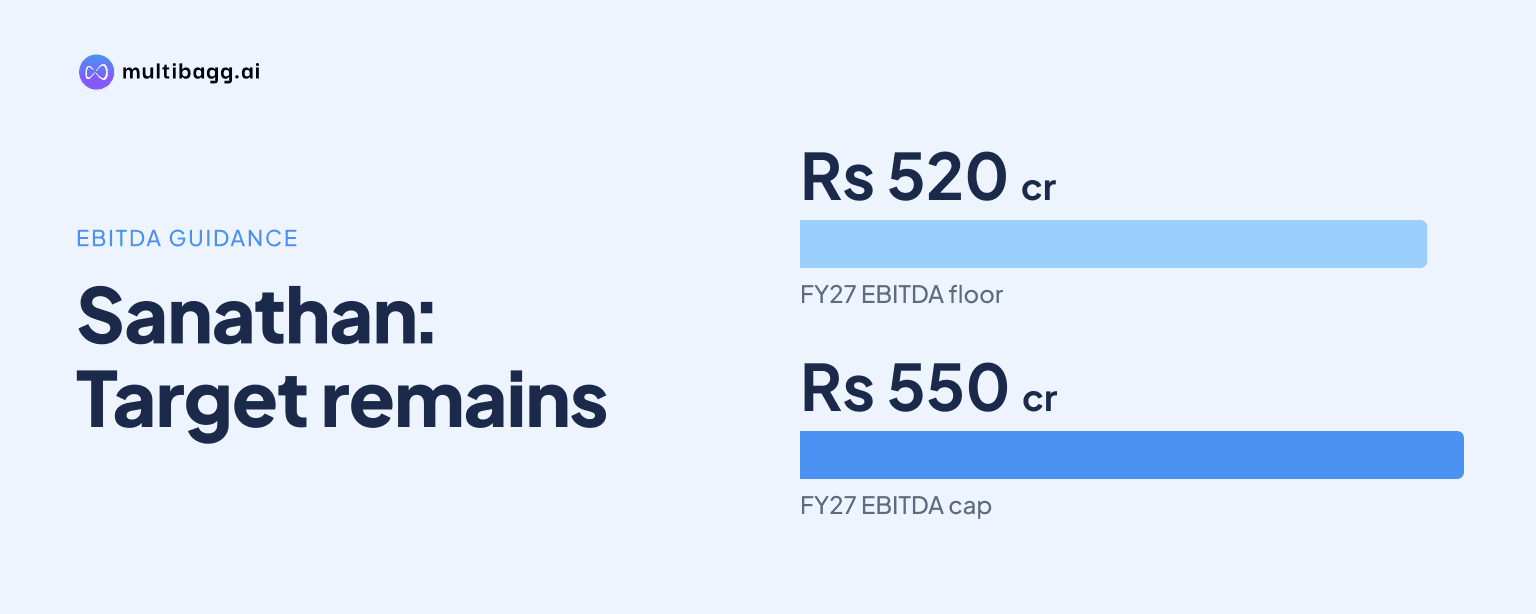
In Q2 FY2027, Sanathan Textiles Limited said its FY2027 EBITDA target remained Rs 520 crore to Rs 550 crore, while Punjab was scheduled for a 900-tonnes-per-day ramp-up by June or July. Consolidated EBITDA rose 43% quarter on quarter to Rs 154 crore, which management attributed to Punjab’s operating performance.
Know Sanathan Textiles inside out
Results, valuation, peers and who's buying, in one view.
What is Sanathan’s FY2027 EBITDA guidance?
Sanathan’s disclosed FY2027 EBITDA guidance is Rs 520 crore to Rs 550 crore, not above Rs 560 crore. During the November 5, 2026 call, an analyst referred to an approximately Rs 5,600 crore revenue outlook and Rs 520 crore to Rs 530 crore of EBITDA, while management restated a wider range of Rs 520 crore to Rs 550 crore. The supplied call does not record a management increase beyond Rs 560 crore.
Management said EBITDA per tonne, rather than EBITDA as a percentage of revenue, was the more relevant measure because selling prices had shifted sharply in the prior two quarters. EBITDA means earnings before interest, tax, depreciation and amortisation. At Punjab, EBITDA per tonne was about Rs 2,500 to Rs 3,000 when utilisation was roughly 76% to 77% in Q1 FY2027; management said it was substantially higher in Q2 as utilisation approached 90%.
When will Sanathan’s Punjab expansion reach 900 tonnes daily?
Sanathan expects Punjab to complete its ramp-up to 900 tonnes per day by June or July. Management said the first portion of the second phase would commission sometime in December, and that at least part of the full expansion should be available in the final quarter of FY2027. These are management’s stated operating milestones rather than reported production outcomes.
Punjab’s planned ramp-up follows a sequential rise in plant use from roughly 76% to 77% in Q1 FY2027 to close to 90% in Q2 FY2027. Management targets efficiency of about 95% to 96% during the next two quarters, compared with the approximately 95% operating rate it reported for Silvassa in Q2. Reaching 900 tonnes per day therefore depends on both the December commissioning and progress toward that utilisation target.
The analyst asking about the project referred to 250 tonnes per day in Punjab’s second phase, but management only confirmed that the first portion would commission in December. Management also said it could receive at least part of the full addition in the last quarter of FY2027. The transcript does not specify the exact tonnage that will be operating at each December or fourth-quarter milestone.
How did Punjab affect Sanathan’s Q2 FY2027 earnings?
Punjab’s operating performance helped lift Sanathan’s consolidated Q2 FY2027 EBITDA to Rs 154 crore from Rs 108 crore in Q1 FY2027 and Rs 63 crore in Q2 FY2026. The reported increases were 43% quarter on quarter and 144% year on year. Management said Punjab was contributing meaningfully to volumes and profitability as the plant’s operating rate improved.
The increase in EBITDA was followed by a larger rise in quarterly PAT, which reached Rs 61 crore in Q2 FY2027 from Rs 24 crore in Q1 FY2027 and Rs 20 crore a year earlier. Depreciation was Rs 36.6 crore, compared with Rs 34.7 crore in Q1, while finance costs were Rs 42 crore, compared with Rs 38.6 crore. Management said these costs were largely stable, allowing much of the EBITDA gain to flow into profit.
Silvassa moved differently in Q2 FY2027. Management said its EBITDA was about 11% lower than in Q1 because the previous quarter had benefited from low-cost inventory, while Q2 did not, and because of incremental expenses. It added that quarterly volumes, which an analyst put at about 57,000 to 58,000 metric tonnes recently versus 60,000 to 62,000 metric tonnes previously, can shift with product mix, demand and netback.
Got a follow-up? Ask IRIS
What else could affect Sanathan’s FY2027 execution?
Sanathan’s expanded technical-textiles operation at Silvassa is another stated contributor to FY2027. The facility was commissioned on August 20, and capacity doubled from 9,000 to 18,000 metric tonnes per annum. Management said production had stabilised, material had been placed in domestic and export markets, and the new capacity was operating at about 94% to 95%.
Management estimated the technical-textiles addition could generate Rs 80 crore to Rs 90 crore of incremental FY2027 revenue, compared with about Rs 150 crore to Rs 160 crore on a full-year basis. The lower FY2027 contribution reflects commissioning in August and roughly half a year of available capacity. Management also said technical textiles typically earn higher EBITDA per tonne than the group’s usual product mix.
Raw-material pass-through and debt are additional variables. Management said it typically takes about two weeks to pass price changes to customers after purified terephthalic acid, or PTA, and crude-price movements. It forecast FY2027-end gross debt of about Rs 1,350 crore and net debt of about Rs 1,150 crore, alongside capital expenditure of about Rs 200 crore in the current year.
For the following year, management planned about Rs 400 crore of capital expenditure, with some spending spilling into FY2028-29, and expected gross debt to decline by about Rs 120 crore. Management also said Silvassa exports, historically ranging from 4% to 5% at the low end and 16% to 17% at the high end, could move into double digits in coming months if netbacks support exports. These are management expectations, not reported FY2027 outcomes.
Conclusion
Sanathan’s November 5 call supports a FY2027 EBITDA range of Rs 520 crore to Rs 550 crore, alongside a defined Punjab commissioning and ramp-up schedule, rather than a target above Rs 560 crore. The Q2 result showed the earnings effect of Punjab’s higher utilisation: consolidated EBITDA rose to Rs 154 crore and PAT reached Rs 61 crore as depreciation and finance costs increased only modestly from Q1.
The next disclosed milestones are first commissioning of Punjab’s second phase in December, movement toward 95% to 96% Punjab efficiency in the next two quarters, and completion of the 900-tonnes-per-day ramp-up by June or July. Management’s Rs 80 crore to Rs 90 crore FY2027 technical-textiles revenue estimate, planned Rs 400 crore following-year capital expenditure and expected Rs 120 crore gross-debt reduction are further execution points to watch.