










Sanathan Textiles Punjab plant turns PAT-positive in Q2
Key highlights
- Punjab average polymerisation utilisation exceeded 90% in Q2 FY27, versus roughly 76% to 77% in Q1 FY27.
- Consolidated PAT rose to Rs 61 crore in Q2 FY27 from Rs 24 crore in Q1 FY27.
- Consolidated sales volume increased to 1.22 lakh metric tonnes from 96,000 metric tonnes sequentially.
- The first 250-tonne-per-day portion of Punjab phase two is expected to commission in December 2026.
powered by IRIS
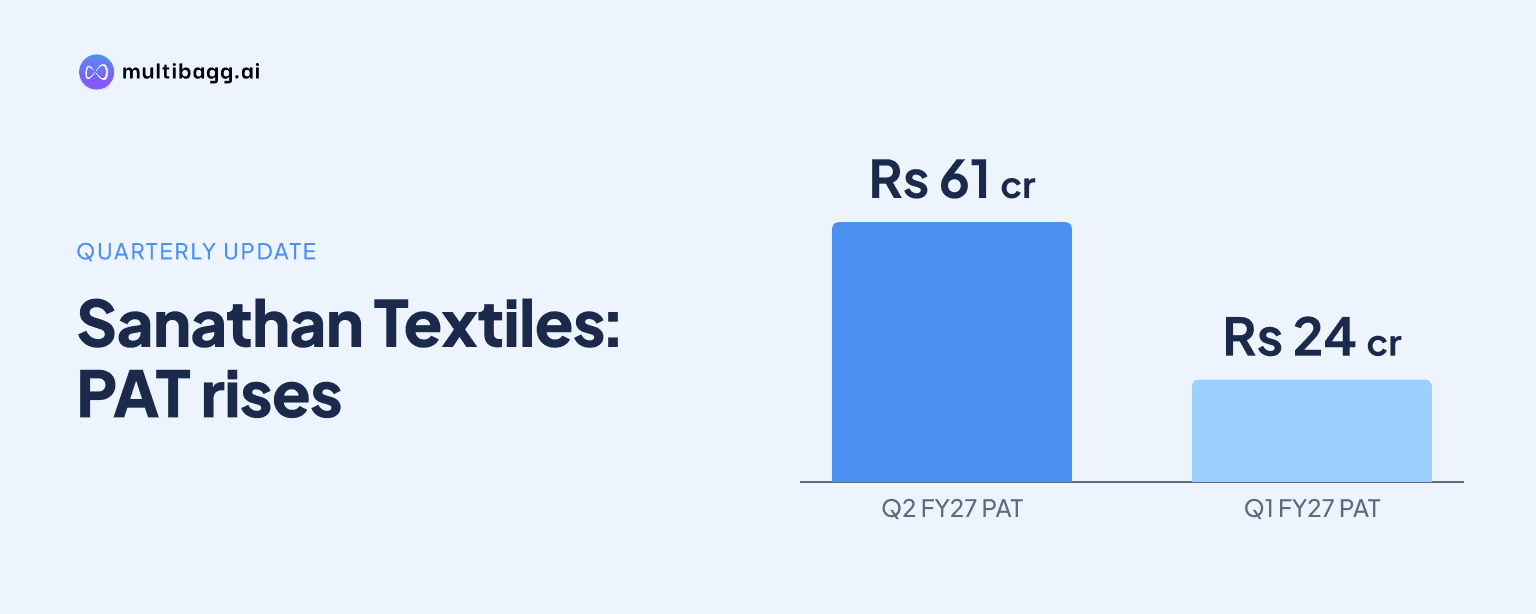
Sanathan Textiles Limited said its Punjab plant became profit after tax (PAT)-positive in Q2 FY27, when average polymerisation utilisation exceeded 90% and consolidated PAT rose to Rs 61 crore from Rs 24 crore in Q1 FY27. Management attributed the improvement to higher Punjab volumes, fixed-cost absorption and better realisations.
Know Sanathan Textiles inside out
Results, valuation, peers and who's buying, in one view.
Why did Sanathan Textiles' Punjab plant become PAT-positive?
Sanathan Textiles said the Punjab plant became PAT-positive in the quarter ended September 30, 2026, because higher production spread fixed costs across a larger output base. Phase one was fully operational, polymerisation capacity was 700 metric tonnes per day, and average utilisation exceeded 90% in Q2 FY27. The company did not disclose a separate PAT amount for Punjab.
The Q2 operating rate was higher than the roughly 76% to 77% utilisation management indicated for Punjab in Q1 FY27. Management said Punjab EBITDA per tonne was about Rs 2,500 to Rs 3,000 in Q1, before rising utilisation and product optimisation improved the facility's contribution in Q2. Consolidated earnings before interest, tax, depreciation and amortisation (EBITDA) per tonne was Rs 12,725 in Q2, up 13% sequentially.
The financial change was also helped by a slower increase in costs below EBITDA than in operating earnings. Consolidated EBITDA increased by Rs 46 crore to Rs 154 crore in Q2 FY27 from Rs 108 crore in Q1 FY27. Depreciation rose to Rs 36.60 crore from Rs 34.70 crore and finance costs rose to Rs 42 crore from Rs 38.60 crore, an aggregate increase of Rs 5.30 crore.
How did Punjab change Sanathan Textiles' Q2 FY27 earnings?
Sanathan Textiles' Punjab ramp-up coincided with consolidated sales volume rising to 1.22 lakh metric tonnes in Q2 FY27 from 96,000 metric tonnes in Q1 FY27. The company produced about 1.15 lakh metric tonnes of yarn and sold more than it produced, as customers resumed normal purchases after delaying orders during Q1 volatility.
Punjab sold about 64,000 metric tonnes in Q2, compared with approximately 58,000 metric tonnes from Silvassa. That made Punjab the larger of the two reported sources of consolidated sales volume during the quarter. Management cited higher volumes, returning customer purchases and better selling prices as the three drivers of consolidated revenue growth to Rs 1,804 crore.
The year-on-year comparison shows the scale of the expanded manufacturing base. Consolidated revenue increased from Rs 818 crore in Q2 FY26 to Rs 1,804 crore in Q2 FY27, while EBITDA rose from Rs 63 crore to Rs 154 crore. PAT increased from Rs 20 crore to Rs 61 crore, and basic earnings per share, not annualised, rose to Rs 7.30 from Rs 2.80 in Q1 FY27.
What did utilisation and product mix contribute at Sanathan Textiles?
Sanathan Textiles said utilisation above 90% at Punjab was the main driver of the improvement in consolidated EBITDA in Q2 FY27. After phase one became fully operational, management focused on efficiency, product optimisation and value addition at the 700-metric-tonne-per-day polymerisation facility. These measures were intended to improve earnings as the new capacity scaled.
The company also began production at its expanded technical-textiles capacity at Silvassa on August 20, 2026. Installed technical-textiles capacity doubled to 18,000 metric tonnes per annum from 9,000 metric tonnes per annum. Management said production had stabilised and material had been placed in domestic and export markets, while noting that technical textiles typically generate higher EBITDA per tonne.
Raw-material conditions were more stable in Q2 than in April and May, according to management. Prices of purified terephthalic acid, monoethylene glycol and raw cotton stabilised during the quarter, allowing industry price pass-through to take effect. Management said price changes typically take about two weeks to pass through, leaving future realisations linked to raw-material movements as well as utilisation.
Got a follow-up? Ask IRIS
What parts of Sanathan Textiles' Q2 result require monitoring?
Sanathan Textiles' consolidated improvement differed from its standalone trend, where EBITDA fell to Rs 84 crore in Q2 FY27 from Rs 95 crore in Q1 FY27. Standalone revenue nevertheless increased to Rs 992 crore from Rs 813 crore, while sales volume rose to 58,000 metric tonnes from 52,000 metric tonnes. Management attributed the EBITDA decline to normalised spreads and higher operating expenses.
Management also said the standalone business did not have the low-cost inventory benefit recorded in Q1 FY27. It identified the absence of that benefit and incremental expenses as reasons for the lower Silvassa EBITDA in Q2. Management added that shifts in product mix can change quarterly volume and revenue patterns, making direct comparisons between individual quarters less exact.
Funding and capital expenditure remain connected to the production expansion. The chief financial officer said gross debt was expected to be close to Rs 1,350 crore and net debt close to Rs 1,150 crore at the end of FY27. Management estimated capital expenditure of about Rs 200 crore in FY27 and about Rs 400 crore in the following year, with some expenditure extending into FY29.
What is Sanathan Textiles planning next at Punjab?
Sanathan Textiles plans to commission the first portion of Punjab phase two, representing 250 tonnes per day, sometime in December 2026. Management said at least part of the full addition should be available in the last quarter of FY27. The company is targeting completion of the ramp-up to 900 tonnes per day by June or July.
Management reaffirmed an FY27 EBITDA range of Rs 520 crore to Rs 550 crore and asked investors to focus on EBITDA per tonne rather than EBITDA margin percentage because selling prices had changed significantly over the preceding two quarters. It said Punjab's Q1 EBITDA per tonne of about Rs 2,500 to Rs 3,000 was expected to improve further as the plant ramps up.
Conclusion
Sanathan Textiles' Q2 FY27 results show that Punjab moved beyond its initial ramp-up stage, when full depreciation and interest costs had weighed on earnings. Consolidated sales volume increased by 26,000 metric tonnes sequentially to 1.22 lakh metric tonnes, while PAT rose by Rs 37 crore to Rs 61 crore. Management said the plant's utilisation above 90% enabled the facility to become PAT-positive.
The next disclosed milestone is the December 2026 commissioning of the first 250-tonne-per-day portion of Punjab phase two. Management's target to complete the ramp-up to 900 tonnes per day by June or July makes utilisation, EBITDA per tonne, additional financing and depreciation charges, and progress toward the Rs 520 crore to Rs 550 crore FY27 EBITDA range the items to watch next.