










Sanghvi H1 EBITDA gains 25% while group margin falls to 36%
Key highlights
- Sanghvi’s H1 FY27 EBITDA before exceptional items rose 25% to Rs 245 crore from Rs 195 crore.
- Sanghvi’s consolidated EBITDA margin fell to 36% in H1 FY27 from 39% in FY26.
- Sanghvi’s GCC crane-rental margin turned to 24% in H1 FY27 from a negative 23% in FY26.
- Sanghvi had Rs 401 crore of its Rs 583 crore FY27 capex pool pending for H2 FY27.
powered by IRIS
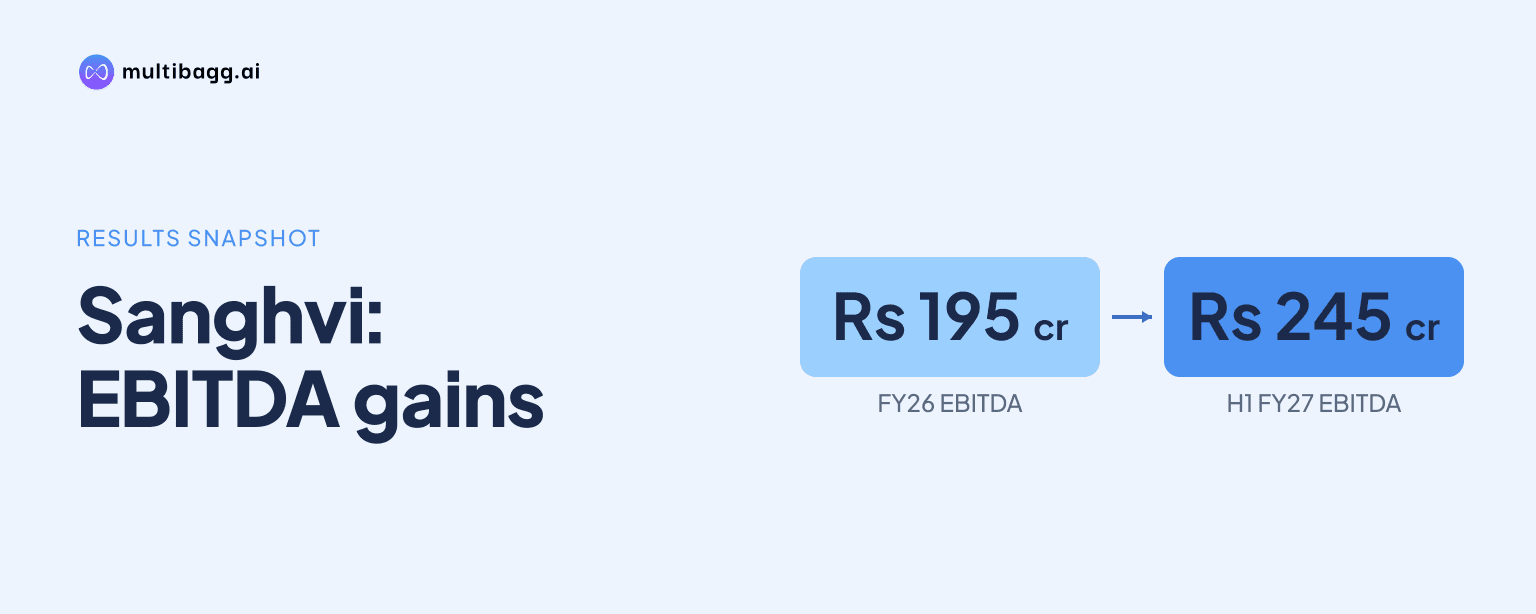
Sanghvi reported H1 FY27 EBITDA before exceptional items of Rs 245 crore, up 25% from Rs 195 crore in H1 FY26, while consolidated EBITDA margin fell to 36% from 39% as lower-margin renewables and Middle East crane-rental operations accounted for more of the group’s earnings mix.
Know Sanghvi Movers inside out
Results, valuation, peers and who's buying, in one view.
What drove Sanghvi’s H1 FY27 EBITDA growth?
Sanghvi’s H1 FY27 EBITDA growth came from higher revenue and contributions from each operating business. Revenue from operations increased 36% to Rs 657 crore from Rs 483 crore in H1 FY26, while profit after tax rose to Rs 106 crore from Rs 87 crore and cash profit increased to Rs 181 crore from Rs 149 crore.
The H1 EBITDA bridge assigns Rs 24 crore of the increase to SML+SMBPL, Rs 12 crore to SFRPL and Rs 14 crore to SMMEL+SMMEHL. Sanghvi says these entity-level contributions are rounded, with the consolidated variance at Rs 49 crore, and notes that the SML gain includes Rs 16 crore of higher other income.
Quarterly results showed lower activity in Q2 than Q1, consistent with the presentation’s discussion of monsoon seasonality. Revenue from operations was Rs 380 crore in Q1 FY27 and Rs 277 crore in Q2 FY27, while EBITDA was Rs 139 crore and Rs 106 crore respectively. Q2 FY27 EBITDA remained above Rs 88 crore in Q2 FY26, when revenue from operations was Rs 210 crore.
Why did Sanghvi’s consolidated EBITDA margin fall to 36%?
Sanghvi’s consolidated EBITDA margin fell because renewables and Middle East crane rental carried lower margins than the core India crane-rental business. The group margin was 36% in H1 FY27, compared with 39% in FY26 and 45% in FY25, while SML+SMBPL reported a 46% H1 FY27 margin.
Sanghvi attributes the decline from 39% to 36% to the larger share of SFRPL, which reported a 14% margin, and SMMEL+SMMEHL, which reported a 24% margin. Those rates were below the 46% margin reported by SML+SMBPL, so growth in those businesses reduced the consolidated rate despite higher group EBITDA.
The operating-key-performance data show the underlying scale of this mix. SML+SMPL recorded total income of Rs 406 crore and a 46% margin, renewables E&C recorded Rs 365 crore and a 14% margin, and GCC crane rental recorded Rs 39 crore and a 24% margin. Inter-company eliminations of Rs 121 crore resulted in group total income of Rs 689 crore.
Sanghvi describes SFRPL as an asset-light model that trades a 14% margin for higher returns and cash generation. Its trailing-12-month return on capital employed, or ROCE, was 63% in H1 FY27, compared with 15% for India crane rental and 16% for the group. Its days sales outstanding, or DSO, was 59 days, against 89 days for India crane rental and 165 days for GCC crane rental.
How did Sanghvi’s Middle East crane-rental business change?
Sanghvi’s GCC crane-rental operation moved to a 24% EBITDA margin in H1 FY27 from a negative 23% margin in FY26 as fleet utilisation ramped. SMMEL+SMMEHL added Rs 14 crore in the H1 EBITDA bridge, and the business had 54 cranes and Rs 148 crore of gross block in the operating-key-performance data.
Quarterly data show utilisation in KSA and Qatar at 86% in Q1 FY27 and 87% in Q2 FY27. Yield was 4.10% in Q1 FY27 and 3.60% in Q2 FY27, compared with India and Botswana yield of 2.29% and 2.20% respectively over those two quarters.
The operation still reported only Rs 1 crore of cash profit and a trailing-12-month ROCE of 0% in H1 FY27. Its DSO of 165 days was the highest among the operating businesses, while its enquiry pipeline was Rs 586 crore and its order book was Rs 45 crore as of 23 October 2025.
India crane rental had a larger pipeline and order book at the same date, at Rs 1,293 crore and Rs 683 crore respectively. The comparison shows that the Middle East business delivered a margin turnaround and high utilisation, but had a smaller disclosed order book and longer receivable cycle than the India operation.
Got a follow-up? Ask IRIS
Why did Sanghvi’s core crane-rental margin decline?
Sanghvi’s SML EBITDA margin declined to 46% in H1 FY27 from 53% in FY26 because of revenue mix, a Project EPC contract loss, one-time incentives, other operating costs and monsoon seasonality. The margin bridge assigns 3 percentage points to revenue mix, 1 point to Project EPC, 1 point to a one-time incentive and 2 points to other operating costs.
Sanghvi says H1 FY27 includes monsoon quarters, when crane utilisation is lower, while FY26 included peak Q3 and Q4 quarters. SML also reported H1 FY27 utilisation of 78%, yield of 2.24% and cash profit of Rs 144 crore.
The 3-point revenue-mix impact reflected more hired ancillary equipment in place of capital expenditure and a new asset-light cross-rental crane revenue stream, according to Sanghvi. The bridge figures are rounded to whole percentage points and include a 0.4-point overlap between other costs and the mix effect.
The Project EPC effect arose from a loss on one contract, with related revenue under discussion with the client. Sanghvi says that revenue will be recognised under IAS on client confirmation, which it expects before Q4; it also says contract labour, insurance and other operating costs should ease in Q3 and Q4 as higher revenue absorbs fixed and partially fixed costs.
What do Sanghvi’s cash flow and capex plans show?
Sanghvi generated consolidated free cash flow to firm of Rs 16 crore in H1 FY27, compared with an outflow of Rs 98 crore in FY26. Cash flow from operations was Rs 231 crore, equal to 83% of FY26 cash flow from operations of Rs 278 crore, although H1 FY27 covers six months and FY26 covers 12 months.
Consolidated cash flow from operations to EBITDA improved to 0.94 times in H1 FY27 from 0.65 times in FY26. Gross debt rose 19.4% to Rs 805 crore from Rs 674 crore, while net debt increased 18% to Rs 391 crore and debt to equity rose to 0.58 times from 0.51 times.
The FY27 capex pool totals Rs 583 crore, comprising Rs 167 crore carried forward from FY26 and Rs 416 crore approved by the board on 02 November 2026. Sanghvi capitalised Rs 182 crore, or 31% of the pool, in H1 FY27, leaving Rs 401 crore for H2 FY27; Rs 560 crore, or 96%, is classified as revenue-generating.
Of the available capex pool, SML India accounted for Rs 337 crore and SMMEL KSA accounted for Rs 246 crore. Sanghvi says shipping disruptions and port congestion curtailed SMMEL KSA capex deployment from FY27 to FY28 by Rs 80 crore, an identified constraint on the timing of fleet deployment.
Conclusion
Sanghvi’s H1 FY27 performance combined 25% EBITDA growth with a 3-percentage-point decline in consolidated margin. The core crane-rental business, renewables and the Middle East operation all added to EBITDA, but the expansion of businesses reporting 14% and 24% margins, alongside the core operation’s decline to 46%, changed the group earnings mix.
The next disclosed markers are the Rs 401 crore of capex pending for H2 FY27, including Rs 176 crore for SMMEL KSA, and expected client confirmation before Q4 for revenue related to the loss-making Project EPC contract. Management also expects higher Q3 and Q4 revenue to absorb contract labour, insurance and other operating costs.