










SMMEL capex shifts to FY28 as shipping delays cranes
Key highlights
- SMMEL reported 86% fleet utilisation and a 3.80% rental yield in H1 FY27.
- SMMEL held a Rs 45 crore order book, representing four to five months of revenue visibility.
- Part of SMMEL’s new-crane capex has moved to FY28 because shipping disruptions may delay delivery and deployment.
- The GCC crane-rental segment reduced DSO by 36 days, to 165 days in Q2 from 201 days in Q1.
powered by IRIS
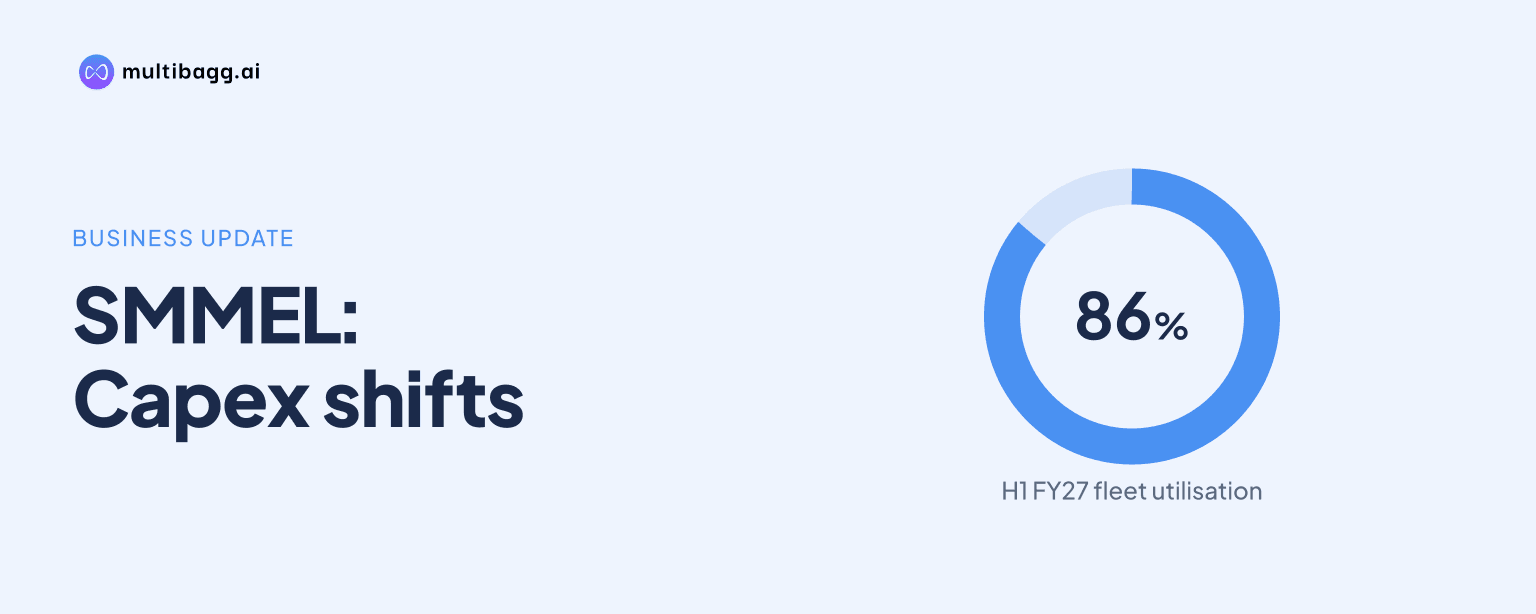
Sanghvi Movers Middle East Ltd. has moved part of its new-crane capital expenditure to FY28 because West Asia supply-chain and shipping disruptions may delay delivery and deployment, while SMMEL reported 86% fleet utilisation in H1 FY27, a 3.80% rental yield and positive earnings before interest, tax, depreciation and amortisation.
Know Sanghvi Movers inside out
Results, valuation, peers and who's buying, in one view.
Why has SMMEL moved crane capex to FY28?
SMMEL has shifted part of its capital expenditure to FY28 because supply-chain and shipping disruptions linked to the West Asia conflict may delay the delivery and on-site deployment of new cranes. Management’s disclosed mitigation is phased procurement aligned with order inflows, with the deferred spending concentrated on assets expected to generate the highest returns.
The change concerns the timing of physical fleet expansion rather than a disclosed reduction in orders. SMMEL said its crane-rental order book stood at Rs 45 crore, providing four to five months of revenue visibility, and described the underlying customer-capex issue as a timing shift rather than a fall in demand. It also cited a strong enquiry and project pipeline, although it did not disclose a value for that pipeline on the disruption page.
SMMEL operates within the Gulf Cooperation Council, or GCC, crane-rental segment alongside its Qatar operation. The H1 FY27 operating key performance indicators table reports a GCC crane fleet of 54 units and a gross block, meaning the accounting value of fixed assets before depreciation, of Rs 148 crore. New cranes delayed in transit therefore affect a defined expansion programme rather than the group’s 510-unit fleet.
Are SMMEL’s operating returns meeting its original plan?
SMMEL’s deployed-crane economics met its initial investment thesis in H1 FY27, according to management, supported by an 86% fleet-utilisation rate, a 3.80% rental yield and positive EBITDA. The rental yield exceeded management’s stated 3.5% target by 0.30 percentage points, while the presentation characterises Middle East EBITDA as positive.
The H1 FY27 KPI table provides further detail for the combined GCC crane-rental business, comprising SMMEL and the Qatar entity. It records Rs 39 crore of total income, a 24% EBITDA margin and Rs 1 crore of cash profit. The same table shows a 0% return on capital employed, or ROCE, on a trailing-twelve-month basis, distinguishing an operationally positive period from the still-zero reported return on the segment’s capital base.
The GCC segment’s operating measures also differ from Sanghvi Movers Ltd. and Sanghvi Movers Private Ltd., the domestic crane-rental business shown in the same table. Domestic crane rental reported 78% utilisation, below the GCC segment’s 86%, but a 46% EBITDA margin, above the GCC segment’s 24%. Domestic rental yield was 2.24%, compared with 3.80% in GCC, showing that the overseas business had a higher reported yield but a lower reported margin in H1 FY27.
Got a follow-up? Ask IRIS
What demand and competition risks does SMMEL face?
SMMEL faces the possibility that project deferrals could reduce near-term crane-rental demand, but its Rs 45 crore order book offers four to five months of stated revenue visibility. Management also identifies delays in customer project awards as a risk because they can postpone customers’ capital-expenditure programmes and, in turn, crane requirements.
Competition is a separate risk because additional crane supply could pressure rental rates and margins. Management’s response is that rental yields were above its 3.5% target and that the economics of deployed cranes met the initial investment thesis. This is an assessment of the assets already in operation, not a forecast that future cranes will achieve identical utilisation, yields or margins.
The wider H1 FY27 table places the Rs 45 crore GCC order book against an enquiry pipeline of Rs 586 crore. It also shows the group’s total order book at Rs 1,582 crore and its total enquiry pipeline at Rs 6,716 crore. These figures show that GCC is a smaller disclosed order-book contributor than the Rs 683 crore domestic crane-rental and Rs 854 crore renewables engineering-and-construction segments, while the source does not state what portion of the GCC pipeline belongs specifically to SMMEL rather than Qatar.
How are collections and mobilisation costs being managed?
SMMEL reduced days sales outstanding, or DSO, to 165 days in Q2 from 201 days in Q1 through a focused customer-collections effort. DSO measures the number of days taken to collect receivables, so the reported change is a reduction of 36 days, although the H1 FY27 level remains above the 89 days reported for domestic crane rental and 59 days for renewables engineering and construction.
The company identifies lower utilisation, pricing pressure and slower customer payments as factors that could affect revenue and cash flow. Its collection activity addresses the payment part of that risk, while phased procurement seeks to match new fleet spending with order inflows. The H1 FY27 KPI table reports Rs 1 crore of cash profit for the combined GCC crane-rental segment, alongside the 165-day DSO figure.
Fuel-price volatility and crane-mobilisation logistics are additional risks because they can raise operating costs and postpone deployment. SMMEL said customer-supplied fuel and cost-plus mobilisation arrangements limit its cost exposure. Those mechanisms do not remove the stated risk of delayed crane mobilisation, which is particularly relevant while supply-chain and shipping disruptions are affecting new-equipment delivery.
Conclusion
SMMEL’s disclosed evidence indicates that the West Asia disruption has postponed part of the crane-expansion timetable rather than changed the initial operating case for deployed assets. In H1 FY27, the GCC business reported 86% utilisation, 3.80% yield, Rs 39 crore of income and a 24% EBITDA margin, while the Rs 45 crore order book provided four to five months of visibility.
The next item to watch is execution of the phased procurement plan and the movement of deferred capex into FY28, especially whether shipping conditions allow cranes to be delivered and deployed against contracted orders. Investors can also monitor whether the 165-day DSO improves further, whether utilisation and yield remain near H1 FY27 levels, and whether project-award timing changes the stated demand pipeline.